






Ovule, Megasporogenesis And The Megaspore
Reproduction In Flowering Plants of Class 12
The ovule
Ovule is considered to be an integumented megasporangium. The ovules are situated inside the ovary, attached to a special tissue called placenta.
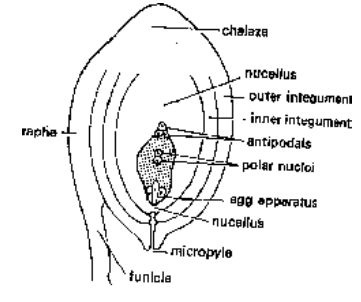
Fig. L.s. of a typical ovule
Structure of ovule
The stalk is called funicle. One end of the funicle is attached to placenta and the other end to the body of the ovule. The point of attachment of funicle with the body is called hilum. Funicle sometimes extends up to the base of ovule (i.e. chalaza). The ridge thus formed is called raphe.
The body of the ovule shows two ends- the basal end, often called the chalaza and the upper end is called the micropylar end. The main body of the ovule is covered with one or two envelops called integuments. These leave an opening at the top of the ovule called micropyle. The integuments enclose a large parenchymatous tissue known as nucellus. In the centre of the nucellus is situated a female gametophyte known as embryo sac.
Following are some of the conditions seen in ovule in relation to integuments.
- Unitegmic Ovule with a single integument; e.g. gamopetalous dicotyledons.
- Bitegmic Ovule with two integuments as in polypetalous dicotyledons and monocotyledons.
- Aril This is a collar-like outgrowth from the base of the ovule and forms third integument. Aril is found in litchi, nutmeg, etc.
- Caruncle It is formed as an outgrowth of the outer integument in the micropylar region. Caruncle is common in the ovules of Euphorbiaceae e.g. castor.
- Ategmic In some parasites like Loranthus, Viscum, Santalum, etc. there is no integument, such an ovule is called ategmic.
Types of ovules
There are six types of ovules in Angiosperms. These are classified on the basis of mutual relationship between funicle, chalaza and micropyle.
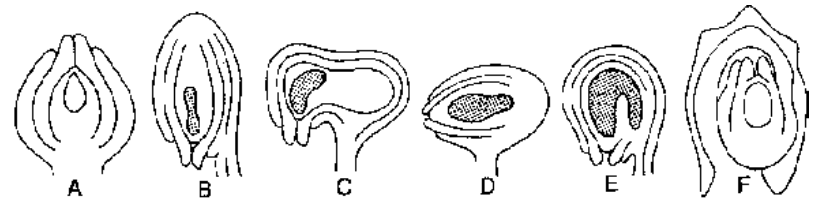
Fig. A-F Types of Ovules : A. Orthotropous, B. Anatropous, C. Campylotropous, D. Heminatropous, E. Amphitropous, F. Circinotropous
- Atropous or orthotropous : In this type, funicle, chalaza and micropyle are situated on one vertical axis with micropyle directed upwards. Hence it is also known as straight ovule; e.g. Polygonum, Piper etc.
- Anatropous : These ovules are also called inverted (180° curved) because the body of the ovule is so bent that micropyle is now directed downwards and lies close to the hilum. It is the most common type of ovule found in angiosperms, e.g., castor.
- Campylotropous : This is an ovule placed transversely on the funicle (90° curved). The body is bent in such a way that micropyle gets directed downwards and is not in straight line with chalaza. It is found in gram, bean, members of Cruciferae like mustard etc.
- Hemianatropous : In this type, the body of the ovule is situated at right angles to the funicle e.g. Ranunculus.
- Amphitropous : The ovule is curved (at 180°) and embryo sac also becomes horse shoe-shaped. The micropyle is directed downwards and does not lie on straight line with chalaza. Amphitropous ovules occur in poppy, members of Alismaceae, Butomaceae, etc.
- Circinotropous : The ovule is initially orthotropous but becomes anatropous due to unilateral growth of funicle. The growth continues till the ovule once again becomes orthotropous. As a result funicle completely surrounds the body of the ovule; e.g. Opuntia (prickly pear).


