








Gravitation for NEET 2026 | Complete Chapter, Download Complete Notes PDF
Gravitation for NEET 2026 covers Newton’s law of gravitation, properties, vector form, superposition principle, gravitational field and intensity, acceleration due to gravity, its variation with height and depth, and applications for planets and different mass configurations.

Gravitation for NEET 2026: Gravitation is a fundamental property of matter that causes all bodies in the universe to attract one another. This universal force is not limited to Earth but operates throughout the cosmos, influencing the motion of planets, stars, moons, and even galaxies. It is the invisible thread that maintains the structure and order of the universe, ensuring that celestial bodies remain in their orbits and that objects on Earth stay grounded.
Beyond holding the planets in motion around the Sun, gravitation plays a crucial role in natural phenomena such as tides, the formation of mountains, and the behavior of objects falling under gravity. Its study has not only deepened our understanding of the physical world but also paved the way for advancements in astronomy, space exploration, and engineering.
The concept of gravitation connects the everyday experiences we observe on Earth with the vast mechanics of the universe, highlighting the universality and consistency of natural laws.
Gravitation for NEET 2026 Complete Chapter Notes PDF
Gravitation is a key chapter for NEET 2026, explaining how masses attract each other and how this force governs planetary motion, tides, and objects on Earth. Understanding this chapter is crucial for both theoretical concepts and numerical problem-solving.
You can download the complete Gravitation notes in PDF format for quick revision and efficient preparation. These notes cover Newton’s law, gravitational force, field, acceleration due to gravity, variations with height and depth, and important solved examples to strengthen your exam readiness.
Gravitation for NEET 2026 Complete Chapter Notes PDF Download
Discovery of the Law of Gravitation
The journey to understanding gravitation was gradual and involved several key scientists:
-
Nicolaus Copernicus (1473–1543) proposed the heliocentric model of the solar system, suggesting that planets revolve around the Sun.
-
Tycho Brahe (1546–1601) made precise measurements of planetary positions, providing essential observational data.
-
Johannes Kepler (1571–1630) analyzed this data and formulated empirical laws of planetary motion.
-
Isaac Newton (1642–1727) synthesized all observations and experiments to develop the general theory of universal gravitation.
Newton’s Law of Gravitation
Newton’s law states that every particle in the universe attracts every other particle with a force that is:
-
Directly proportional to the product of their masses.
-
Inversely proportional to the square of the distance between them.
Mathematically:
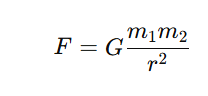
Where:
-
F = gravitational force
-
m1,m2 = masses of the two objects
-
r = distance between the centers of the two masses
-
G = universal gravitational constant
Vector Form of Gravitational Force
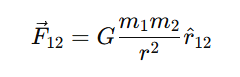
Gravitational force is a vector quantity, meaning it has both magnitude and direction. The force exerted by mass m1 on m2 is along the line joining them:

Properties of Gravitational Force
-
Always attractive.
-
Acts along the line joining two particles.
-
Independent of the medium between the bodies.
-
Forms an action-reaction pair, obeying Newton’s Third Law.
-
It is a conservative and central force, meaning the work done in moving a mass depends only on its initial and final positions.
Superposition Principle
When multiple bodies interact gravitationally, the net force on any body is the vector sum of the forces due to all other bodies:
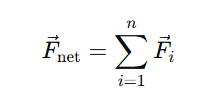
Applications include:
-
Equilateral triangle: If three equal masses are placed at the vertices, the net force on one mass is directed towards the centroid.
-
Square arrangement: Four equal masses at the corners produce a net force along the diagonal on a mass at any corner.
-
Center of square: For masses at corners, the resultant force on a mass at the center can be calculated using vector addition.
Gravitational Field and Its Intensity
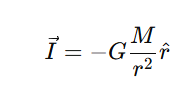
A gravitational field is the space around a mass where it can exert gravitational influence on other masses.

-
Vector quantity, direction same as the force.
-
SI unit: N/kg.
-
Extends theoretically to infinity, but practically becomes negligible at large distances.
Field due to Different Configurations
-
Point Mass:
-
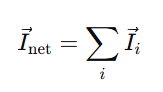
System of Point Masses:
-
Uniform Spherical Mass:
-
Outside: behaves as point mass at center.
-
Inside a solid sphere: varies linearly with distance from the center.
-
Inside a hollow sphere: field is zero.
-
Uniform Circular Ring: Field along axis:
-
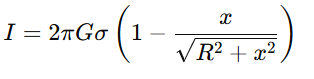
Uniform Circular Disc: Field along axis:
Acceleration Due to Gravity (g)
The gravitational force on a mass m near a planet’s surface:
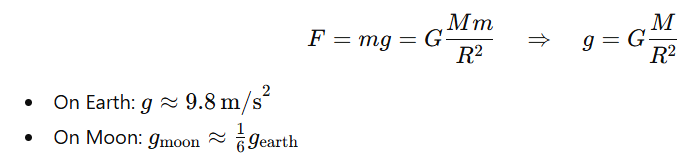
Variation of g
-
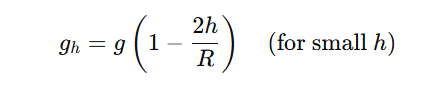
With height h:
-
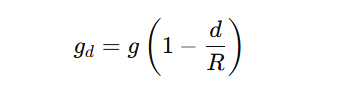
With depth d:
-
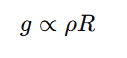
Other Planets: Depends on radius and density:
To excel in Gravitation for NEET 2026, you must solve various gravitation numericals. Practice helps you understand how to apply the constant $G$ and the variable $g$ correctly. You should also review the gravitation solved examples to learn the best shortcuts for calculations.
Many students find gravitation notes helpful for quick revision of definitions. Reading gravitation physics from NCERT textbooks provides a strong foundation. You should also attempt gravitation important questions from previous years to understand the exam pattern. Consistent practice of gravitation questions for NEET will improve your speed and accuracy.
Mastering Gravitation for NEET 2026 requires a clear understanding of both theory and math. Keep revising the concepts of fields and potentials. Use this guide as a roadmap for your Gravitation for NEET 2026 studies. With regular effort, you can score full marks in this chapter.
Gravitation for NEET 2026 FAQs
What is the universal law of gravitation?
Every particle in the universe attracts every other particle with a force proportional to the product of their masses and inversely proportional to the square of the distance between them.
How does acceleration due to gravity (g) vary with height and depth?
It decreases with height above the surface and decreases linearly with depth below the surface.
What is the gravitational field and its SI unit?
It is the region around a mass where it can exert a gravitational force on another mass, measured in N/kg.
How does a hollow spherical shell affect the gravitational field inside it?
The gravitational field inside a hollow spherical shell is zero.
What is the difference between gravitational force and gravitational field?
Gravitational force is the actual pull between two masses, while gravitational field is the force experienced per unit mass at a point in space.


Have questions about your prep?
Our experts can answer all your questions





Free Learning Resources
PW Books
Notes (Class 10-12)
PW Study Materials
Notes (Class 6-9)
Ncert Solutions
Govt Exams
Our Other Websites
Class 6th to 12th Online Courses
Govt Job Exams Courses
UPSC Coaching
Defence Exam Coaching
Gate Exam Coaching
Other Exams
Know about Physics Wallah
Physics Wallah is an Indian edtech platform that provides accessible & comprehensive learning experiences to students from Class 6th to postgraduate level. We also provide extensive NCERT solutions, sample paper, NEET, JEE Mains, BITSAT previous year papers & more such resources to students. Physics Wallah also caters to over 3.5 million registered students and over 78 lakh+ Youtube subscribers with 4.8 rating on its app.
We Stand Out because
We provide students with intensive courses with India’s qualified & experienced faculties & mentors. PW strives to make the learning experience comprehensive and accessible for students of all sections of society. We believe in empowering every single student who couldn't dream of a good career in engineering and medical field earlier.
Our Key Focus Areas
Physics Wallah's main focus is to make the learning experience as economical as possible for all students. With our affordable courses like Lakshya, Udaan and Arjuna and many others, we have been able to provide a platform for lakhs of aspirants. From providing Chemistry, Maths, Physics formula to giving e-books of eminent authors like RD Sharma, RS Aggarwal and Lakhmir Singh, PW focuses on every single student's need for preparation.
What Makes Us Different
Physics Wallah strives to develop a comprehensive pedagogical structure for students, where they get a state-of-the-art learning experience with study material and resources. Apart from catering students preparing for JEE Mains and NEET, PW also provides study material for each state board like Uttar Pradesh, Bihar, and others
Copyright © 2026 Physicswallah Limited All rights reserved.