Morphology of Flowering Plants NEET Mindmap Download PDF
Morphology of Flowering Plants NEET Mindmap helps students understand plant parts and their functions through clear visuals. With PW notes, NEET aspirants can easily remember root types, stem modifications, leaf and flower structures, and fruit types.

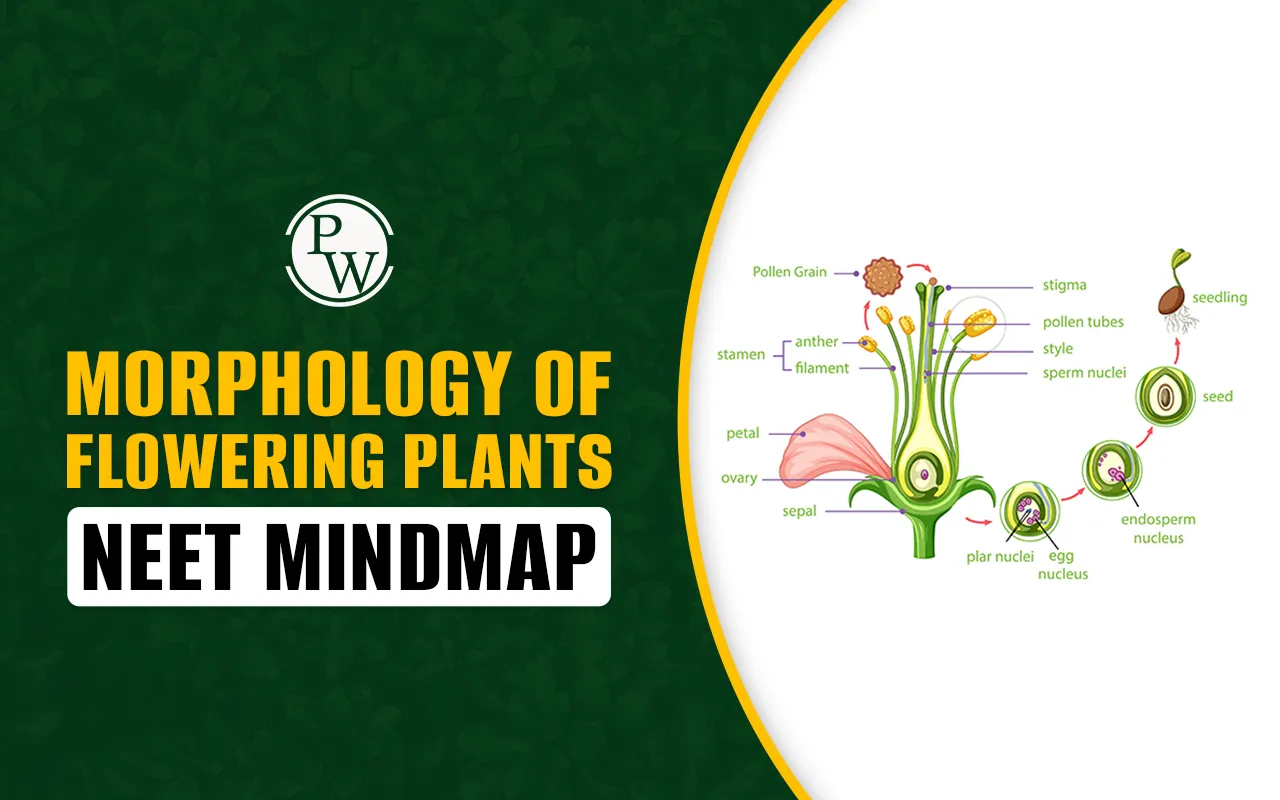
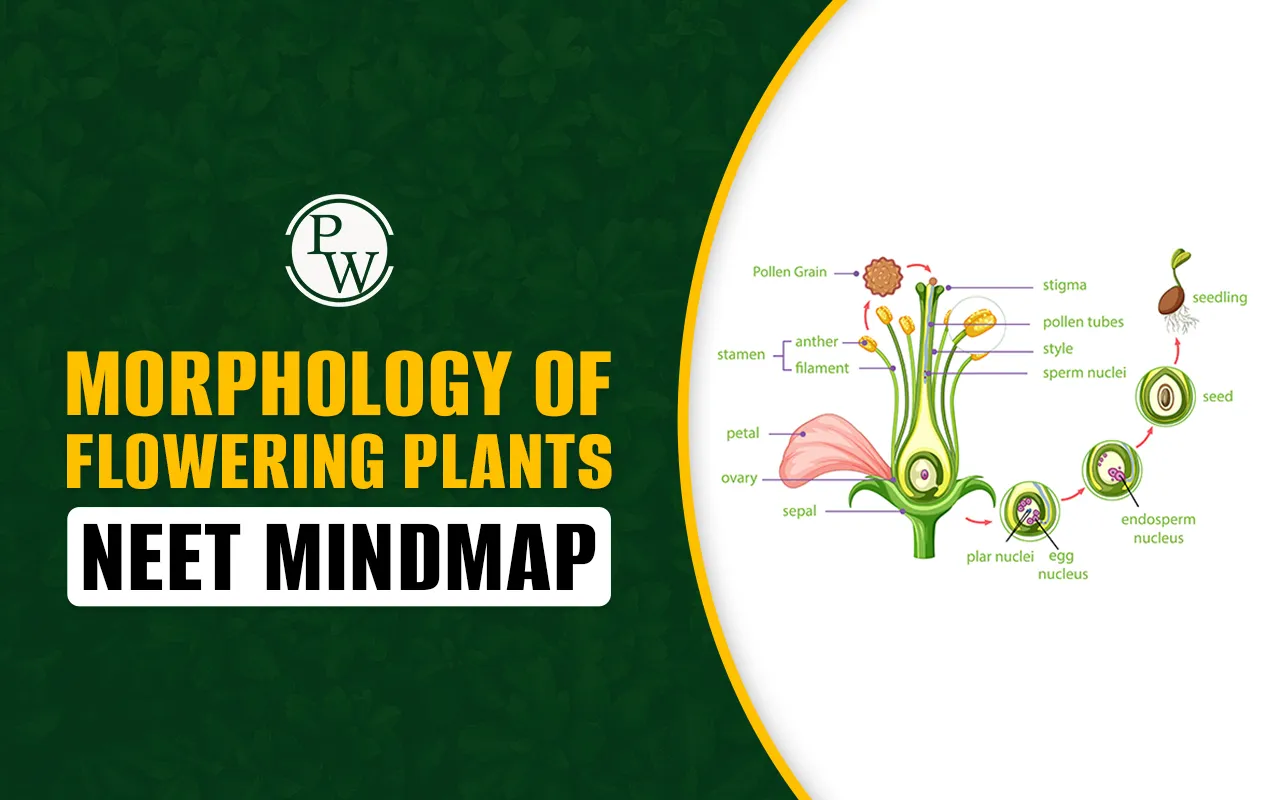
Morphology of Flowering Plants NEET Mindmap helps you visualise the form and structure of various plant parts. Morphology of Flowering Plants is a class 11 NCERT topic in NEET Biology, which is asked directly in NEET. Morphology means the study of form and structure. Flowering plants have roots, stems, leaves, flowers, and fruits. All these plant parts have a definite shape and structure and carry out a specific function in the plant’s growth and reproduction.
PW provides NEET notes, important questions, and mindmaps of morphology of flowering plants to make this topic simple and systematic for you. You can easily revise the important terms and spot the modifications in plants in no time with these resources. Students can link this Morphology of Flowering Plants NEET Mindmap with other PW NEET Physics notes and important question bank for extensive preparation.
Morphology of Flowering Plants NEET Mindmap
The Morphology of Flowering Plants NEET Mindmap covers all the major plant parts as discussed in NCERT — root, stem, leaf, flower, and fruit. Further, these major parts have multiple subtopics which are NEET question favorites. The topic allows learners to identify various plant modifications and understand the association of plant structure with function.
Also Read: Morphology of Flowering Plants MCQs
The root anchors the plant and absorbs water and minerals from the soil. The stem provides support to plant branches and transports food and water to various plant parts. The leaf helps in the process of photosynthesis. The flower is the reproductive part, and the fruit types is meant for seed protection. The understanding of these basic connections forms the foundation of plant biology.
PW tries to make these basic connections between different plant structures visually as simple as possible. The Morphology of Flowering Plants NEET Mindmap is a great study aid for last-minute NEET revision. Physics Wallah (PW) has prepared an elaborate Morphology of Flowering Plants NEET Mindmap PDF for free download by students. The PDF file with extensive coverage has been designed in a simple format of easy-to-understand diagrams, flowcharts, and point-wise keyword-based explanations. The Morphology of Flowering Plants NEET Mindmap enables students to study smarter and faster.
Also Read: Morphology of Flowering Plants NEET Notes 2026
Morphology of Flowering Plants NEET Mindmap PDF
PW offers a free Morphology of Flowering Plants NEET Mindmap PDF which lets students review the complete chapter from one single display. It summarizes all NCERT based topics in one go in a neat and lucid layout. PW NEET Mindmap PDF has all these topics in diagrammatic form, so that the students find it easy to understand the morphology of plants. The student doesn’t have to slog through the huge volume of text. It is easy to remember the concepts by connecting the dots. That is why Morphology of Flowering Plants NEET Mindmap is one of the most useful tools for quick NEET Biology revision.
Download Morphology of Flowering Plants NEET Mindmap PDF
Tricks To Learn the Morphology of Flowering Plants NEET Mindmap
When you build a Morphology of Flowering Plants NEET Mindmap, make links with an example and function of every term. Short and simple, these tricks will let you memorize roots, stem, leaf, flower, and fruit structures in a jiffy. Use them during your NEET Revision to clear the basics.
-
Root Types – Recollect by Function: Taproot anchors deeply (mango), Fibrous root provides wide support (wheat), Adventitious root originates from non-root part (banyan).
-
Stem Modifications – Recall with their Purpose: Underground stem-Tuber is used for food storage (potato), Aerial stem-Tendril is used for climbing (grapevine), etc.
-
Leaf Types – Spot the structure: Simple leaf-Guava (single lamina), Compound leaf-Neem (multiple leaflets), etc. Remember three types of arrangement- Alternate, Opposite, Whorled
-
Flower Structure – Remember the sequence: Calyx, corolla, androecium, gynoecium is the general order. Don’t forget any part of the flower, connect each with its function.
-
Inflorescence – Direction indicates type: Flowers grow upward in racemose inflorescence and downward in cymose. Once you visualize, it is easy to point it out.
-
Fruit Types – Memorize with examples: Mango-Simple fruit, Strawberry-Aggregate fruit, Pineapple-Multiple fruit, Learn one fruit with its type and remember.
-
Draw Visual Links in Mindmap: Use arrows, color codes in your Morphology of Flowering Plants NEET Mindmap. Connect all the structures with their functions and make revision lightning fast.
Prepare for NEET 2026 with Arjuna NEET 3.0, Lakshya NEET 3.0, and Yakeen NEET 3.0 online batches. These courses provide clear lessons and regular practice tests to help you cover the entire syllabus step-by-step.
Also Check:
- NEET Exam Pattern 2026
- NEET 2026 Admit Card
- NEET Eligibility Criteria 2026
- NEET 2026 Exam Centres
- NEET Candidate Login 2026
Morphology of Flowering Plants NEET Mindmap FAQs
Q1. What is the use of Morphology of Flowering Plants NEET Mindmap ?
Q2. What are the key topics included in Morphology of Flowering Plants NEET Mindmap?
Q3. Where can I download Morphology of Flowering Plants NEET Mindmap PDF ?
Q4. How to memorize the various examples of Morphology of Flowering Plants ?
Q5. Is the Morphology of Flowering Plants NEET Mindmap enough for revision ?