

IOQM Fermat Theorem, Wilson Theorem Question, Download Practice Questions PDF

IOQM Fermat Theorem: The Indian Olympiad Qualifier in Mathematics (IOQM) is known for testing deep mathematical thinking and logical reasoning. Among the many topics included in the syllabus, number theory holds an important place. Within number theory, certain theorems help students solve difficult remainder and divisibility problems quickly. Two such ideas are Fermat’s theorem and Wilson’s theorem.
Understanding these ideas helps students approach problems involving large powers, modular arithmetic, and divisibility. Many olympiad problems look complicated at first glance, but they become manageable when the right theorem is applied.
Here, we’ll explain the concept of IOQM Fermat Theorem, its use in solving remainder problems, and how it connects with other number theory concepts used in olympiad practice.
Also Read:
IQM Fermat Theorem Problems with Solutions
Fermat’s theorem is widely used in Olympiad number theory. It helps simplify expressions involving large powers. Students often encounter such questions in remainder and divisibility problems.
Practicing different problems helps develop familiarity with the theorem. It also improves the ability to recognize when the theorem should be applied in a question.
The following section explains the concept in simple terms and includes examples from olympiad-style questions.
IQM Fermat Theorem Problems with Solutions PDF
Understanding the IOQM Fermat Theorem
The IOQM Fermat Theorem is based on the concept introduced by the mathematician Pierre de Fermat. The theorem is widely used in modular arithmetic and number theory. The statement of the theorem is simple.
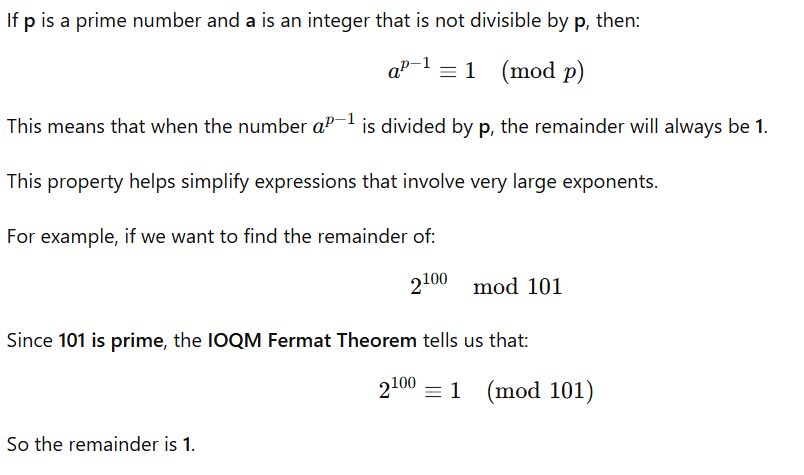
This technique is frequently used in olympiad-style questions.
Why the IOQM Fermat Theorem Is Important?
IOQM questions often include very large powers, such as:
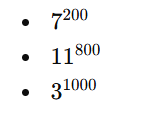
Direct calculation is not practical. The IOQM Fermat Theorem helps reduce these powers into manageable expressions.
Students use it to:
-
find remainders
-
simplify powers
-
solve modular equations
-
analyze divisibility
These ideas appear regularly in number theory practice.
Example: Remainder Problem Using Fermat’s Theorem
Consider the expression:
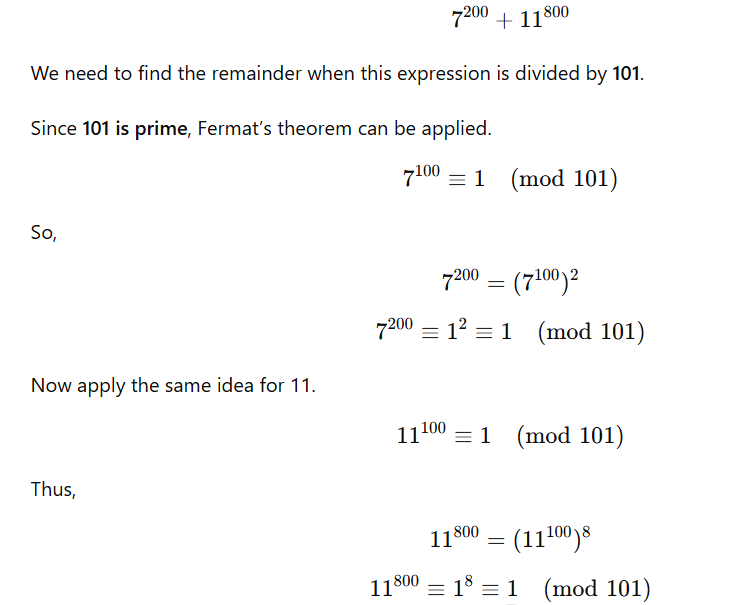
Now add the results:
1+1=2
So the remainder is 2.
This example shows how the IOQM Fermat Theorem reduces large calculations into simple steps.
Practice With IOQM Fermat Theorem
Students preparing for olympiad exams often practice different types of remainder questions.
These questions usually involve:
-
large exponents
-
prime modulus
-
modular simplification
Working through IOQM fermat little theorem questions helps build confidence in handling such expressions.
For example, a question may ask:
Find the remainder when 29992^{999}2999 is divided by 100.
Instead of multiplying repeatedly, students use cyclic patterns or modular properties.
Another Example Based on Large Powers
Consider the problem:
Find the last two digits of:

To solve this, we examine powers of 2 modulo 100.
After identifying the repeating pattern, we can reduce the exponent and determine the final remainder.
Using this method, the last two digits turn out to be 88.
Problems like these often appear in olympiad practice sets and illustrate the power of modular arithmetic.
Wilson’s Theorem in IOQM
Another concept used in Olympiad number theory is Wilson’s theorem.
The theorem states:
If p is a prime number, then
(p−1)!≡−1(modp)
This means the factorial of one less than a prime number leaves a remainder p−1 when divided by p.
This property helps solve problems involving factorial expressions.
Students preparing for olympiad practice frequently attempt IOQM Wilson theorem questions to understand factorial divisibility.
For example:
6!=720
When divided by 7, the remainder becomes 6, which matches the theorem.
Combining Ideas in Number Theory
Many IOQM problems combine different concepts.
A single question may involve:
-
modular arithmetic
-
prime numbers
-
factorial expressions
-
algebraic manipulation
In such situations, knowing when to apply the IOQM Fermat Theorem becomes important.
Sometimes the theorem helps simplify powers first. After that, another technique is used to complete the solution.
This layered approach is common in Olympiad mathematics.
Example of a Number Theory System
Consider the system:
xy+xz=255
xy+yz=31
Subtract the second equation from the first.
xz−yz=224
Factor the expression.
z(x−y)=224
By analyzing integer possibilities and substituting values, we obtain two valid solutions:
-
x=15,y=1,z=16
-
x=17,y=1,z=14
Problems like this test logical reasoning and factorization skills.
Understanding Digit Sum Problems
Some IOQM questions involve digit patterns.
Example:
(33333)2+22222
Rewrite 33333 as:
3×11111
Then simplify the expression step by step.
After the calculation, the number becomes:
1111111111
Now add the digits.
1+1+1+1+1+1+1+1+1+1=10
So the sum of digits is 10.
These problems train students to identify patterns in numbers.
Base Conversion Questions
IOQM also includes questions related to number bases.
Example:
A number ABC in base 5 becomes CBA when written in base 7.
To solve this, convert both numbers to base 10.
25A+5B+C
Equating both expressions gives:
12A+B=24C
From digit constraints, we conclude:
B=0
These problems combine algebra and number systems.
Practicing IOQM Fermat Theorem Problems
Students preparing for olympiad exams benefit from solving different forms of remainder problems.
Working through IOQM Fermat theorem problems with solutions helps understand how the theorem applies in different situations.
Some practice questions may include:
-
Finding remainders of large powers
-
simplifying modular expressions
-
solving exponential congruences
Repeated practice improves speed and accuracy.
The Theorem becomes easier to recognize once students solve many such questions.
Number theory forms a major part of Olympiad mathematics. Concepts such as modular arithmetic, factorial properties, and number systems appear frequently in problems.
Among these tools, the Theorem is very useful for simplifying large power expressions and solving remainder problems. When students understand this theorem well, many difficult questions become manageable.
Wilson’s theorem, base conversion ideas, and algebraic reasoning also play an important role in olympiad preparation.
Regular practice of number theory problems strengthens logical thinking and mathematical intuition. With consistent effort, students can become comfortable applying these theorems in a wide range of IOQM questions.
PW provides Olympiad exam content, including Olympiad Exams Updates, sample papers, mock tests, guidance sessions, and more. Also, enroll today in the Olympiad Online Batches for preparation.
IOQM Base System and Congruences Question
Study without using the internet
IOQM Fermat Theorem FAQs
Why is the IOQM Fermat Theorem important for olympiad exams?
What are IOQM Fermat Little Theorem questions?
What are IOQM Wilson theorem questions?
How can students practice IOQM Fermat Theorem problems effectively?