

IOQM Number Theory Perfect Squares Questions With Solutions

IOQM Number Theory Perfect Squares Question: Number theory plays an important role in the Indian Olympiad Qualifier in Mathematics (IOQM), and perfect squares are among the most frequently tested concepts. Practicing IOQM Number Theory Perfect Questions helps students develop logical reasoning and problem-solving techniques needed to handle challenging olympiad problems.
By solving IOQM Perfect Square Problems with Solutions, aspirants can understand common patterns and strategies used in olympiad-level mathematics.
Also Read:
IOQM Number Theory Perfect Squares Questions and Solutions
IOQM Number Theory Perfect Square Questions on mathematical problems where students must determine whether a number is a perfect square or manipulate expressions to form perfect squares. These problems often involve prime factorization, divisibility rules, algebraic identities, and logical deductions.
Below are the IOQM Number Theory Perfect Squares Questions and solutions. This will help improve accuracy and build strong olympiad problem-solving skills.
1. The least common multiple of a and b is 12, and the least common multiple of b and c is 15. What is the least possible value of the least common multiple of a and c?
Sol. 1. (20)
We wish to find possible values of a,b , and c . By finding the greatest common factor of 12 and 15, we can find that b is 3. Moving on to a and c , in order to minimize them, we wish to find the least such that the least common multiple of a and 3 is 12, 4 → . Similarly, with 3 and c , we obtain 5. The least common multiple of 4 and 5 is 20 → 20
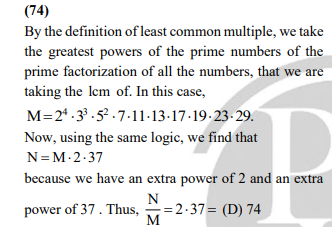
2. Let M be the least common multiple of all the integers 10 through 30, inclusive. Let N be the least common multiple of M,32,33,34,35,36, 37,38,39 , and 40. What is the value of N/M ?
Sol.
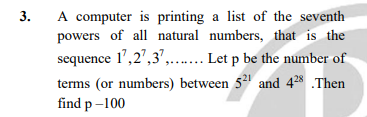
3.
Sol.
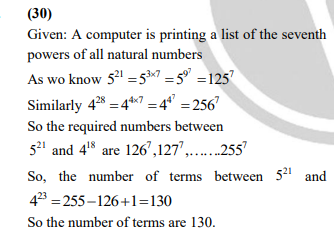
4. How many two-digit numbers have digits whose sum is a perfect square?
Sol. (17)
There is 1 integer whose digits sum to 1:10 . There are 4 integers whose digits sum to 4:13,22,31 , and 40 .There are 9 integers whose digits sum to 9:18,27,36,45,54,63,72,81 , and 90. There are 3 integers whose digits sum to 16 : 79, 88, and 97. Two digits con not sum to 25 or any greater square since the greatest sum of digits of a two digit number is 9 + 9 = 18. Thus, the answer is 1+ 4 + 9 + 3 = 17
5. Forty slips of paper numbered 1 to 40 are placed in a hat. Alice and Bob each draw one number from the hat without replacement, keeping their numbers hidden from each other. Alice says, "I can't tell who has the larger number." Then Bob says, "I know who has the larger number." Alice says, "You do? Is your number prime?" Bob replies, "Yes," Alice says, "In that case, if I multiply your number by 100 and add my number, the result is a perfect square. "What is the sum of the two numbers drawn from the hat?
Sol. (27)
Let Alice have the number A,BobB . When Alice says that she can't tell who has the larger number, it means that A cannot equal 1, Therefore, it makes sense that Bob has 2 because he now knows that Alice has the larger number. 2 is also prime. The last statement means that 200 A+ is a perfect square. The three squares in the range 200 300 − are 225, 256, and 289. So, A could equal 25, 56, or 89, so A B+ is 27, 58, or 91, of only 27 is an answer choice.
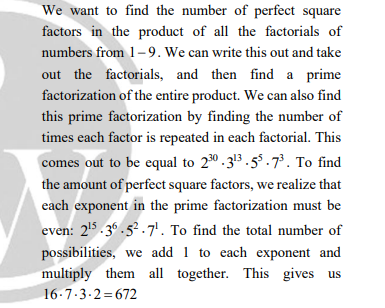
6. Let P be the no. of perfect squares are divisors of the product 1! 2! 3! 9!. Find P – 600
Sol. 72
7.

Sol.
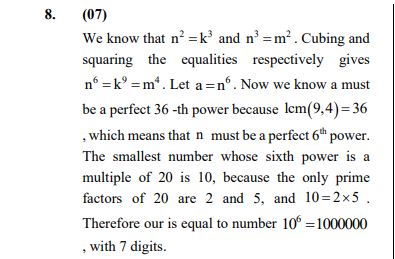
8. Let n be the smallest positive integer such that n is divisible by 20, n2 is a perfect cube, and n3 is a perfect square. What is the number of digits of n ?
Sol.
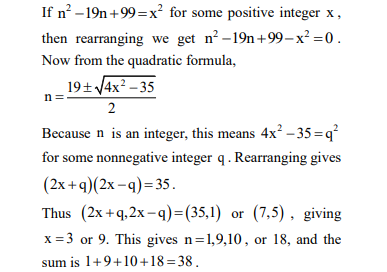
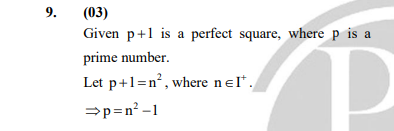
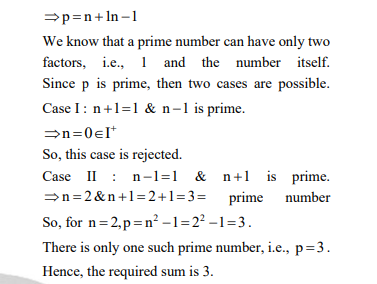
9. Let p be a prime number such that the next larger number is a perfect square. Find the sum of all such prime numbers. (For example, if you think that 11 and 13 are two such prime numbers, then the sum is 24)
Sol.
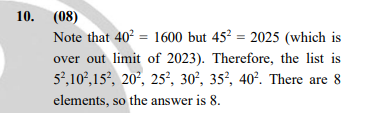
10. How many positive perfect squares less than 2023 are divisible by 5.
Sol.
How to Solve IOQM Number Theory Perfect Squares Problems
Solving IOQM Number Theory Perfect Squares Question requires a clear understanding of number theory concepts and mathematical patterns. By studying and analyzing IOQM Perfect Squares Previous Year Questions, students can develop effective strategies to approach olympiad-level problems.
Here’s how you must solve IOQM Number Theory Perfect Questions:
-
Use Prime Factorization
Break the number into its prime factors. A number is a perfect square only if all prime factors have even powers. This method is used in number theory perfect squares problems.
-
Apply Algebraic Identities
Use identities as they often help simplify expressions in IOQM Perfect Square Problems with Solutions.
-
Look for Patterns in Numbers
Many questions rely on recognizing patterns in sequences or expressions that can be transformed into perfect squares.
-
Check Divisibility Conditions
Sometimes a number becomes a perfect square only after multiplying or dividing by certain factors. Identifying such conditions is key when solving IOQM Number Theory Perfect Questions.
-
Practice Previous Year Problems
Solving IOQM Perfect Squares Previous Year Questions helps students understand common olympiad tricks and improve speed and accuracy.
PW provides Olympiad exam content, including Olympiad Exams Updates, sample papers, mock tests, guidance sessions, and more. Also, enroll today in the Olympiad Online Batches for preparation.
IOQM Number Theory Perfect Squares Questions FAQs
Where can students find IOQM Perfect Squares Previous Year Questions?
How do IOQM Perfect Square Problems with Solutions help students?
Why are IOQM Number Theory Perfect Squares Problems important for olympiad preparation?
What is the best way to practice IOQM Number Theory Perfect Questions?