







IOQM Wavy Curve Method Questions with Solutions PDF
 Neha Tanna21 Feb, 2026
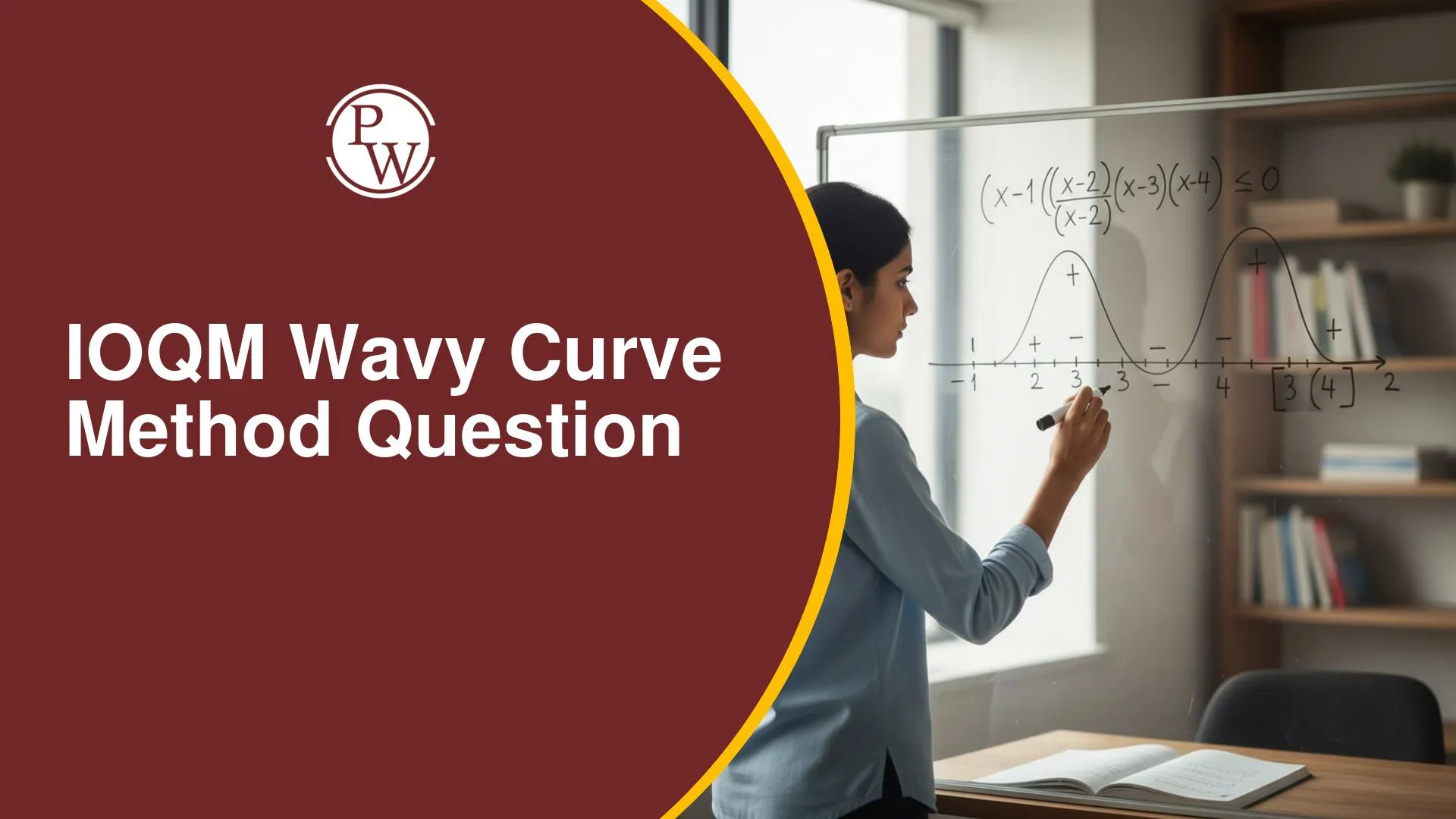
IOQM Wavy Curve Method Questions: Preparing for the Indian Olympiad Qualifier in Mathematics requires strong logical thinking, especially in inequalities and algebraic sign analysis. One powerful visual technique used in solving IOQM problems is the wavy curve method.
Whether you're practicing the IOQM wavy curve method questions, exploring IOQM wavy curve method examples, or working through the detailed IOQM wavy curve method solution steps, this technique helps you quickly analyze polynomial inequalities with clarity and precision. The IOQM emphasizes structured reasoning, and the wavy curve method fits perfectly into that approach.
Also Read:
IOQM Wavy Curve Method Questions Download PDF
Students can strengthen concepts by practicing curated ioqm wavy curve method questions designed for Olympiad level difficulty. Download the practice sheet from the link below to work through structured IOQM wavy curve method examples and detailed IOQM wavy curve method solution approaches.
Regular practice from the PDF will improve accuracy and speed in advanced inequality-based IOQM problems.
IOQM Wavy Curve Method Practice Problems PDF
What is the Wavy Curve Method?
The wavy curve method is a graphical sign-analysis technique used to solve polynomial inequalities. Instead of expanding or testing multiple values blindly, this method allows you to determine intervals where an expression is positive or negative by analyzing:
-
The roots of the polynomial
-
The multiplicity of each root
-
The sign change pattern across intervals
This method is extremely helpful in IOQM wavy curve method questions, especially those involving higher-degree polynomials.
Common Types of IOQM Wavy Curve Method Questions
Here are common problem patterns seen in IOQM:
-
Solving inequalities like
(x−1)(x−3)(x+2)>0(x - 1)(x - 3)(x + 2) > 0(x−1)(x−3)(x+2)>0 -
Determining solution sets for rational inequalities
-
Analyzing repeated roots and understanding when the sign changes or remains same
-
Solving higher-degree polynomial inequalities efficiently
These forms are very common in IOQM wavy curve method practice problems.
IOQM Wavy Curve Method Example
Here is an example of the IOQM Wavy Curve method:
Example:
Solve:
(x−1)(x−3)(x+2)>0(x - 1)(x - 3)(x + 2) > 0(x−1)(x−3)(x+2)>0
Step 1: Find Roots
Set each factor equal to zero:
x=1,3,−2x = 1, 3, -2x=1,3,−2
Step 2: Arrange Roots in Order
−2, 1, 3-2,\; 1,\; 3−2,1,3
Step 3: Draw the Wavy Curve
Since all roots have multiplicity 1 (odd multiplicity), the sign changes at every root.
Start from the rightmost interval:
For large positive xxx, the expression is positive.
Now alternate signs at each root.
How Wavy Curve Method Appears in IOQM?
In IOQM, this method is often hidden inside:
-
Inequality-based number line reasoning
-
Rational expressions with restrictions
-
Polynomial sign analysis problems
-
Functional equation domains
-
Absolute value inequality simplifications
Many students struggle not because the algebra is hard, but because they lack structured sign analysis. Mastering ioqm wavy curve method questions solves that issue.
How to Solve IOQM Wavy Curve Method Questions Effectively?
Solving IOQM wavy curve method questions becomes easier when you follow a structured, step-by-step approach instead of random substitution. Understanding roots, multiplicity, and sign changes is key. Check below to learn the correct method for solving inequalities efficiently and accurately.
Factor Completely
Always reduce the expression into linear factors.
Mark Critical Points
Find roots and undefined points (for rational expressions).
Identify Multiplicity
Check whether the power is odd or even.
Start from Right
Determine the sign for large positive values and alternate accordingly.
Avoid Random Substitution
The whole purpose of this method is to avoid unnecessary computation.
Consistent practice of ioqm wavy curve method practice problems builds speed and confidence.
Benefits of Mastering the Wavy Curve Method for IOQM
Strong command over this method:
-
Improves inequality solving speed
-
Strengthens conceptual clarity in sign analysis
-
Reduces calculation errors
-
Helps in rational function reasoning
-
Builds a foundation for advanced algebra and calculus concepts
In short, mastering this technique gives a big advantage in solving structured IOQM algebra questions.
PW provides Olympiad exam content, including Olympiad Exams Updates, sample papers, mock tests, guidance sessions, and more. Also, enroll today in the Olympiad Online Batches for preparation.
IOQM Wavy Curve Method FAQs
IOQM Wavy Curve Method FAQs
Are ioqm wavy curve method questions difficult?
How often does this method appear in IOQM?








Get Free Counselling Today
and Clear up all your Doubts
 Live & recorded classes available at easeDashboard for progress trackingLakhs of practice questions

