







AI Is Making Entry-Level Workers More Productive, but Why Are 45% Working Longer Hours?
 Avisha Das3 Nov, 2026
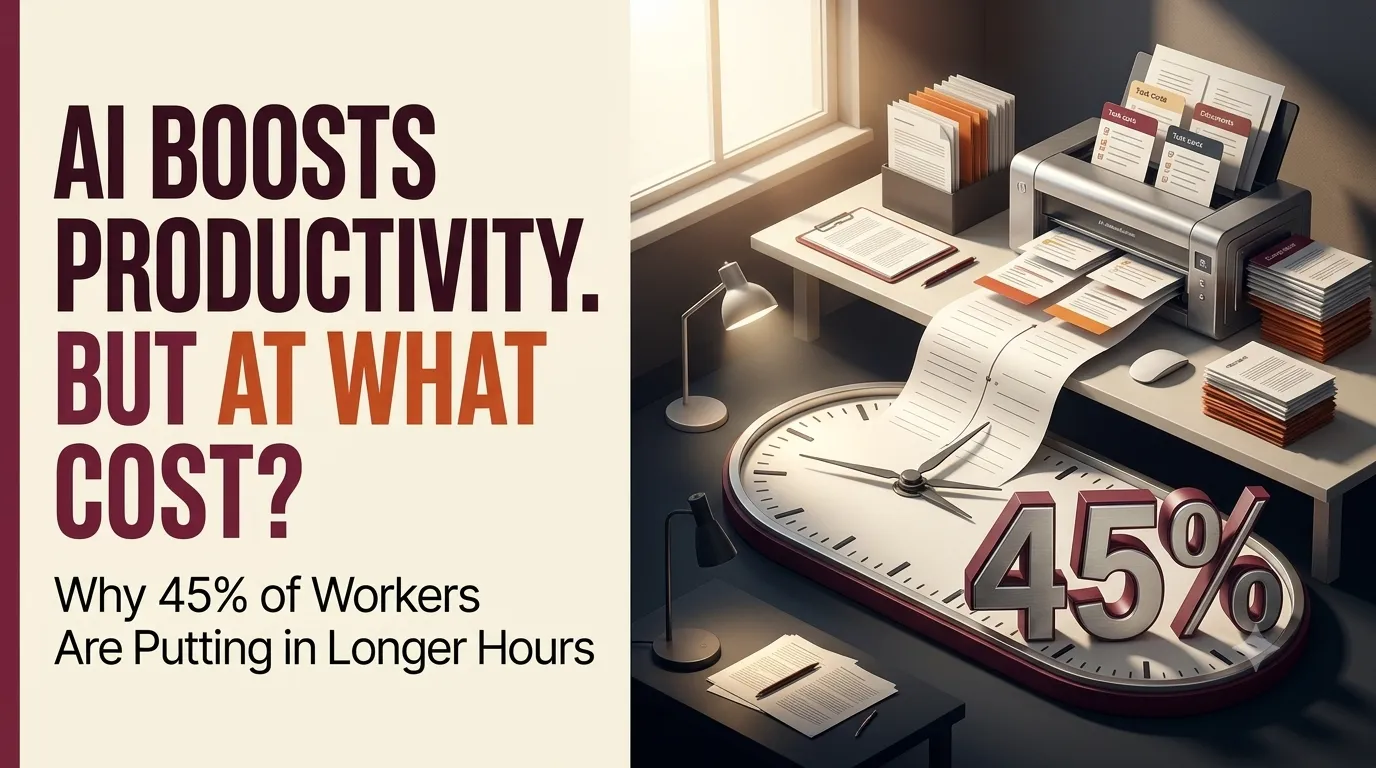
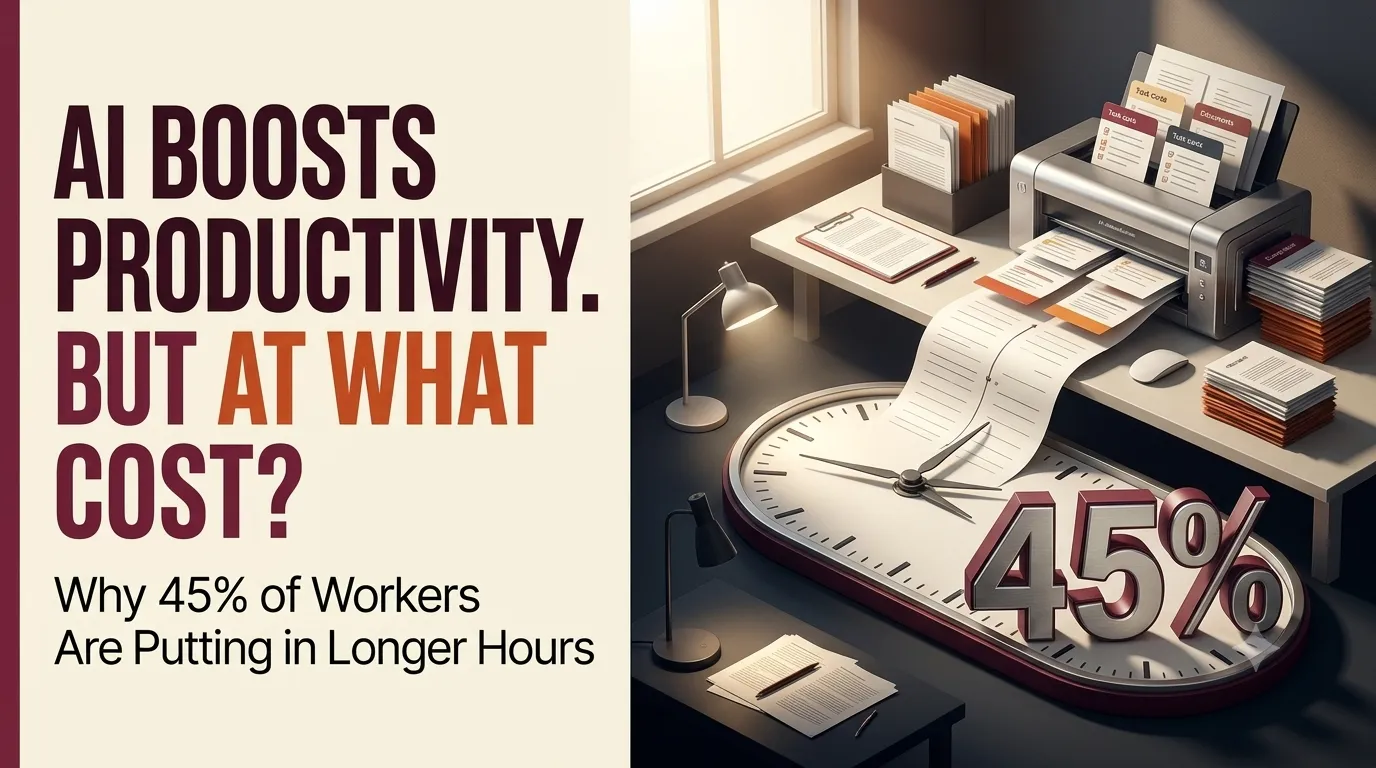
AI is helping employees get more done, but is it actually saving them time? A June 2026 WEF and PwC report found that 68% of entry-level workers reported higher productivity due to AI, while 45% said they were spending more time working as a result. As AI speeds up tasks, higher workloads can reduce the time saved. Discover why productivity gains do not always mean less work and which skills fresh graduates need to thrive.
What if becoming faster at your job is the very reason you end up working longer hours?
Imagine using AI to finish a report in 20 minutes instead of an hour. Instead of getting an extra 40 minutes to breathe, you are handed another task, then another. Your productivity has improved, but your workload has grown too. The tool meant to save you time may have quietly raised the bar for how much work you are expected to finish.
This is not just a hypothetical workplace dilemma. A June 2026 report by the World Economic Forum (WEF), developed in collaboration with PwC, found that
68% of entry-level workers reported increased productivity due to AI, while 45% said they were spending more time working as a result.
So, if AI is helping employees get more done, why isn't it helping them get more time back?
AI Is Helping Entry-Level Workers Do More, Faster
For someone starting their career, AI can feel like having an extra team member. It can help draft emails, summarise lengthy documents, analyse information and generate initial ideas in minutes. Tasks that once required considerable time and repeated effort can now be completed much faster.

The finding is relevant because entry-level roles often involve tasks such as research, drafting, data processing and basic analysis, where AI can speed up work. Instead of spending hours preparing a first draft, a new employee can use AI to create one and focus on checking the information, improving the output and understanding the problem.
However, completing individual tasks faster does not automatically mean completing less work overall. The real impact depends on what happens after AI saves time.
Why Are 45% of Entry-Level Workers Spending More Time Working?
If AI is making work faster, longer working hours might seem contradictory. But the two trends can exist together when employers and employees change how they use the time saved.
The WEF and PwC report identifies work intensification as a risk of adopting AI without deliberately redesigning jobs.
When employees can produce more in less time, expectations may rise, even if deadlines, working hours and the amount of support available remain unchanged.
The report also notes that some organisations redirect the time saved into higher-value activities, such as strategic analysis, problem-solving and stakeholder engagement. Others struggle to decide how that time should be used, potentially leading to duplicated outputs, superficial analysis or poorly defined tasks.
The key issue is not simply whether AI saves time. It is whether organisations allow employees to benefit from that time savings or use it to raise output expectations continuously.
AI Can Make Work Faster Without Making It Better
Getting a task done quickly is useful, but speed is only one measure of good work. For someone at the beginning of their career, the process of completing a task can be just as important as the final result.
The WEF and PwC report highlights three risks when AI is added to existing workflows without sufficient thought.
1. Losing opportunities to develop critical thinking
Entry-level employees learn by researching, testing ideas, spotting mistakes and solving problems. If AI handles too much of this work, employees may have fewer opportunities to develop independent judgement. Over-reliance on AI can also contribute to skill decay.
2. Facing higher workloads and mental fatigue
When faster output becomes the new expectation, employees may feel pressure to deliver more within the same working day. The report warns that work intensification can contribute to cognitive fatigue, burnout and weaker decision-making.
3. Missing out on meaningful work
If AI takes over the more engaging or creative parts of a role, employees could be left with repetitive checking or narrowly defined tasks. Without thoughtful job design, work may become faster but less fulfilling.
These risks matter particularly at the entry level because early jobs are not just about completing assignments. They help people develop professional judgement, understand how businesses operate and build the skills required for more senior responsibilities.
Want to understand AI beyond simply using its tools? Explore PW’s Business Analytics and Generative AI programme.
The Bigger Problem: AI Is Changing Entry-Level Jobs, Not Just Individual Tasks
The productivity debate is part of a much larger change in how organisations hire, assign work and develop talent. AI can help new employees contribute sooner, but it can also change which tasks they are expected to perform and how they learn the fundamentals of a profession.
According to the WEF and PwC report, more than one in three young workers globally (37%) are employed in occupations with medium to high exposure to AI-driven task change.
The exposure is particularly high in knowledge-intensive sectors, where many jobs involve processing information and performing tasks that AI can support or automate.
Entry-level hiring is already under pressure
Research cited in the report points to declines in early-career job opportunities in several countries, particularly in occupations with greater AI exposure.
One US analysis cited by the report found a 16% decline in entry-level jobs in AI-exposed fields since late 2022.
However, it would be misleading to blame AI for every hiring slowdown.
The report notes that declines in entry-level job postings began before ChatGPT was released in November 2022. Economic uncertainty, cost pressures and cautious hiring decisions also play a role.
Employers are therefore facing two connected questions: how can AI improve productivity, and how can organisations continue creating opportunities for people who need their first professional experience?
For students, this is an important distinction. AI may change the tasks involved in a first job, but the outcome depends partly on how employers choose to redesign those roles
If AI does the technical work, will you know enough to spot its mistakes? Build deeper AI skills with PW’s Generative AI and Machine Learning programme.
If AI Does the Routine Work, What Will Entry-Level Employees Learn?
Think about a junior software developer who uses AI to generate code, a marketing trainee who asks AI to prepare campaign copy or a finance graduate who uses it to summarise a spreadsheet. Each employee can complete certain tasks faster. But do they understand the work well enough to identify an error or explain why a particular decision makes sense?
That is one of the central challenges raised by the report.
Traditionally, entry-level employees have developed professional skills through repetition and gradually taken on more complex responsibilities. If AI automates too many foundational tasks, the old learning process may weaken. Employees could be expected to make decisions earlier in their careers without having enough practical experience to support them.
Early-career engineers are still expected to develop coding fundamentals before relying heavily on AI-generated code.
This helps them validate outputs and challenge suggestions when necessary.
The principle applies beyond software development:
-
Marketing: AI can draft campaign copy, but employees still need to understand the audience, assess the message and interpret campaign performance.
-
Finance: AI can assist with calculations and summaries, but employees need to understand the assumptions behind the numbers and check their accuracy.
-
Research: AI can organise information, but employees must evaluate the quality of sources and distinguish evidence from unsupported claims.
-
Business analysis: AI can identify patterns, but employees need to interpret the findings in context and explain their implications.
The finding is relevant because AI proficiency alone is not the same as professional competence. Employees need enough subject knowledge to judge whether an AI-generated result is accurate, appropriate and useful.
Want to strengthen your financial judgement with AI skills? Explore PW’s Gen AI in Financial Markets, Investment and Risk Management programme
The Skills Fresh Graduates Need Are Changing Faster Than Before
Learning a tool is useful, but learning how to adapt when that tool changes may be even more important.
The WEF and PwC report draws attention to the speed at which skills are evolving.
The World Economic Forum's Future of Jobs Report 2025, cited in the June 2026 report, estimates that 39% of workers' existing skill sets will be transformed or become outdated over the 2025–2030 period.
The pressure is especially significant for entry-level roles with high AI exposure. The report finds that these roles experience nearly twice the rate of net skills change seen in non-entry-level roles.
There is also uncertainty among workers themselves. Around 28% of entry-level workers believe that half or fewer of their current skills will remain relevant in three years.
Three capabilities to build alongside AI skills
-
Critical thinking: Check AI-generated answers, question assumptions and recognise when an output does not make sense.
-
Problem-solving: Understand the problem before choosing a tool, and work through challenges that AI cannot reliably resolve on its own.
-
Adaptability: Keep learning as tools, workflows and job requirements change, rather than relying on a single set of technical skills.
These capabilities complement AI proficiency. Knowing how to write a prompt can help you obtain an output, but knowing how to evaluate that output can help you produce work that others can trust.
The Future of Entry-Level Work Depends on What We Do With AI
AI is creating a workplace where fresh graduates may be expected to produce more, learn faster and contribute to complex tasks earlier in their careers. That creates opportunities, but it also raises questions about workload, skill development and access to first jobs.
Key Takeaways
-
-
AI boosts productivity, but not always free time.
-
68% of entry-level workers reported increased productivity due to AI, while 45% said they were spending more time working.
-
-
Higher output can mean higher expectations
-
When employers use time saved by AI to increase workloads without redesigning jobs, productivity gains can come at the cost of employee well-being.
-
-
Entry-level jobs are changing
-
AI is reshaping job tasks and hiring needs, making it important to preserve opportunities for fresh graduates to gain practical experience.
-
-
Professional judgement still matters
-
Critical thinking, problem-solving and adaptability help employees evaluate AI-generated outputs and apply them appropriately.
-
-
Practical experience can make a difference
-
Projects, internships and hands-on learning help fresh graduates connect subject knowledge with real workplace challenges.
AI's real value lies not just in how much work it helps people complete, but in whether it improves work quality, supports learning and creates better opportunities for early-career employees.
For students and fresh graduates, the practical takeaway is to treat AI as a tool for learning and improving work, not as a substitute for understanding it. Experiment with AI tools, build projects, check your results and strengthen your ability to think independently.
Because the real advantage in an AI-enabled workplace may not be how quickly you can produce an answer, but how well you can judge whether that answer is worth using.


Have questions about your prep?
Our experts can answer all your questions

Get Free Counselling Today
and Clear up all your Doubts
 Live & recorded classes available at easeDashboard for progress trackingLakhs of practice questions


