President Murmu Calls AI a Growth Opportunity, Says AI Skills Will Drive Future Jobs


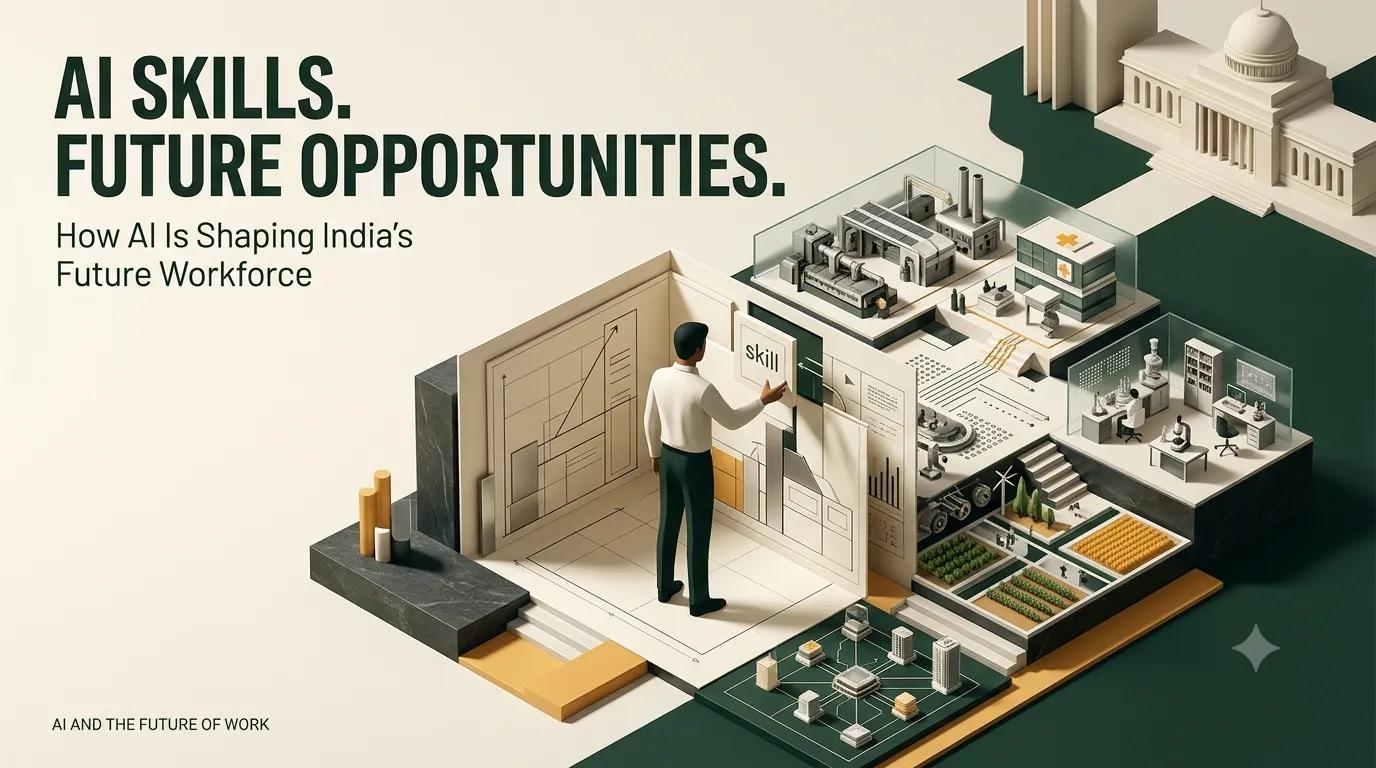
Artificial Intelligence is changing the way people work, learn and build careers. But as businesses across sectors begin adopting AI, an important question is emerging: are young learners developing the skills needed to keep up with this shift? Understanding AI is no longer limited to those pursuing technology-related careers. From data analysis to problem-solving, familiarity with emerging technologies is becoming increasingly relevant across industries. Highlighting this shift, President Droupadi Murmu has called AI a major opportunity for India's growth, stressing the need to build a skilled workforce and ensure that the benefits of this technology reach every section of society.
President Murmu Highlights AI's Role in India's Economic Growth
Speaking at a programme organised by the Ministry of Skill Development and Entrepreneurship on January 1, 2026, President Droupadi Murmu highlighted the growing importance of Artificial Intelligence in shaping India's economic and technological future.
She noted that AI is changing economies and societies worldwide, influencing how people access services, learn new things and carry out their work. For a young country like India, she described this development as an opportunity to drive positive change.
President Droupadi Murmu said:
"For a young nation like India, AI is not just a technology, but a tremendous opportunity for positive change."
The President also highlighted AI's potential contribution to India's GDP, employment generation and overall productivity in the coming decade. As the country works towards becoming a global technology leader, developing the right talent and making emerging technologies accessible will be important.
She further emphasised that AI should not create new social or economic divisions. Instead, its applications should help reduce existing barriers and expand opportunities, particularly for people from underprivileged communities.
As AI reshapes industries, are your skills keeping pace with changing job requirements? Read how AI is changing job requirements
Which AI Skills Will Matter for India's Future Workforce?
As AI adoption expands across industries, the demand for specialised technical capabilities is also gaining attention. President Murmu specifically highlighted three areas that could play an important role in developing India's AI talent pool: data science, AI engineering and data analytics.
President Droupadi Murmu said:
"Skills such as data science, AI engineering and data analytics will play a crucial role in developing the country's AI talent pool."
Here is what these skills involve and how learners can explore them:
|
Skill |
What Learners Need to Understand |
Potential Career Areas |
|
Data Science |
Working with data, identifying patterns, applying statistics and developing insights. |
Data Scientist, Data Science Analyst |
|
AI Engineering |
Building, testing and maintaining AI-powered applications and systems. |
AI Engineer, Machine Learning Engineer |
|
Data Analytics |
Analysing information, identifying trends and supporting business decisions. |
Data Analyst, Business Analyst |
These areas offer different entry points into the growing technology ecosystem. For example, data science combines mathematics, statistics and programming to solve problems using information. AI engineering focuses on developing intelligent systems, while data analytics helps organisations understand information and make informed decisions.
For learners, developing a foundation in mathematics, logical reasoning, programming and data handling can be a useful starting point before moving towards specialised AI skills.
Unsure how to prepare for an AI-driven career? Use PW’s Career Roadmap Generator to plan your next steps.
Key Highlights
-
AI as a growth driver: AI is expected to contribute to India's GDP, employment and productivity in the coming decade.
-
Three important skill areas: Data science, AI engineering and data analytics were highlighted as important for developing India's AI talent pool.
-
AI education in schools: The government is promoting AI labs and learning modules to encourage innovation and future-ready skills among children.
-
Inclusive AI adoption: The President stressed that AI's benefits should reach all sections of society, especially underprivileged communities.
-
New skilling initiative: The #SkillTheNation Challenge was launched under the SOAR initiative to encourage wider participation in AI learning.
Are traditional management skills enough in an AI-driven workplace? See how IIMs and B-schools are updating MBA curricula to include AI.
How Is the Government Introducing AI Learning in Schools?
Preparing the future workforce for an AI-driven economy requires introducing relevant concepts early in the learning journey. Recognising this, the government is promoting the use of AI in school education through AI labs and learning modules.
President Murmu highlighted how these initiatives are helping children develop innovative thinking and future-ready skills. The focus is on familiarising young learners with emerging technologies and encouraging them to explore their applications.
President Droupadi Murmu said:
"AI labs and AI modules are promoting innovative thinking and future-ready skills among children."
Early exposure to AI can help schoolchildren understand how technology works and where it can be applied. It can also encourage them to experiment, ask questions and approach everyday problems with a problem-solving mindset.
However, learning AI does not mean every school student needs to start building complex algorithms or training machine learning models. Understanding basic AI concepts, developing digital literacy and learning to evaluate technology critically can provide a strong foundation.
As students progress academically, they can explore programming, data science, machine learning and other specialised areas based on their interests.
What Are SOAR and the #SkillTheNation Challenge?
Another important development highlighted during the programme was the government's effort to make AI learning more accessible through SOAR (Skilling for AI Readiness), an initiative under the Skill India Mission.
The initiative provides free AI learning modules covering topics related to artificial intelligence and the basic concepts of machine learning.
It aims to increase AI awareness, support skill development and prepare learners for a technology-driven economy.
During the January 1 programme, President Murmu conferred AI certificates upon learners, including school students and Members of Parliament, who had completed the programme.
She also launched the #SkillTheNation Challenge, a national campaign designed to encourage wider participation in AI learning and innovation. The initiative aims to motivate learners to improve their capabilities and contribute to developing India's future-ready workforce.
The campaign reflects the broader objective of making AI education accessible beyond technology professionals and encouraging people from different backgrounds to explore emerging skills.
What Should Students Start Learning to Prepare for an AI-Driven Future?
The growing importance of AI does not mean that every learner needs to pursue a career in artificial intelligence. However, understanding how AI works and how it can be applied is becoming useful across academic disciplines and professional fields.
Students can begin by developing a few foundational skills:
-
Digital literacy: Understand how digital platforms, applications and emerging technologies work.
-
Programming fundamentals: Explore programming languages such as Python to understand how software and AI applications are developed.
-
Mathematics and logical reasoning: Strengthen problem-solving abilities, mathematical concepts and analytical thinking.
-
Data literacy: Learn how information is collected, interpreted and used to identify patterns.
-
Critical thinking: Develop the ability to evaluate AI-generated information, identify errors and make independent decisions.
-
Responsible AI use: Understand issues related to data privacy, bias, accuracy and ethical technology adoption.
These skills can help learners build confidence while exploring different career pathways. They also provide a foundation for those who later wish to specialise in data science, AI engineering or machine learning.
Wondering which AI skills you need to improve? Identify your skill gaps with PW’s Skill Gap Analyzer.
India's AI Future Will Depend on How Well It Prepares Its People
Beyond education and skilling, President Murmu also highlighted the importance of strengthening India's Digital Public Infrastructure and implementing the IndiaAI Mission to establish the country as a global AI leader.
She emphasised the need for collaboration between the government, educational institutions, industry partners and academia to ensure that India not only adopts emerging technologies but also contributes to shaping a responsible technological future.
Her message also connects with the broader vision of Viksit Bharat and the National Education Policy, which emphasises making India a knowledge-driven and technology-enabled nation.
For young learners, the message is clear: understanding emerging technologies, developing relevant skills and learning to use them responsibly will be important as the world of work continues to change.
AI may create new opportunities, but access to education, practical learning and the ability to adapt will determine how people can participate in this transformation.