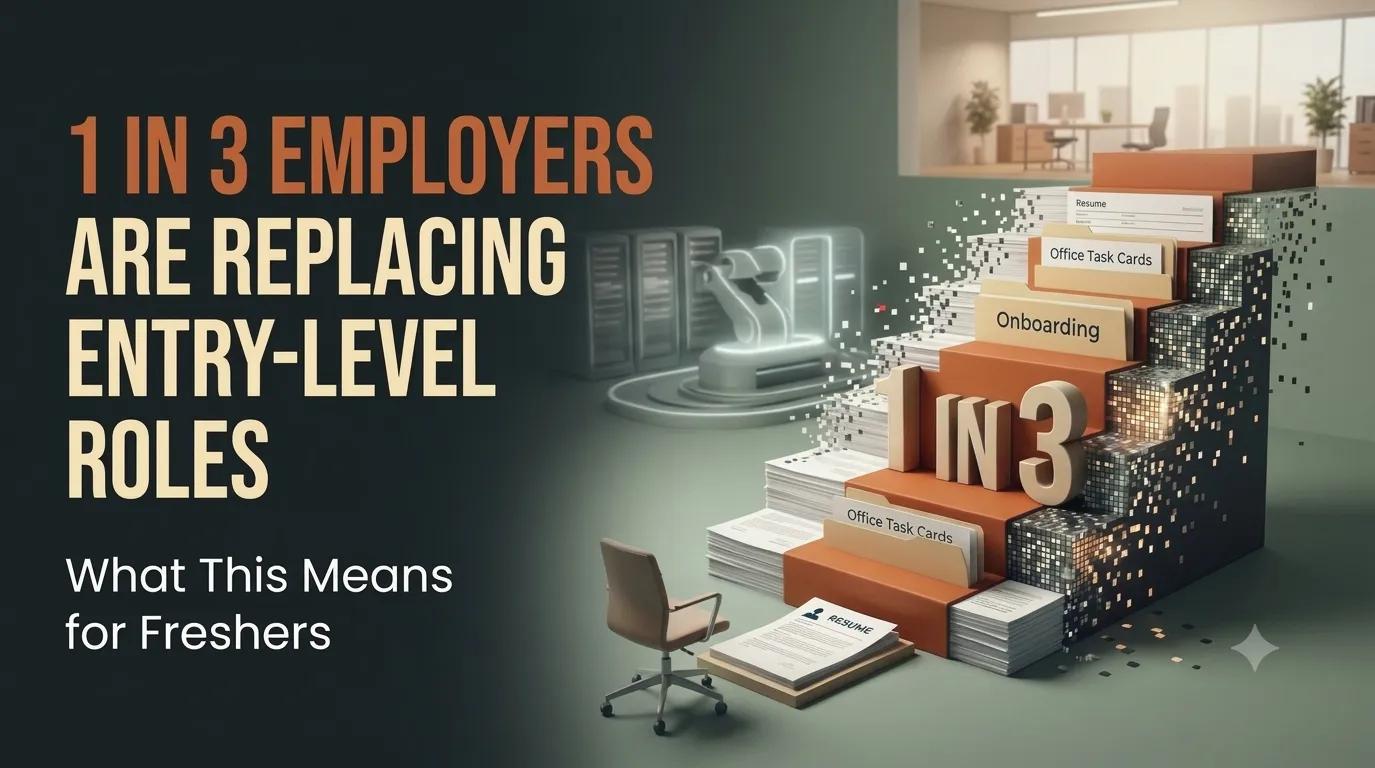
1 in 3 Employers Are Already Replacing Entry-Level Roles With AI


For years, entry-level jobs have been the starting point for graduates entering the workforce. They offered a chance to learn on the job, handle routine tasks, build experience and gradually take on more responsibility.
AI is beginning to change that starting point.
According to the GMAC Corporate Recruiters Survey 2026, one in three employers globally reported that they had already replaced at least some entry-level roles with AI. The impact was most visible in technology and manufacturing, where 40% and 36% of employers respectively reported replacing entry-level roles. Recruiters also mentioned work such as coding, data entry and customer service among the tasks being replaced.
That does not mean one in three entry-level jobs have disappeared. It means a significant share of employers are already using AI to take over some work that was previously handled by early-career employees.
For freshers, that raises a more useful question than simply asking whether AI will take their jobs:
If AI can handle some of the tasks that traditionally helped people enter the workforce, what skills will employers expect from freshers now?
What Is Changing About Entry-Level Work?
The biggest shift is not necessarily from human workers to AI. It is from routine task execution to higher-value work.
A fresher who was previously hired to perform repetitive data-related tasks, write basic code, respond to routine customer queries or complete standard processes may now be expected to work with AI instead.
That changes the value of the role.
Instead of only asking whether someone can complete a task, employers may increasingly need people who can decide which task should be automated, check whether the output is correct, interpret the information and decide what should happen next.
This is reflected in the wider findings of the GMAC survey. AI-related skills saw the largest growth in importance, but employers also placed greater value on data analysis, adaptability, problem-solving and communication.
So, learning AI is only one part of the answer.
Key takeaway:
“AI is changing what entry-level work looks like, not just how quickly it gets done.”
First, Freshers Need to Know How to Use AI at Work
Knowing how to write a prompt is not the same as knowing how to use AI effectively at work.
The GMAC survey gives a clearer picture of what employers mean by AI skills. Among employers concerned about AI capabilities, 67% wanted graduates to be able to use AI to automate tasks, making it the most commonly selected AI capability in the survey. Around half also wanted candidates who could use AI for research, business strategy and decision-making, content generation, and learning new skills.
For a fresher, that could mean using AI to automate repetitive processes, speed up research, analyse information or support development work.
But there is an important distinction here: AI should become part of the skill, not the entire skill.
A developer still needs to understand programming. A data analyst still needs to understand data. A marketer still needs to understand audiences and campaigns.
That is why learning AI alongside a core career skill can be more useful than learning AI tools in isolation.
Build AI Skills Alongside Technology Skills
For students looking to enter technology and development roles, this could mean building programming fundamentals first and then learning how AI can be used within development workflows.
Courses such as Full Stack Development with AI, Python Bootcamp for AI, Gen AI Engineering Course and Computer Science and Programming Fundamentals can help learners build different parts of this combination.
The goal is not simply to say “I know AI.”
It is to be able to say:
“I know how to use AI within the work I am trained to do.”
Want to stay ahead of routine coding? Take up PW Skills’ Full Stack Development with AI Course.
Data Skills Are Becoming More Important Too
There is another important signal in the GMAC findings.
Data analysis and interpretation moved from 10th place to 4th place among the skills employers value when hiring current graduates. GMAC connects this increase to the growing use of generative AI, noting that organisations need people who can review AI-generated output and understand technology-enhanced data analysis.
This matters because AI can produce an answer very quickly. That does not automatically make the answer useful or correct.
Someone still needs to ask:
-
Does this data make sense?
-
What is the important finding?
-
Is there something missing?
-
What should the business do with this information?
That is where data interpretation becomes valuable.
If You Want a Data Career, Combine Analytics With AI
For an aspiring data professional, learning tools alone may not be enough.
Building skills in data analytics, visualisation and AI can create a more relevant combination for an AI-enabled workplace.
PW Skills courses such as Data Analytics With AI, Data Science With Generative AI and Mastering Data Visualisation With Power BI And MS Excel align with this broader skill combination.
The idea is simple: learn to work with data, understand what it is telling you, and use AI to make the process more efficient.
Want to turn AI-powered analysis into a data skill? Take up PW Skills’ Data Analytics With AI Course.
Key takeaway:
“Learning AI alone is not enough. Freshers need AI skills alongside a core career skill.”
Problem-Solving Becomes More Valuable When Routine Work Is Automated
There is another reason why simply learning a tool may not be enough.
Problem-solving was the second most valued skill among employers in the 2026 survey. Communication ranked first, while adaptability moved into third place.
Think about the difference between these two situations.
A fresher is asked to generate a report.
In the first situation, they follow a fixed process and produce the report.
In the second, the process has changed. The data is incomplete. An AI tool has produced an unexpected result. The manager wants a different analysis by the afternoon.
The second situation requires something beyond task execution.
It requires the ability to identify the problem, work through it and decide what to do next.
As more routine work becomes automated, this kind of problem-solving can become an important part of what a fresher brings to the role.
Adaptability Is Becoming Part of Employability
AI tools, software and workflows are changing quickly. A skill that is relevant today may be used differently a year from now.
That is one reason adaptability has risen to the third spot among employers' current skill priorities in the GMAC survey.
For freshers, adaptability does not necessarily mean learning every new tool that appears.
It means being comfortable with learning something new, changing an existing approach and applying knowledge in a different situation.
This is particularly important when entering technology-led careers, where the tools used at work may continue to evolve after a student finishes a course.
The Same Principle Applies Beyond Tech
The AI shift is not limited to software development or data roles.
A digital marketer may use AI for content research, campaign ideas or audience analysis. A finance professional may use AI alongside financial modelling and analysis. A social media professional may use AI to speed up content workflows while still making decisions about audience, positioning and communication.
That is why the more useful career question is not:
“Which AI course should I take?”
It is:
“Which career skill do I want to build, and where does AI fit into that work?”
For students interested in marketing, for example, PW Skills offers Digital Marketing with AI and Social Media Marketing, allowing AI to be considered alongside the underlying marketing skill rather than as a standalone technology.
Similarly, learners interested in finance can explore areas such as Financial Modeling with AI and AI in Finance, where technology can be applied to a specific professional domain.
Key takeaway:
“Strong career skills matter more when you can adapt, solve problems and use AI effectively.”
Communication Still Matters, Even in an AI-First Workplace
It may seem surprising that communication remains so important when AI can generate emails, presentations and other content in seconds.
Yet communication was the #1 skill employers valued in the 2026 survey, cited by 64% of respondents.
The reason becomes clearer when you consider how AI-generated work is actually used.
Someone has to explain the insight to a manager.
Someone has to present a recommendation to a client.
Someone has to question an AI-generated answer.
Someone has to explain why a particular decision should be made.
GMAC also found that presentation and verbal communication were among the most valued specific communication skills among employers concerned about communication capabilities.
So, the future entry-level employee is not simply someone who can produce more output.
It is someone who can use technology, understand the output and communicate what it means.
What Should Freshers Learn Now?
The GMAC findings point towards a combination rather than a single “AI skill”.
-
For technology careers
Programming + AI + problem-solving
Build strong foundations in programming and development, then learn how AI can support coding, development and engineering workflows.
-
For data careers
Analytics + visualisation + AI
Learn how to work with data, interpret it and present insights, while using AI to make analysis more efficient.
-
For marketing careers
Marketing fundamentals + AI + communication
AI can accelerate research and content creation, but understanding audiences, campaigns and communication remains essential.
D) For finance careers
Finance + modelling + AI
AI can support analysis and modelling, but the underlying financial concepts and ability to interpret results remain important.
Across all four, the pattern is similar:
Domain skill + AI capability + human judgement.
Key takeaway:
“ The future-ready fresher is not just an AI user, but someone who can apply, question and communicate its output.”
AI May Change the First Job, But It Does Not Remove the Need to Build a Career
AI may be changing the tasks freshers start with, but it is not removing the need for human skills. Problem-solving, adaptability, communication and data skills remain important alongside AI capabilities.
The takeaway is simple: build the skill behind the task, learn how AI can strengthen it, and develop the judgement to know what to do when the answer is not obvious. For the next generation of professionals, learning to work with AI may matter just as much as learning about it.