







Knowing How to Use ChatGPT May No Longer Be Enough to Get You Hired



Knowing how to use ChatGPT can make everyday tasks faster, but it does not automatically make you job-ready. As AI becomes part of everyday work, employers are looking beyond people who can generate prompts or content. They increasingly value professionals who can apply AI to solve problems, interpret information and deliver meaningful outcomes.
For students, fresh graduates and working professionals, this shift calls for more than basic AI familiarity. Workday’s report, AI Is Rewriting Jobs More Than It’s Cutting Them, explores how AI is reshaping job responsibilities and changing the skills employers need.
AI is Changing the Work, Not Just the Tools
The conversation around AI often focuses on whether jobs will disappear. However, another change is taking place within existing roles: the tasks themselves are being reshaped.
AI can support research, content creation, data processing, coding, and routine analysis. This can save time, but it also raises expectations about the quality, speed, and judgement people bring to their work.
Imagine two candidates applying for a data-related role. Both know how to use ChatGPT. One can generate a summary from a spreadsheet. The other can clean the data, identify a meaningful pattern, verify the AI-generated explanation, and communicate what the finding means for a business decision.
The second candidate brings more than AI familiarity. They combine AI with domain knowledge, analysis, and sound judgement.
This is why the discussion around AI and the future of work is about more than learning new tools. It is also about how people adapt their capabilities as tasks change.
From Prompting to Problem-Solving
Prompting is a useful starting point, but it is only one part of an effective workflow.
The goal is not to master every AI tool. It is to develop expertise in a field and use AI to strengthen that expertise.
To use AI successfully at work, you may need to:
-
Define the problem before asking AI for a solution.
-
Provide relevant context and clear instructions.
-
Evaluate whether the output is accurate and useful.
-
Identify errors, missing information, or biased assumptions.
-
Adapt the result to the needs of a team, customer, or business.
This is important because AI-generated content can sound convincing even when it is incorrect. The ability to question an answer is just as important as the ability to generate one.
What if you could do more than get answers from AI? Learn how to build AI-powered applications and understand the technology behind them with PW Skills' Generative AI Engineering Course.
Those who want to understand how AI systems can perform multi-step tasks can also explore AI agents explained for beginners.
AI becomes more valuable when it is paired with skills that help you interpret, evaluate, and apply its output.
What the Workday Report Signals
Workday’s Global Workforce Report points to a shift in the skills employers are seeking:
-
Demand for basic AI skills, such as simple prompting, fell 25% after peaking in January 2026.
-
Demand for hands-on skills, including building AI tools, automating workflows, and AI engineering, rose 51% between September 2025 and July 2026.
-
40% of business leaders expect AI to help them get more out of their existing employees, while 28% expect it to reduce headcount.
Workday analysed job requisition skills data from more than 550 employers using Workday Recruiting. These figures reflect demand in that dataset, not the share of all jobs or employers worldwide.
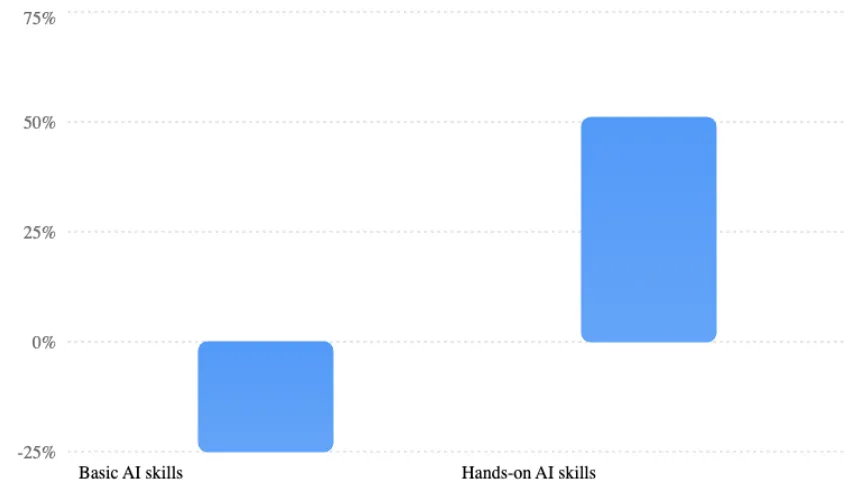
The contrast is significant. Basic AI familiarity may be becoming less distinctive, while the ability to build and apply AI is gaining importance.
Prompting remains useful, but practical AI skills may provide a stronger indication of job readiness.
Build Evidence, Not Just AI Familiarity
A resume that states “Proficient in ChatGPT” may not tell an employer much. A project that demonstrates how you used AI to solve a problem can provide stronger evidence of your abilities.
Consider creating a small project that reflects the work you want to do:
-
For data roles: Analyse a dataset, use AI to explore patterns, and verify the conclusions.
-
For software roles: Build a small application, document how AI supported development, and test the result.
-
For marketing roles: Create a campaign concept, then explain the audience, strategy, and measures of success.
-
For business roles: Use AI to organise information and prepare a recommendation, while showing how you checked the evidence.
Need an idea to get started? Explore generative AI project ideas for a job-ready portfolio and choose a project that reflects the work you want to do.
A useful portfolio shows more than what AI produced. It demonstrates your contribution, the problem you chose, the decisions you made, and how you evaluated the outcome.
A Practical Way to Strengthen Your AI Skills
You do not need to master every AI technology at once. Start with the role you want and work backwards.
-
Study job descriptions: Look for recurring skills, tools, and responsibilities, not just the phrase “AI proficiency.”
-
Choose one relevant capability: This might be data analysis, workflow automation, software development, or AI-assisted content production.
-
Practise on a real problem: Use a project, case study, or work task to apply the skill.
-
Check the result: Verify facts, test outputs, and note where AI struggled.
-
Explain your process: Be ready to describe your choices, your contribution, and how you measured success.
For example, if you are interested in software development, strengthening your fundamentals through full-stack web development can help you understand the systems AI tools assist with, rather than focusing only on the code they generate.
Build expertise in a field, practise applying AI to real problems, and demonstrate your skills through projects and clear explanations.
The next time you use ChatGPT, ask yourself a question beyond “Did it give me a good answer?”
Ask “What can I now do that I could not do before, and can I demonstrate it?” That may be a more meaningful measure of AI readiness than the number of prompts you know.
Do not stop at learning how to use AI. Start building the skills to work with it, question it, and create something meaningful with it.


Have questions about your prep?
Our experts can answer all your questions

Get Free Counselling Today
and Clear up all your Doubts
 Live & recorded classes available at easeDashboard for progress trackingLakhs of practice questions


