Degrees vs Micro-Credentials: What Employers Think About Short-Term Professional Courses


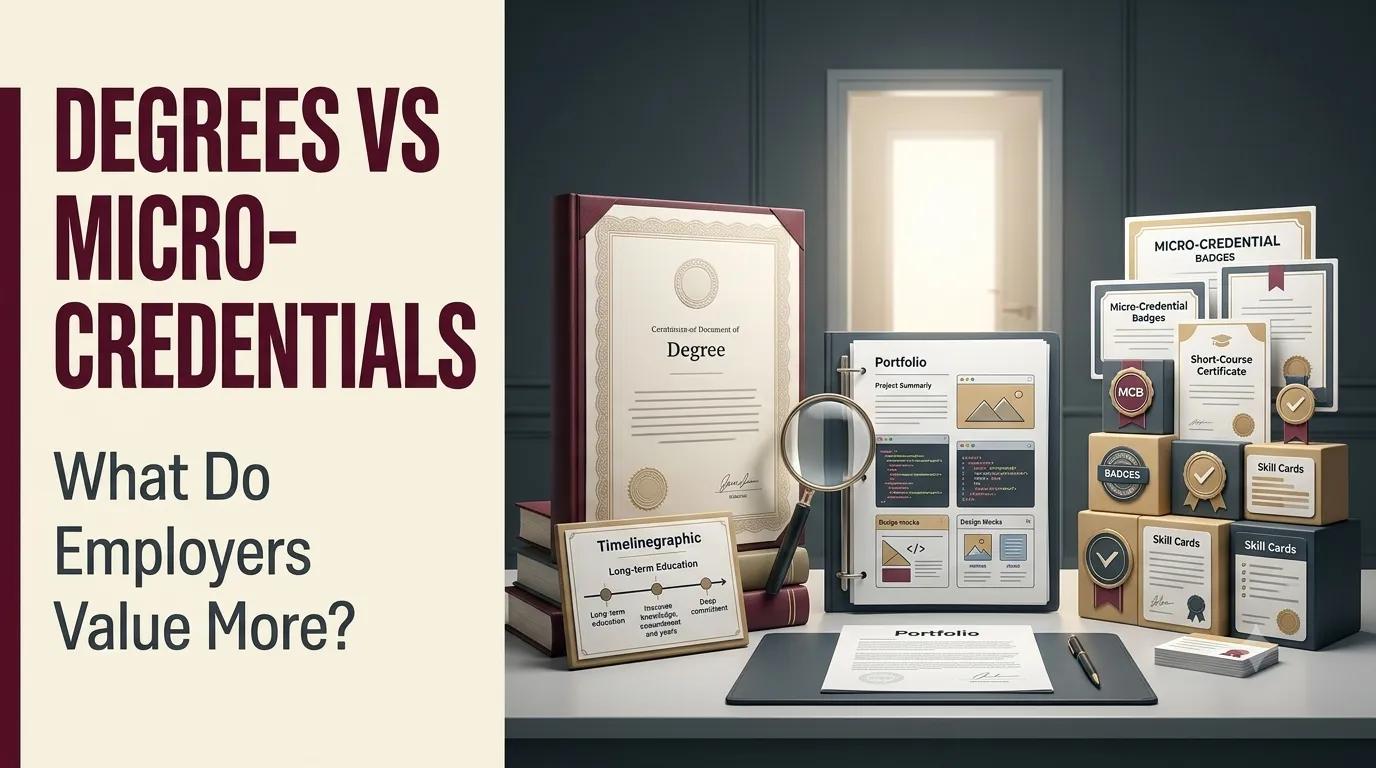
A degree has traditionally been one of the clearest signals of professional readiness. But as skills and technologies change faster, professionals are increasingly turning to micro-credentials and short-term programs to build specific capabilities.
So, do employers see these credentials as a real alternative to degrees?
The GMAC Corporate Recruiters Survey 2026 offers a nuanced answer. Graduate degrees still carry stronger overall employer confidence, but attitudes towards micro-credentials are changing, particularly in some markets.
Degrees Still Carry the Stronger Employer Signal
GMAC found that employers globally still tend to favour employees with graduate business degrees over those with micro-credentials alone.
That is understandable. A degree represents a broader period of structured learning and can signal business knowledge, analytical ability, and preparation for complex professional environments.
The distinction is important: micro-credentials are gaining relevance, but they have not replaced the broader employer value of a graduate degree.
The survey also found that 100% of employers expressed at least some confidence in graduate management education, reinforcing the continued value of formal postgraduate qualifications.
But Where You Work Changes the Answer
The global picture becomes more interesting when the survey is broken down by region.
U.S. employers were the least likely to agree that employees with graduate business degrees are more likely to succeed than employees with micro-credentials alone. Just under half of U.S. employers agreed with that statement, compared with nearly three-quarters of employers in Asia.
That difference matters.
It suggests that micro-credentials are not being evaluated uniformly across global labour markets. Their value can depend on the employer, geography, industry, and the type of skill being demonstrated.
A short-term credential may carry more weight when it directly addresses a skill employers are actively looking for.
Why Are Micro-Credentials Becoming More Relevant?
The answer may lie in the skills employers increasingly want.
According to GMAC, data analysis and interpretation moved from 10th place in 2025 to fourth place in 2026, while AI-related skills recorded the largest year-over-year increase in importance.
These are fast-changing areas where professionals may need to update their skills without committing to another multi-year qualification.
Someone with an existing degree, for example, may choose to develop practical AI and data analysis skills to address a specific gap in their current skill set.
This is where short-term learning can complement, rather than compete with, formal education.
A Certificate Is Not the Same as Demonstrated Skill
There is another distinction employers may increasingly care about: the difference between earning a credential and proving a capability.
A certificate shows that someone completed a learning experience. It does not automatically demonstrate that the person can apply that knowledge effectively.
Consider data analytics. A professional who learns data visualisation and analytical reporting can create stronger evidence of their skills by applying those capabilities to a real dataset or business problem.
The same applies to technical roles. Learning AI-enabled software development becomes more meaningful when candidates can demonstrate applications, projects, or solutions they have actually built.
The strongest value of a micro-credential may therefore come from the skill it proves, not simply the certificate it provides.
Degrees and Micro-Credentials May Serve Different Purposes
The GMAC findings suggest that the debate should not necessarily be framed as degrees versus micro-credentials.
They can serve different purposes.
A degree can provide broad academic and professional foundations. A micro-credential can help someone develop a specialised capability in response to changing industry requirements.
This is particularly relevant in areas such as AI, analytics, cloud computing, and other technology-driven fields, where new tools and workflows can emerge faster than traditional academic programs are updated.
For professionals with an existing foundation, focused learning in areas such as generative AI and data science can therefore function as an additional layer of expertise rather than a replacement for formal education.
So, What Do Employers Actually Want?
The GMAC survey does not indicate that degrees are losing their value. Employer confidence in graduate management education remains strong.
At the same time, the growing importance of AI, data analysis, adaptability, and other emerging skills creates a stronger case for targeted professional learning.
The real value of a micro-credential may therefore depend on four things: what skill it teaches, how relevant that skill is to the role, how credible the credential is, and whether the candidate can demonstrate practical application.
That changes the question.
Instead of asking whether a micro-credential is equal to a degree, professionals may need to ask: What capability does this credential add that an employer can actually see and use?
As skills continue to change, that may be the more important measure of the value of short-term professional education.