The Communication Skills Employers Want Go Beyond Good English: Insights From the GMAC 2026 Survey


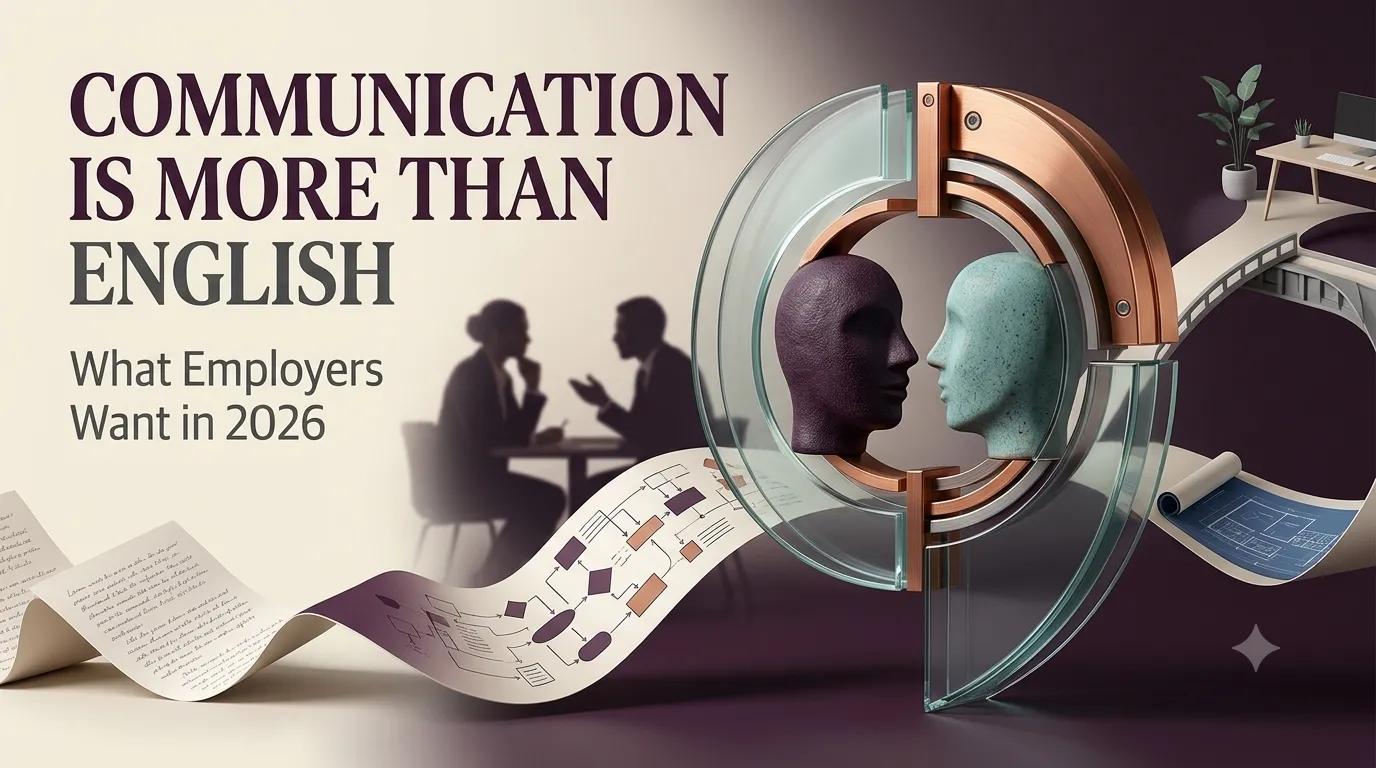
Good English can help you enter a professional conversation. But it does not necessarily make you effective in one.
The latest GMAC Corporate Recruiters Survey 2026, based on responses from more than 620 corporate recruiters and hiring managers across 39 countries, puts communication at the top of the skills employers value in business school graduates.
64% of employers identified communication as important, placing it ahead of problem-solving at 62% and adaptability at 60%.
The finding is significant because the workplace is becoming more technology-driven, not less. If communication remains the most valued skill while AI and data capabilities are rapidly gaining importance, the real question is not whether professionals can speak English well. It is whether they can make ideas understandable, listen effectively, work with others and communicate decisions with clarity.
Communication is More Than Just Speaking Clearly
In a professional setting, communication is rarely just about vocabulary, grammar or pronunciation.
It involves explaining an idea to a client, presenting analysis to a manager, listening to a colleague's concern, negotiating priorities with another team and adjusting the message depending on the audience.
GMAC's interpretation of communication includes the ability to convey information and ideas effectively, both verbally and in writing, along with active listening, relationship-building and negotiation.
That distinction matters. A professional may have excellent English and still struggle to explain a complex issue to a non-technical stakeholder. Another person may speak simply but know exactly how to structure an argument, ask the right question and move a discussion towards a decision.
Employers are ultimately evaluating the second capability.
Why Communication Ranks Above AI Skills Today
The 2026 survey presents an interesting contrast.
Technology, AI and data analysis skills recorded some of the largest increases in employer importance compared with the previous year. Yet communication remained the single most valued skill in current hiring decisions.
AI-related skills recorded the largest year-over-year increase in importance, but communication still ranks first among the capabilities employers value today.
The finding does not suggest that communication is replacing technical skills. Instead, it points towards a workplace where the two increasingly work together.
Consider a data professional who can build a strong model but cannot explain what the results mean to a business team. Or a developer who can create an AI-enabled application but cannot communicate trade-offs, timelines or risks to stakeholders.
The technical skill may get the work started. Communication often determines whether the work creates value.
The Rise of Data Makes Communication Even More Important
One of the most notable changes in the GMAC survey is the rise of data analysis and interpretation.
The skill moved from 10th place in 2025 to fourth place in 2026, with 59% of employers identifying it as important.
This creates an important connection between technical and human capabilities.
Professionals increasingly need to analyse information, interpret results and then communicate what those results mean. Developing AI-enabled data analysis skills can therefore be valuable, but the ability to translate findings into a clear business narrative is equally important.
A report filled with charts is not necessarily useful. The professional value comes from answering questions such as: What does the data show? Why does it matter? What should the organisation do next?
That is communication applied to analytical work.
Listening May Matter as Much as Speaking
Another overlooked part of professional communication is listening.
Workplaces involve multiple perspectives, competing priorities and incomplete information. Active listening helps professionals understand what a client actually needs, identify the concern behind a question and avoid making decisions based on assumptions.
This also connects communication with problem-solving. GMAC ranks problem-solving as the second most valued skill among current GME graduates, with 62% of employers identifying it as important.
In practice, the two skills often work together.
A professional first needs to understand the problem accurately. Then they need to frame it clearly, discuss possible solutions and communicate a decision. Communication is therefore not simply the presentation layer of professional work. It can influence the quality of the work itself.
What Employers May Really Mean by "Good Communication"
The GMAC findings suggest that candidates should think beyond conventional ideas of communication skills.
Employers are looking for professionals who can:
-
Explain complex ideas in simple language
-
Listen actively before responding
-
Adapt communication to different audiences
-
Present evidence and recommendations clearly
-
Collaborate across teams and functions
-
Negotiate priorities and expectations
-
Communicate decisions with confidence
-
Connect technical information with business outcomes
This becomes particularly important as professionals work alongside AI systems. A candidate may develop strong data visualisation and analytical reporting capabilities, but employers still need people who can interpret those outputs and communicate what they mean to others.
The same applies to technology roles. Building AI-enabled software development capabilities is increasingly relevant, but software professionals also have to discuss requirements, explain technical constraints and collaborate with people who may not have a technical background.
The Skill Combination is the Bigger Story
The GMAC survey is most useful when its findings are viewed together rather than as individual rankings. Communication leads the list, followed by problem-solving and adaptability, while data analysis and AI skills are gaining importance.
The emerging professional profile combines communication, problem-solving, adaptability, data and AI capabilities.
These skills are complementary. Professionals need to use technology, interpret information, solve problems and communicate their findings effectively.
That means improving workplace communication is not simply about speaking better English. It is also about structuring an argument, presenting data, asking the right questions, listening carefully and explaining complex work to different audiences.
The direction is clear: the strongest professionals will not just know more. They will know how to make what they know useful and actionable.


Have questions about your prep?
Our experts can answer all your questions