More People Are Applying for Tech Jobs, but Are They Becoming More Employable?


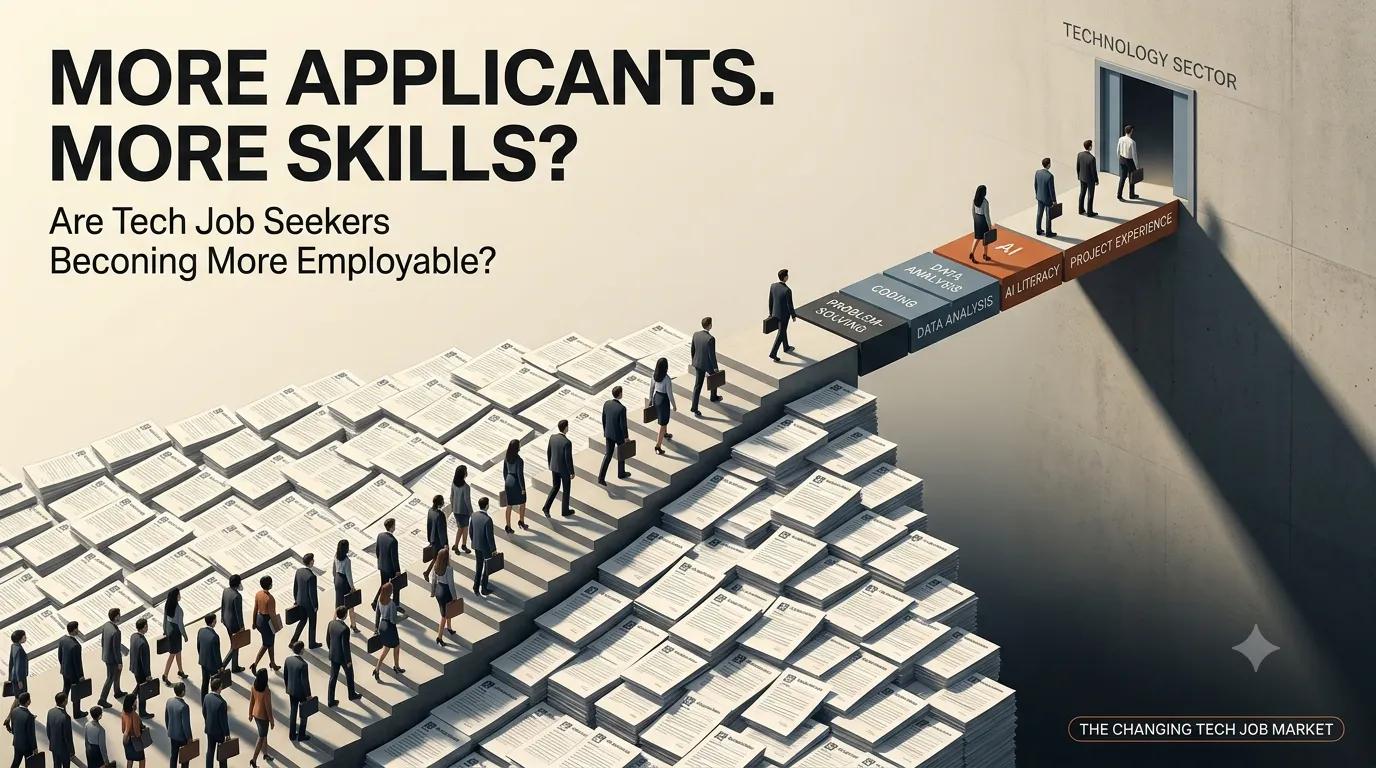
Applying for a job has never been easier. AI tools now help people write, edit and send applications at a pace that was hard to imagine a year ago. The result, according to Workday's October 2026 Global Workforce Report, is a crowded field: in technology and media, the number of applicants per job filled rose 40 percent year over year.
Yet hiring has not sped up. The time it takes to fill a role held steady at about 60 days, and employers say roles mostly stay open because candidates lack the right skills. More applications, in other words, are not the same as more qualified candidates.
So are more applicants becoming more employable? The report does not measure that directly, but it points one way: what employers want is changing, and many workers are not getting the support to keep up.
Median applicants per filled job rose from 58 to 69 in a year, yet the time to fill a role stayed at about 60 days.
How Much Has Competition for Roles Grown?
Applications are rising faster than hiring.
Workday says AI making it easier to apply to more jobs at once is a possible cause. Here is what the report found:
|
Measure |
Figure |
|---|---|
|
Median applicants per job filled |
69, up from 58 a year earlier |
|
Applicants per job filled, technology and media |
Up 40% year over year |
|
Applicants per job filled, financial services |
Up 27% year over year |
|
Time to fill a role |
About 60 days, unchanged |
|
Job seekers who used AI in their search |
84% |
|
Applicants who said AI increased the roles they applied to |
57% in technology and media, 53% in financial services |
Tip: Applicants per filled job in technology and media rose 40 percent year over year.
Does Applying to More Jobs Make a Candidate More Employable?
More applications are not translating into faster hiring.
No, because more applications do not necessarily mean more qualified candidates, the 60-day time to fill did not move. Employers told Workday that roles mostly stay open for two reasons: candidates lack the right skills, or pay, location, or flexibility do not line up with what people want.
Phil Willburn, vice president at Workday, describes what employers are looking for:
“It's whether they can learn fast enough to solve the next problem.” — Phil Willburn, Workday
Employers say roles mostly stay open because candidates lack the right skills, or because pay, location or flexibility do not line up.
Which AI Skills Are Employers Actually Hiring For?
Companies have moved from wanting people who use AI to people who build with it.
Workday analysed skills data on job requisitions across more than 550 employers using Workday Recruiting:
-
Demand for basic AI skills, like simple prompting, rose through late 2025, peaked in January 2026, then fell 25 per cent over the following months.
-
Demand for hands-on skills, like building AI tools, automating workflows and AI engineering, climbed 51 per cent between September 2025 and July 2026.
Demand for hands-on AI skills rose 51 per cent in ten months, while demand for basic AI skills fell 25 per cent from its January peak.
Tip: If your AI skills stop at prompting, add one you can show: a tool you built or a workflow you automated.
Want to build AI applications and automate workflows? Explore the PW Skills Gen AI Engineering Course to learn Python, LLMs, AI agents, RAG and LLMOps through practical projects.
Are Workers Getting the Support to Close the Gap?
Workers know what they need. Employers are not always helping.
In a September 2026 survey of 6,000 full-time employees, 79 percent said they know what skills they need to succeed, but only 66 percent said their employer helps them develop those skills. Confidence is high, with 65 percent saying they can learn new skills if asked to.
Heavy AI users are split. In Workday's August AI@Work Pulse survey of 5,944 workers, 62 percent of those who use AI for nearly all their work think it will make their current skills less valuable. Still, 76 percent expect it to open up new career opportunities.
Employers are also asking for less of the skills that help workers through change. Mentions of management and leadership skills in job requisitions fell 7 percent and training skills fell 13 percent between September 2025 and July 2026.
79 percent of workers know which skills they need, but only 66 percent say their employer helps them build them.
Tip: Name the skill you want to build and ask your employer how it will support you.
What Happens When Moving Up Inside Slows Down?
Internal routes are narrowing, so more people look outside.
Internal moves fell at 57 percent of employers, and promotion rates worldwide stayed essentially flat. Employees who tried to move internally most often pointed to hiring being paused for the role, managers who did not support the move, and selection processes that did not feel fair. About half did not try at all, and 27 percent of them saw no attractive opportunity inside their company.
That pushes people to look outside, which feeds the application volume above. For tech and media candidates, the competition is now both wider and harder to stand out in.
Internal moves fell at 57 percent of employers, and promotion rates worldwide stayed essentially flat.
Key Takeaways
-
Median applicants per filled job rose to 69 from 58, and rose 40 percent in technology and media.
-
The time to fill a role held at about 60 days, because more applications do not mean more qualified candidates.
-
Employers say roles stay open mostly because candidates lack the right skills, or because pay, location or flexibility do not line up.
-
Demand for basic AI skills fell 25 percent from its January 2026 peak, while hands-on AI skills rose 51 percent.
-
79 percent of workers know the skills they need, but only 66 percent say their employer helps them build them.
-
Internal moves fell at 57 percent of employers, and promotions stayed flat.
So, Are More Applicants Becoming More Employable?
Not on volume alone. More people are applying, but hiring is no faster, and employers say the gap is mostly skills. What they ask for has also shifted from using AI to building with it. The report does not measure employability directly, but its data shows that applying more is not the same as being more ready.
For job seekers, that means investing in skills employers are now asking for. For employers, it means the gap between what workers know they need and the support they receive is part of the problem.
Before you apply to more roles, check whether the skills you list are ones employers are still asking for.
Looking to build skills for emerging AI roles? Explore the PW Skills Data Science with Generative AI Course to learn Python, SQL, Machine Learning, Deep Learning, NLP and Generative AI through practical projects.