RRB ALP Science Nuclear Reactor & Radioactivity By Arti Mam
 Priyanka Yadav28 Mar, 2026
RRB ALP Science Nuclear Reactor & Radioactivity is an important topic for candidates preparing for the exam. It focuses on radioactive decay, characteristics of alpha, beta, and gamma rays, and their practical applications. The topic also includes nuclear reactions, energy generation, and major components involved in nuclear reactors. A clear understanding of these concepts helps candidates solve objective questions more efficiently in the RRB ALP Exam.
Also Read:
Glass as a Homogeneous Mixture
Glass is a homogeneous mixture known for being a bad conductor of electricity. It uniquely dissolves in hydrofluoric acid.
Composition of Colored Glass
Different chemicals are used to impart specific colours to glass:
-
Green glass: Chromium oxide
-
Blue glass: Cobalt oxide
-
Brown glass: Iron oxide
-
Purple and Red glass: Manganese oxide
-
Orange glass: Selenium oxide
-
Red glass: Cadmium oxide
-
Yellow glass: Ferric oxide
Types of Glass and Their Uses
-
Flint Glass: Commonly used for household utensils, bottles, and windows.
-
Crookes Glass: Utilized in sunglasses due to its ability to reflect UV rays, offering eye protection.
Radioactivity
Radioactivity was discovered by Madame Curie and Henri Becquerel, who together identified radium. Radium was observed to emit alpha, beta, and gamma rays. Radioactive elements are defined as those that continuously emit these three types of rays.
Measurement of Radioactivity
-
General radioactivity is measured using a Geiger-Müller Counter (GM Counter).
-
The intensity of gamma rays in water or other environments is measured using a Scintillation Counter. This is an important exam question.
Units of Radiation Measurement
-
RADS: Measures the amount of absorption of alpha, beta, or gamma radiation by an object.
-
REMS: Measures the effect of radiation absorption on the body.
Uranium
Uranium is famously known as the "Metal of Hope". Its best ore is pitchblende, also called yellowcake.
Properties of Alpha, Beta, and Gamma Rays
Understanding the comparative properties of alpha, beta, and gamma rays is crucial for grasping their behavior and impact.
|
Property |
Alpha (α) |
Beta (β) |
Gamma (γ)
|
|---|---|---|---|
|
Penetration Power |
Least |
Moderate |
Highest |
|
Danger Level |
Least |
Moderate |
Highest |
|
Ionization Power |
Highest |
Moderate |
Least |
Changes in Atomic Number and Mass during Radioactive Decay
When an element X with atomic number Z and atomic mass A undergoes radioactive decay, its atomic composition changes depending on the particle emitted.
|
Particle Emitted |
Change in Atomic Number (Z) |
Change in Atomic Mass (A) |
Particle Comparison
|
|---|---|---|---|
|
Alpha (α) |
Decreases by 2 |
Decreases by 4 |
Helium nucleus (positive particle) |
|
Beta (β) |
Increases by 1 |
No change |
Electron (negative particle) |
|
Gamma (γ) |
No change |
No change |
Photon (neutral particle) |
Worked Example: Radioactive Decay Series
Consider an element X (Z=92, A=234) undergoing a decay series: one alpha particle, followed by one beta particle, and then one gamma particle.
-
Initial Element: X (Z=92, A=234)
-
After Alpha (α) decay: Z becomes 92-2=90, A becomes 234-4=230.
-
After Beta (β) decay: Z becomes 90+1=91, A remains 230.
-
After Gamma (γ) decay: Z remains 91, A remains 230.
Final Answer: The final element will have an atomic number of 91 and an atomic mass of 230.
Uses of Radioisotopes
Radioisotopes have diverse applications in various fields:
-
Uranium-238: Used for dating the age of the Earth.
-
Sodium-24: Used for blood pressure (BP) related studies.
-
Iodine-131: Used for treating diseases like goiter.
-
Cobalt-60: Used in the treatment of cancer.
-
Phosphorus-32: Used in the treatment of skin cancer.
Chain Reaction
A chain reaction describes a process where a neutron bombardment of a radioactive element causes its nucleus to split. This fission releases additional neutrons, which then trigger further fission, leading to a self-sustaining and repeating reaction. This is also known as श्रंखला अभिक्रिया.
Types of Nuclear Reactions: Fission and Fusion
Nuclear reactions are categorized into two primary types: Fission and Fusion.
|
Feature |
Nuclear Fission |
Nuclear Fusion
|
|---|---|---|
|
Elements Involved |
Radioactive elements (heavy nuclei) |
Non-radioactive elements (light nuclei) |
|
Energy Release |
Less energy released per reaction compared to fusion |
More energy released per reaction |
|
Initiating Particle |
Neutron bombardment |
Proton bombardment |
|
Temperature |
Low |
High |
|
Pressure |
Low |
High |
|
Examples / Applications |
Atom bomb, Nuclear Reactor |
Stars (e.g., Sun), Hydrogen Bomb, Artificial Suns (for energy) |
Atomic Bomb History
The atomic bomb was developed by J. Robert Oppenheimer.
-
August 6, 1945: The bomb named "Little Boy" was used on Hiroshima, Japan.
-
August 9, 1945: The bomb named "Fat Man" was used on Nagasaki, Japan.
After testing, Oppenheimer famously stated, "I am the destroyer of worlds," reflecting on its destructive power. -
The Hydrogen Bomb was developed by Edward Teller.
Consequences of Nuclear Weapons and Energy
The use of atomic bombs on Hiroshima and Nagasaki caused long-term devastation, including barren land and severe genetic mutations across generations. This led to international efforts by organizations like the UN to prevent future use. The Chernobyl disaster highlighted the catastrophic potential of uncontrolled nuclear energy. Modern research, such as China's "artificial sun," aims to harness nuclear fusion for peaceful energy generation.
Nuclear Reactor
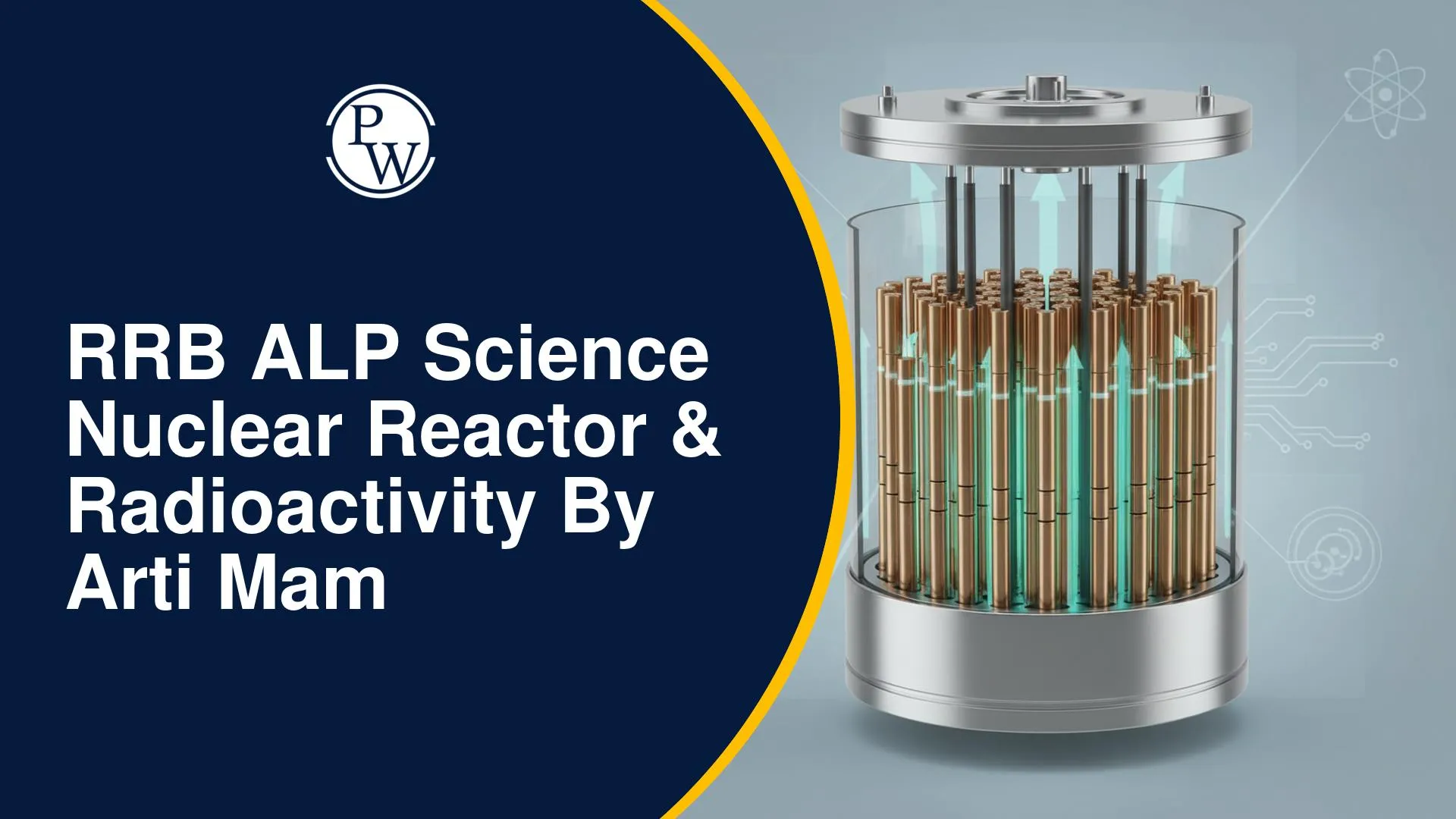
Nuclear reactors were invented by Enrico Fermi. They operate on the principle of controlled nuclear fission, managing a chain reaction to generate energy.
-
Fuel: Primarily Uranium-235.
-
Main Components for Control:
-
Moderators (मंदक): Used to slow down neutrons, ensuring a sustained, controlled chain reaction.
-
Coolants (प्रशीतक): Used to absorb and transfer the excessive heat generated by fission.
-
Control Rods: Used to absorb neutrons, regulating the rate of the chain reaction.
Components of a Nuclear Reactor and Their Materials
The materials used in a nuclear reactor are critical for its safe and efficient operation:
-
Moderators: Commonly use D2O (Heavy Water) or graphite.
-
Coolants: Materials like normal water or D2O (Heavy Water) are employed.
-
Control Rods: Made from materials such as boron, cadmium, strontium, or graphite.
In the Chornobyl accident, the presence of graphite fragments outside the reactor core was a key indicator of core rupture, as graphite is an internal component.
PW provides Railway exam content, including Railway Exam Blogs, sample papers, mock tests, guidance sessions, and more. Also, enroll today on Railway Online Coaching for preparation.
Nuclear Reactor & Radioactivity FAQs
What is glass and what are its key properties?
Who discovered radioactivity and what are the main types of rays emitted by radioactive elements?
How are general radioactivity and gamma ray intensity measured?
What are the differences in penetration and ionization power among alpha, beta, and gamma rays?
What are the core differences between nuclear fission and nuclear fusion?