






| CBSE Class 12 Geography Answer Key 2026 Highlights | |
|---|---|
| Particulars | Details |
| Authority Name | Central Board of Secondary Education (CBSE) |
| Exam Name | Class 12 Senior School Certificate Examination (Board Exam) |
| Class | Class 12 |
| Subject | Geography |
| Exam Date | February 26, 2026 |
| Total Marks | 70 Marks (Theory) + 30 Marks (Internal Assessment/Practical) |
| Exam Duration | 3 Hours |
| Question Type | MCQs, Short Answer, Long Answer, Map-based Questions |
| Official Website | cbse.gov.in |

CBSE Class 12 Geography Answer Key 2026 Out, Download Unofficial Answer Key
CBSE Class 12 Geography Answer Key 2026 (Unofficial) is now available. Students who appeared for today’s exam can download the answer key to check correct responses, estimate scores, and analyze their performance before the official evaluation process is completed.
CBSE Class 12 Geography Answer Key 2026: The Central Board of Secondary Education (CBSE) is conducting the Class 12 board examinations across the country. The Class 12 Geography paper was held today as per the official schedule. The unofficial CBSE Class 12 Geography Answer Key 2026 has been released after the exam, allowing students to check the correct responses and review the CBSE Class 12 Geography Question Paper 2026.
CBSE Class 12 Geography Answer Key 2026 Highlights
The CBSE Class 12 Geography Answer Key 2026 helps students cross-check their responses and estimate their expected scores after the exam. It provides solutions to MCQs, short answers, long answers, and map-based questions asked in the paper. Students can use it to analyze their performance and identify areas for improvement in upcoming exams.
CBSE Class 12 Geography Answer Key 2026 Download Link
The CBSE Class 12 Geography Answer Key 2026 (Unofficial) has been made available for students after the completion of the exam. Students can download the Geography answer key and carefully check their responses with the suggested solutions. This will help them review their attempts, estimate their probable scores, and conduct error analysis accordingly.
The CBSE Class 12 Geography Exam Analysis 2026 also provides insights into the overall difficulty level of the paper, section-wise question distribution, and students’ reactions.
CBSE Class 12 Geography Answer Key 2026 Set Wise PDF
Study without using the internet
CBSE Class 12 Geography Questions With Solutions 2026
Q1. Two statements are given below. They are Assertion (A) and Reason (R). Read both statements carefully and choose the correct option :
Assertion (A): There is a strong dichotomy between physical elements and human beings.
Reason (R): Nature and humans are intricately intertwined.
Options:
(A) Both (A) and (R) are true and (R) is the correct explanation of (A).
(B) Both (A) and (R) are true but (R) is not the correct explanation of (A).
(C) (A) is incorrect but (R) is correct.
(D) (A) is correct but (R) is incorrect. [1]
Answer: Correct option: (C) (A) is incorrect but (R) is correct.
Explanation: The assertion claims a strict separation, but the reason states humans and nature are closely linked; thus (A) is false and (R) is true.
Q2. “Neither there is absolute necessity nor there is absolute freedom.” The given statement is related to which one of the following concepts?
(A) Determinism
(B) Neo-determinism
(C) Possibilism
(D) Individualism [1]
Answer: Correct option: (B) Neo-determinism
Explanation: Neo-determinism (stop-and-go determinism) accepts limited freedom within environmental constraints—neither absolute necessity nor absolute freedom.
Q3. Read the following sub-fields of social geography carefully and choose the correct option :
I. Resource Geography
II. Leisure Geography
III. Gender Geography
IV. Marketing Geography
(A) I and III are correct.
(B) I and IV are correct.
(C) II and III are correct.
(D) II and IV are correct. [1]
Answer: Correct option: (C) II and III are correct.
Explanation: Leisure Geography and Gender Geography are treated as sub-fields of social geography in school-level classification.
Q4. Which one of the following types of farming is most labour intensive?
(A) Horticulture
(B) Subsistence agriculture
(C) Co-operative farming
(D) Collective farming [1]
Answer: Correct option: (A) Horticulture
Explanation: Horticulture/market gardening typically needs very high labour per unit area for intensive care, harvesting, grading and packing.
Q5. Which one of the following is an example of non-metallic mineral based industry?
(A) Aluminium industry
(B) Iron and Steel industry
(C) Copper industry
(D) Cement industry [1]
Answer: Correct option: (D) Cement industry
Explanation: Cement is based on non-metallic minerals like limestone, gypsum, clay etc.
Read the given passage carefully and answer the questions that follow :
The Quaternary Sector
The Quaternary Sector along with the Tertiary Sector has replaced most of the primary and secondary employment as the basis for economic growth. Over half of all workers in developed economies are in the 'Knowledge Sector' and there has been a very high growth in demand for consumption of information-based services from mutual fund managers to tax consultants, software developers and statisticians. Personnel working in office buildings, elementary schools and university classrooms, hospitals and doctors' offices, theatres, accounting and brokerage firms all belong to this category of services.
Like some of the tertiary functions, quaternary activities can also be outsourced. They are not tied to resources, affected by the environment, or necessarily localised by market.
(18.1) Define the concept of 'outsourcing'.
(18.2) More than 50 percent of all workers in developed countries belongs to which sector of economy ?
(18.3) 'Mutual funds managers' are demanding which type of services ? [3]
Answer: (18.1) Outsourcing means getting a job/service done from outside the organisation—often by another company or another country—to reduce cost and/or access specialised skills.
(18.2) They belong to the Knowledge Sector / Quaternary sector (information-based services).
(18.3) They demand information-based, specialised professional services (financial/information/knowledge services).
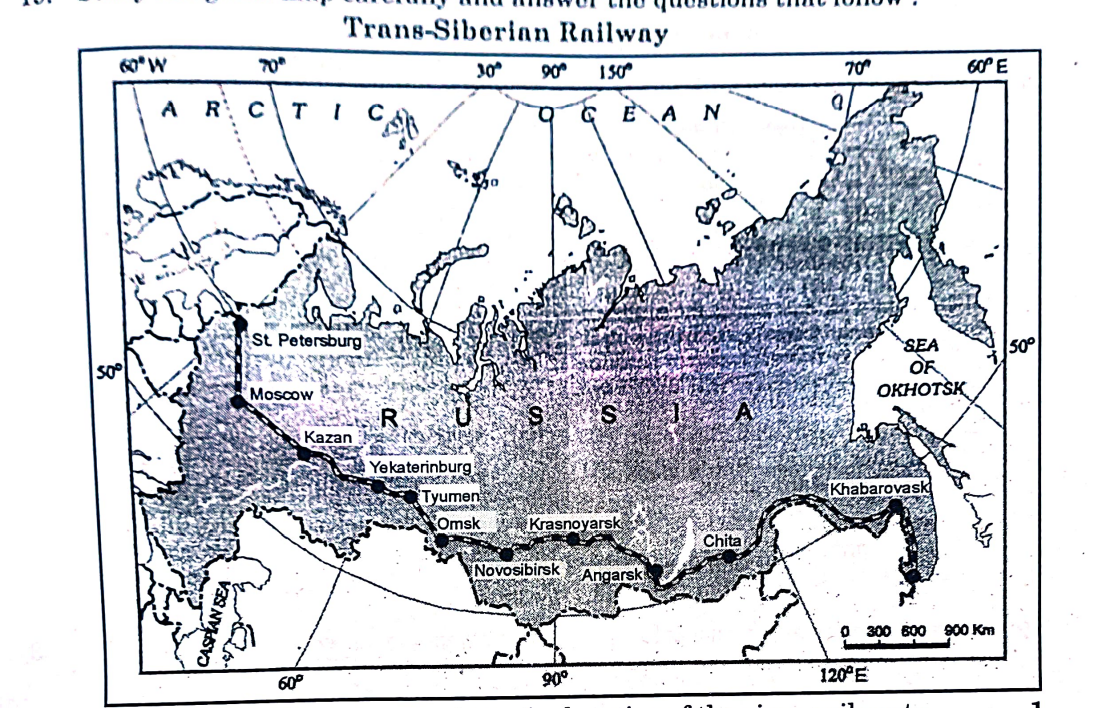
Q19. Study the given map carefully and answer the questions that follow :
Trans-Siberian Railway
(19.1) Name the easternmost terminal station of the given rail route.
(19.2) Name the most important agro centre along the rail route.
(19.3) Name the Sea near to the westernmost terminal station.
Note : Following question is for Visually Impaired Candidates only in lieu for Question No. 19. Describe any three features of 'Trans-Siberian Railway'. [3]
Answer: (19.1) Vladivostok (eastern terminal; on this map the easternmost labeled station is Khabarovask)
(19.2) Novosibirsk (a major agro/industrial centre on the route).
(19.3) Baltic Sea (near the western terminal St. Petersburg).
For visually impaired: Any three features — (i) It is the longest trans-continental railway linking European Russia with the Far East. (ii) It connects major cities/industrial centres (e.g., Moscow, Novosibirsk, Irkutsk region, etc.). (iii) It is vital for transport of wheat, minerals, timber and manufactured goods and supports Russia’s internal integration and international trade.
Section C — Short Answer Questions (80–100 words each)
Q20. (a) "International trade is mutually beneficial to nations." Support the statement with suitable arguments.
OR
(b) "Global sea ports are the gateways of international trade." Support the statement with suitable arguments. [3]
Answer: (a) International trade benefits nations because each country specialises in goods/services where it has comparative advantage, leading to lower costs and better quality. Trade widens the market, increases production and employment, earns foreign exchange, and enables access to resources/technology not available domestically. It promotes competition and efficiency, and helps stabilise supply by importing during shortages.
(b) Global seaports act as gateways because the bulk of world trade moves by sea due to low per‑unit transport cost. Ports provide infrastructure—harbours, container terminals, warehouses, customs, and multimodal links—so goods can be loaded/unloaded, stored, processed and distributed. Efficient ports reduce logistics cost, connect hinterlands to global markets, and therefore drive international trade.
Q21. Explain the importance of the 'Northern Atlantic Sea Route'. [3]
Answer: The North Atlantic Sea Route links the highly industrialised regions of Western Europe with the eastern coast of North America. It is one of the world’s busiest and most important sea routes because it connects major ports, dense population centres and large markets on both sides of the Atlantic. The route supports massive trade in manufactured goods, machinery, petroleum products, food grains and raw materials. It also has well‑developed port facilities and year‑round navigation with modern shipping and communication services.
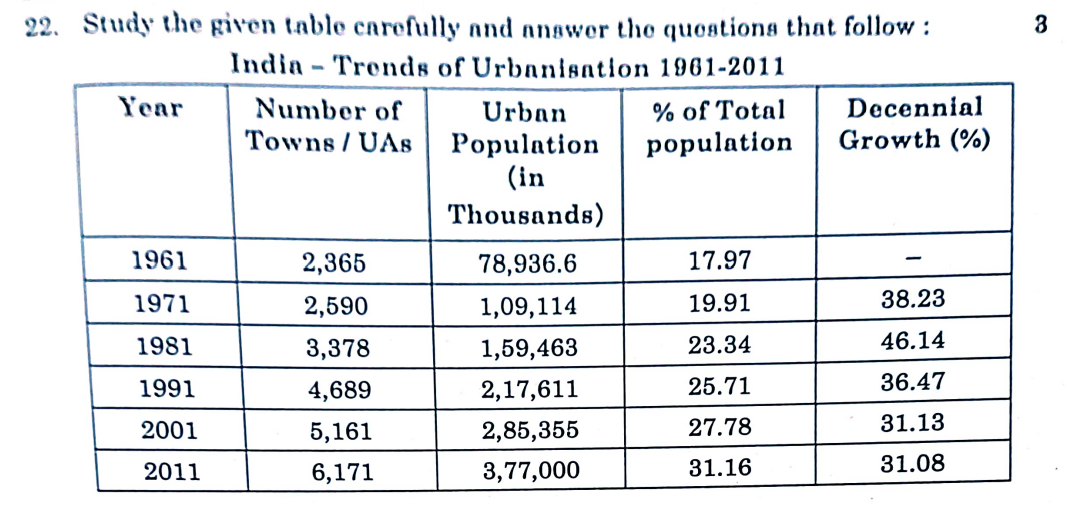
Q22. Study the given table carefully and answer the questions that follow : India - Trends of Urbanisation 1961–2011
22.1 During which decade, the net increase in number of towns/UAs is the lowest?
22.2 Mention the net increase in number of towns/UAs during 1981–91.
22.3 Explain the decennial growth rate of urban population. [3]
Answer: 22.1 The lowest net increase is during 1961–1971 (increase of 225 towns/UAs).
22.2 The net increase during 1981–1991 is 1,311 towns/UAs (4,689 − 3,378).
22.3 Decennial growth rate of urban population means the percentage increase in urban population over a decade. It is calculated as: (Urban population at end − at beginning) ÷ (Urban population at beginning) × 100. It reflects the pace of urbanisation through natural increase, rural‑urban migration, and reclassification/expansion of urban areas.
For Complete Set-wise solutions, kindly access the given PDF
Significance of CBSE Class 12 Geography Answer Key
-
Helps students cross-check their responses after the examination.
-
Allows estimation of expected scores before official results are declared.
-
Assists in identifying mistakes in MCQs, map-based, case-study, and long-answer questions.
-
Supports self-evaluation and error analysis for better understanding.
-
Provides clarity on the exam pattern and marking scheme.
-
Useful for strengthening concepts for future academic and competitive exams.
CBSE Class 12 Geography: Chapter-Wise Exam Pattern & Marking Scheme
The table outlines the CBSE 12th Geography exam pattern:
| CBSE Class 12 Geography: Chapter-Wise Exam Pattern & Marking Scheme | |||
| Section | Question Number | Type of Question | Marks per Question |
| Section A | 1-17 | Multiple Choice Questions (MCQs) | 1 mark |
| Section B | 18-19 | Source-based Questions | 3 marks |
| Section C | 20-23 | Short Answer Type Questions | 3 marks |
| Section D | 24-28 | Long Answer Type Questions | 5 marks |
| Section E | 29-30 | Map-based Questions | 5 marks |
CBSE Class 12 Geography Answer Key 2026 FAQs
When was the CBSE Class 12 Geography exam conducted in 2026?
The Class 12 Geography exam was conducted on 26th February 2026 across CBSE-affiliated schools.
Where can I download the CBSE Class 12 Geography Answer Key 2026?
Students can download the unofficial answer key from the CBSE website or other educational portals immediately after the exam to check their responses.
What is the significance of using the Geography Answer Key?
The answer key helps students cross-check responses, estimate scores, perform error analysis, identify keywords, understand marking distribution, and improve preparation for upcoming exams.
How is the Class 12 Geography exam structured and marked?
The exam includes MCQs, short answer, long answer, and map-based questions, with marks allocated per section. Sections range from 1 mark (MCQs) to 5 marks (long answer and map-based questions), with a total of 70 theory marks + 30 internal assessment/practical.
Free Learning Resources
PW Books
Notes (Class 10-12)
PW Study Materials
Notes (Class 6-9)
Ncert Solutions
Govt Exams
Our Other Websites
Class 6th to 12th Online Courses
Govt Job Exams Courses
UPSC Coaching
Defence Exam Coaching
Gate Exam Coaching
Other Exams
Know about Physics Wallah
Physics Wallah is an Indian edtech platform that provides accessible & comprehensive learning experiences to students from Class 6th to postgraduate level. We also provide extensive NCERT solutions, sample paper, NEET, JEE Mains, BITSAT previous year papers & more such resources to students. Physics Wallah also caters to over 3.5 million registered students and over 78 lakh+ Youtube subscribers with 4.8 rating on its app.
We Stand Out because
We provide students with intensive courses with India’s qualified & experienced faculties & mentors. PW strives to make the learning experience comprehensive and accessible for students of all sections of society. We believe in empowering every single student who couldn't dream of a good career in engineering and medical field earlier.
Our Key Focus Areas
Physics Wallah's main focus is to make the learning experience as economical as possible for all students. With our affordable courses like Lakshya, Udaan and Arjuna and many others, we have been able to provide a platform for lakhs of aspirants. From providing Chemistry, Maths, Physics formula to giving e-books of eminent authors like RD Sharma, RS Aggarwal and Lakhmir Singh, PW focuses on every single student's need for preparation.
What Makes Us Different
Physics Wallah strives to develop a comprehensive pedagogical structure for students, where they get a state-of-the-art learning experience with study material and resources. Apart from catering students preparing for JEE Mains and NEET, PW also provides study material for each state board like Uttar Pradesh, Bihar, and others
Copyright © 2026 Physicswallah Limited All rights reserved.