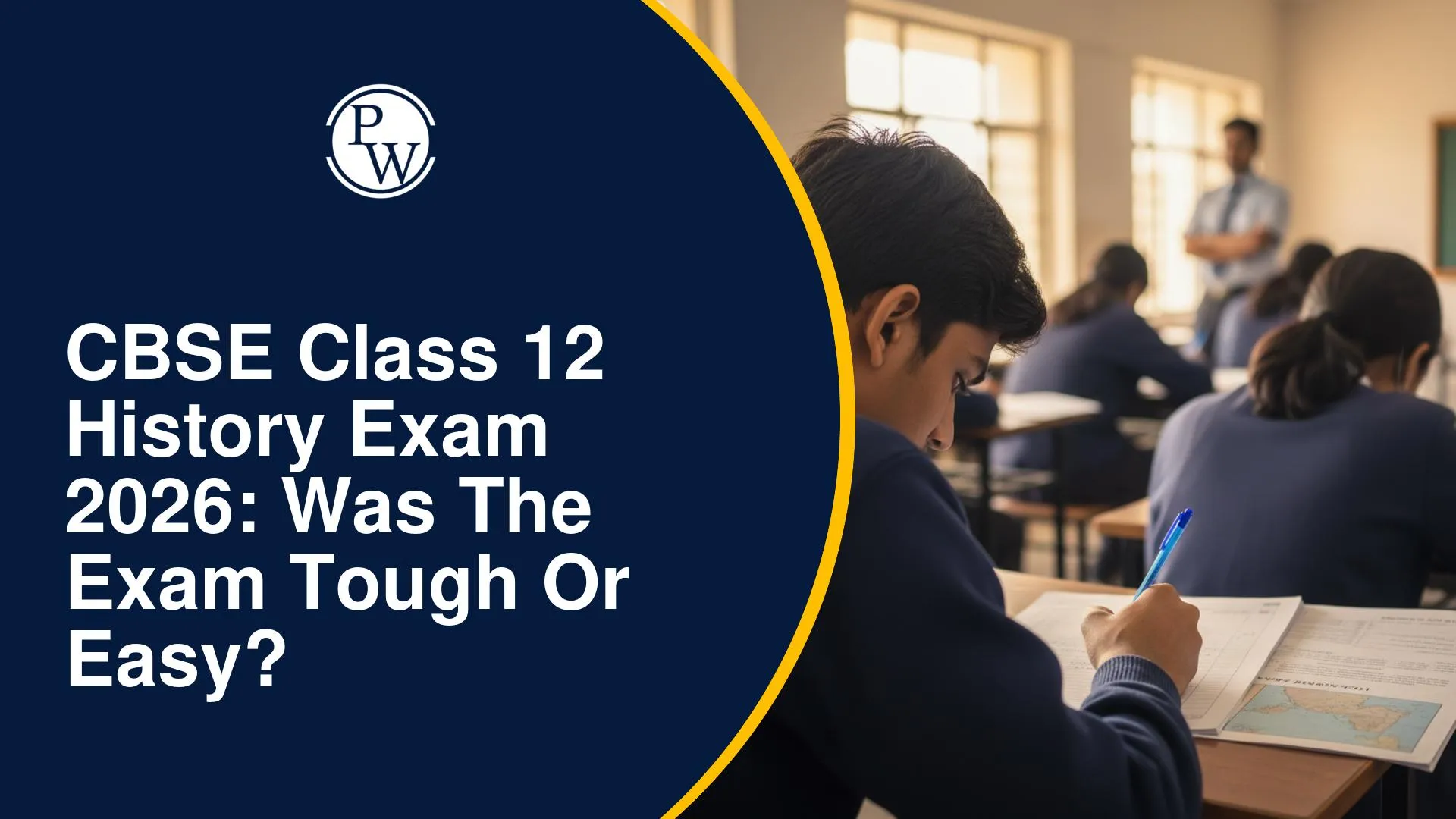
CBSE Class 12 History Exam 2026 was conducted successfully on 30 March 2026 from 10:30 AM to 1:30 PM, and soon after the exam concluded, students and teachers began sharing their detailed feedback. As one of the most important subjects for humanities students, History not only tests memory but also evaluates a student’s ability to analyse, interpret, and present answers in a structured format. This year’s paper followed a balanced approach, combining direct questions with analytical and source-based questions.
Overall, the exam can be classified as moderate in difficulty. It was neither too easy nor excessively tough, but it required a clear understanding of concepts along with effective writing skills. Students who relied only on rote learning found some sections challenging, especially those requiring interpretation and explanation.
CBSE Class 12 History Exam 2026: Easy, Moderate, or Tough?
Based on initial reactions and teacher analysis, the difficulty level can be understood as follows:
-
Overall Level: Moderate
-
Nature of Questions: Mix of direct, conceptual, and analytical
-
Paper Length: Slightly lengthy for some students
-
Scoring Opportunities: Present in objective and short-answer sections
The paper was designed in a way that tested not just factual knowledge but also a student’s ability to connect historical events, interpret sources, and present well-structured answers. Students who had practiced answer writing and revised NCERT thoroughly found the paper manageable.
Section-Wise Breakdown: What Students Should Know?
Understanding the section-wise difficulty helps students evaluate their performance better.
Section A: Easy to Moderate
Section A included objective-type questions such as MCQs, which were mostly straightforward and directly based on NCERT content.
-
Questions were fact-based and direct
-
Covered important topics from the syllabus
-
Required basic understanding rather than deep analysis
Most students found this section easy and scoring, which helped build confidence at the beginning of the exam. Those who had revised NCERT properly were able to attempt this section quickly and accurately.
Section B: Easy to Moderate
This section consisted of short-answer questions that required brief explanations.
-
Questions were concept-based but simple
-
Answers required clarity but not lengthy writing
-
Direct linkage to textbook concepts
Students who had a basic understanding of key topics found this section manageable. It acted as a bridge between objective and more analytical sections.
Section C: Moderate
Section C marked a slight increase in difficulty, requiring students to explain answers in more detail.
-
Questions required clear explanation and examples
-
Some questions were slightly tricky
-
Focus on understanding rather than memorisation
Students needed to present their answers clearly and logically. Those who had practiced writing structured answers performed better in this section.
Section D: Moderate to Difficult
This section included long-answer questions, which tested analytical and descriptive skills.
-
Required in-depth knowledge of topics
-
Focus on answer structure and presentation
-
Time-consuming due to length of answers
Many students found this section challenging because it demanded not just knowledge but also the ability to organise answers effectively. Time management became crucial here.
Section E: Moderate to Tough
Section E included case-based or source-based questions, which were considered the most challenging.
-
Required interpretation of historical sources
-
Tested analytical and critical thinking skills
-
Needed careful reading and understanding
Students who were not comfortable with source-based questions found this section difficult. However, those who had practiced such questions were able to handle it better.
CBSE 12th History Section-wise Difficulty
Students can check the section-wise difficulty level of CBSE 12th board History exam below:
|
CBSE Class 12th History Section Wise Difficulty Level |
|
|
Section |
Difficulty Level |
|
Section A |
Easy to Moderate |
|
Section B |
Easy to Moderate |
|
Section C |
Moderate |
|
Section D |
Moderate to Difficult |
|
Section E |
Moderate to Tough |
Student Reactions and Teacher Analysis of CBSE Class 12 Biology Exam 2026
Students and teachers both provided valuable insights into the exam. Their feedback helps in understanding the overall nature of the paper.
Student Reactions
Students had mixed but largely balanced reactions to the paper:
-
“The paper was balanced but slightly lengthy”
-
“MCQs and short answers were easy, but long answers took time”
-
“Case-based questions were tricky and required more thinking”
-
“Not very tough, but required proper preparation”
Many students felt that the paper was fair but demanded focus and time management.
Teacher Analysis
Teachers and subject teachers provided a detailed analysis of the paper:
-
The exam strictly followed the latest CBSE pattern
-
Questions were largely NCERT-based
-
Emphasis was on conceptual clarity and analytical ability
-
Answer-writing skills played a key role in scoring
According to teachers, students who had prepared thoroughly and practiced previous year questions could score well in this exam.