
The CBSE Class 12 Physics Board Exam 2026 is scheduled for tomorrow (February 20, 2026), which means students are now in the most important stage of preparation. With very limited time left, revision must be focused, strategic, and exam-oriented.
One of the smartest ways to boost scores quickly is by practicing CBSE Class 12 Physics MCQ Questions With Answers daily.
In recent years, CBSE has increased the weightage of competency-based questions, including MCQs and case-study questions.
Class 12 Physics 25 Most Expected Questions
These questions test conceptual clarity, logical reasoning, and formula application. Practicing the Most Important Class 12 Physics MCQ Questions With Answers helps improve speed, accuracy, and confidence before the final exam.
Last Minute Revision for CBSE Class 12 Physics
CBSE Class 12 Physics MCQ Questions With Answers
Solving CBSE Class 12 Physics MCQ Questions With Answers allows students to revise entire chapters quickly and efficiently.
Important chapters frequently asked in MCQ format include Electrostatics, Current Electricity, Magnetism, Ray and Wave Optics, Dual Nature of Radiation and Matter, Atoms, Nuclei, and Semiconductor Electronics.
The Most Important Class 12 Physics MCQ Questions With Answers are given here:
1. When a body is connected to the earth, then electrons from the earth, flow into the body. It means that the body is [Delhi 2021]
(A) unchanged
(B) an insulator
(C) positively charged
(D) negatively charged
Sol. When a positively charged body is connected to the earth, then electrons from the earth flow into the body. Thus (C) is correct option.
2. Three charges, each equal to +q, are placed at the corners of an equilateral triangle. If the force between any two charges is F, then net force on either charge will be [SQP 2004]
(A) 2F
(B) 3F
(C) 2F
(D) 3F
Sol. (D)
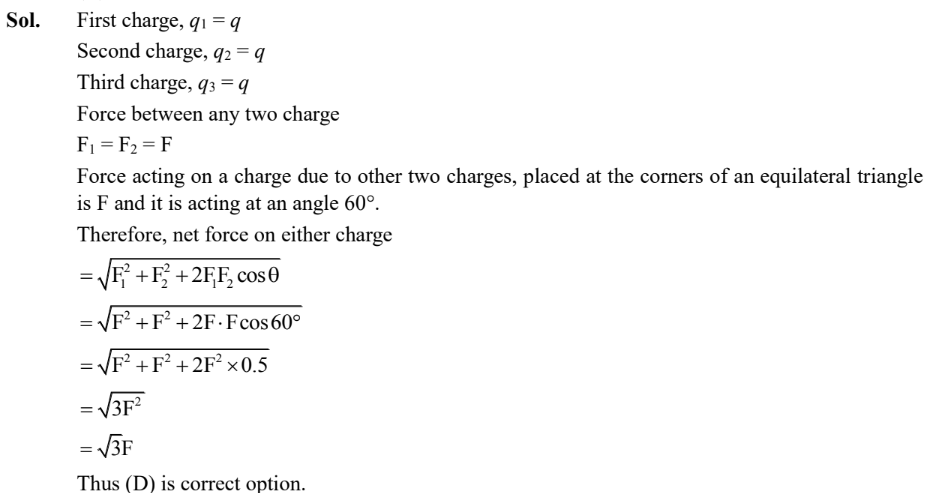
3. 
Sol. 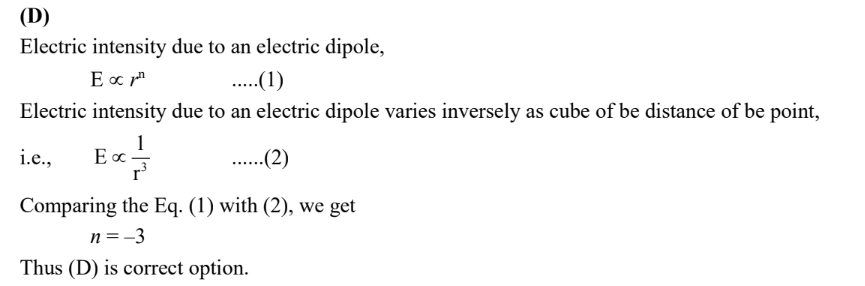
4. Two plates of a parallel plate capacitor are 1 cm apart and potential difference between them is 10 V. The electric field between the plates is [Foreign 2017, Delhi 2002]

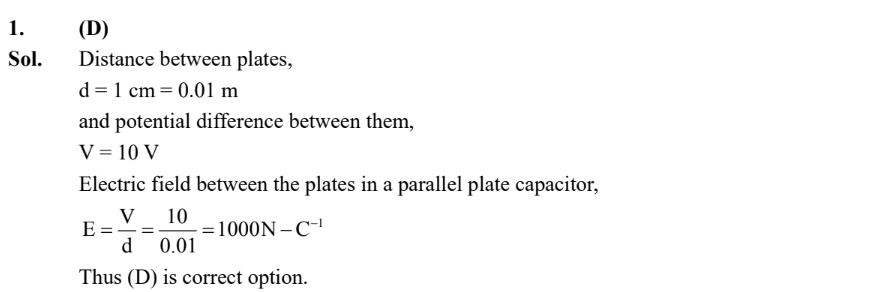
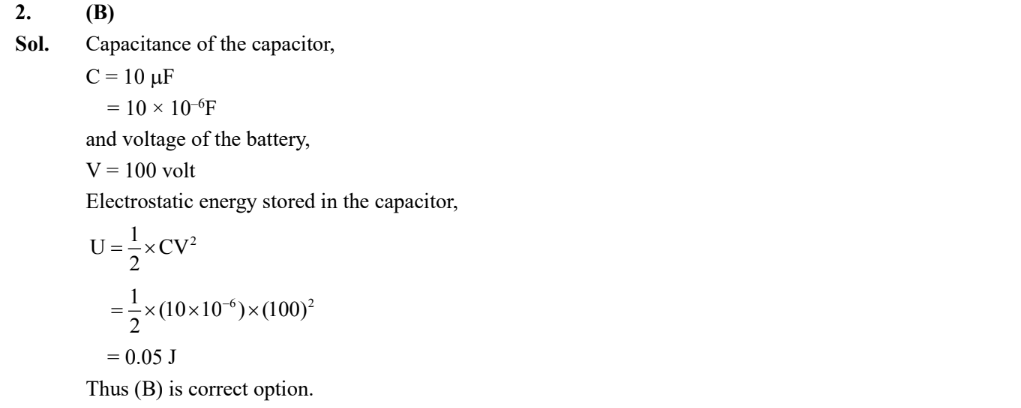
5. A 10 F capacitor is charged by a battery of e.m.f. 100 V. The electrostatic energy stored in the capacitor is [Delhi 2021]
(A) 0.5 J
(B) 0.05 J
(C) 0.5 mJ
(D) 0.05 mJ
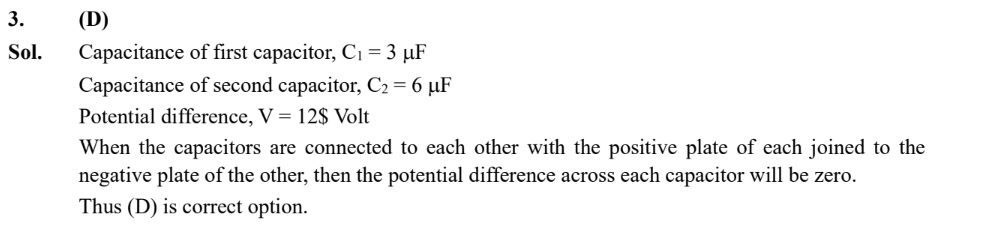
6. Two capacitors of capacitances 3 F and 6 F are charged to a potential of 12 V each. They are now connected to each other, with the positive plate of each joined to the negative plate of the other. The potential difference across each capacitor will be [OD 2002]
(A) 6 V
(B) 4 V
(C) 3 V
(D) Zero
7. Which element is used in electric heater? [Foreign 2017]
(A) Copper
(B) Platinum
(C) Tungsten
(D) Nichrome
Sol. (D)
Nichrome is used in electric heater because of the following reasons:
1. Its melting point is high.
2. Its resistivity is large.
3. It is not easily oxidised by the oxygen of the air when heated.
Thus (D) is correct option.
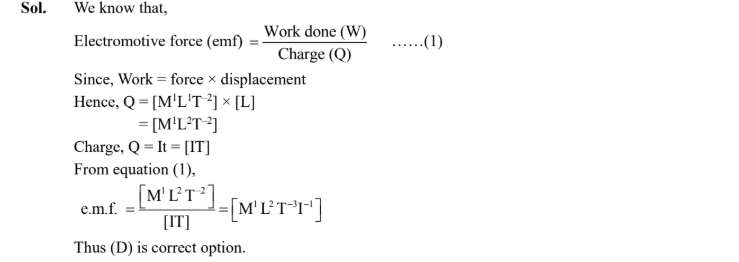
8. Dimension of electromotive force (e.m.f.) is. [Delhi 2002]

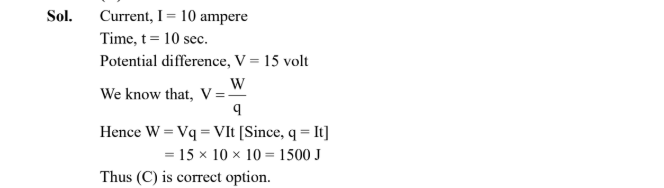
9. A current of 10 ampere flows in a wire for 10 sec. It potential difference across the wire is 15
volt, the work done will be [OD 2012, SQP 2004]
(A) 150
(B) 75 J
(C) 1500 J
(D) 750 J
10. A proton is moving in a space with constant velocity in an electric field E and magnetic field B. The angle between electric field and magnetic field should be [Delhi 2015]
(A) 0°
(B) 30°
(C) 45°
(D) 90°
Sol. (D)
When a charged particle (i.e., proton) is moving in space with a constant velocity in electric field E and magnetic field B, then angle between electric field and magnetic field should be 90°. Thus (D) is correct option.
11. Magnetic field due to a long straight conductor of length l, carrying current I, at a point, distance d from it is given by

Sol. (A)
Length of the straight conductor = l
Current in the conductor = I
and distance of the point from it = d
The magnetic field at a point due to a long current-carrying conductor,

12. On connecting a battery to the two corners of a diagonal of a square conductor frame of side a, the magnitude of magnetic field at the centre will be

Sol. (A)
When a battery is connected two corners of a diagonal of a square conductor frame, then the conductor frame can be taken as two sets of parallel wires carrying currents in the same direction.
Magnetic field at the centre due to two parallel wires carrying currents in the same direction will be equal in magnitude, but opposite in directions. Therefore, magnitude of the magnetic field at the centre will be zero. Thus (A) is correct option.
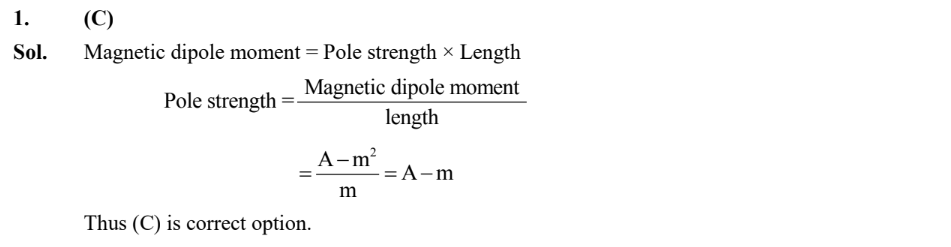
13. S.I. unit of pole strength is [OD 2017, 2010]
(A) N
(B) N/A-m
(C) A-m
(D) T
14. Which of the following is an example for diamagnetic substances? [OD 2014]
(A) copper
(B) nickel
(C) aluminium
(D) iron
Sol. (A)
Copper is an example of diamagnetic substance. And nickel, aluminium, iron are substances. Thus (A) is correct option.
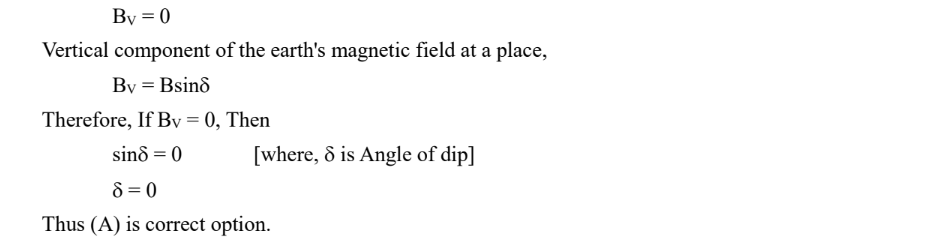
15. The vertical component of the earth's magnetic field is zero at a place where the angle is dip is [Foreign 2019]
(A) 0°
(B) 45°
(C) 60°
(D) 90°
Sol. (A)
Given:
Vertical component of earth's magnetic field,
16. The Lenz's law gives [Foreign 2014]
(A) direction of induced E.M.F.
(B) magnitude of induced E.M.F.
(C) direction of induced current
(D) magnitude of induced current
Sol. (C)
Lenz's law gives the direction of the induced current in electromagnetic induction. According to this law, the direction of induced current is such that it opposes the cause which produces it. Thus (C) is correct option.
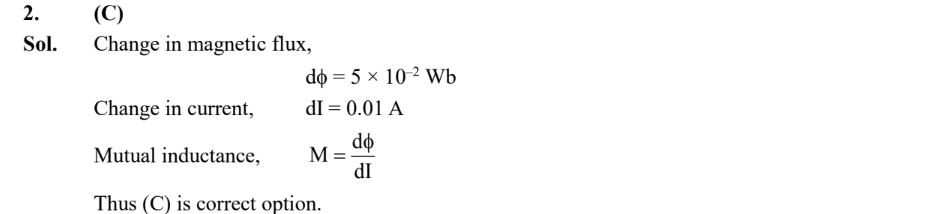
17. The mutual inductance, when the magnetic flux changes by 5×10⁻² Wb and current change by 0.01 A, is [OD 2004]
(A) 0.2 H
(B) 2.5 H
(C) 5 H
(D) 10 H
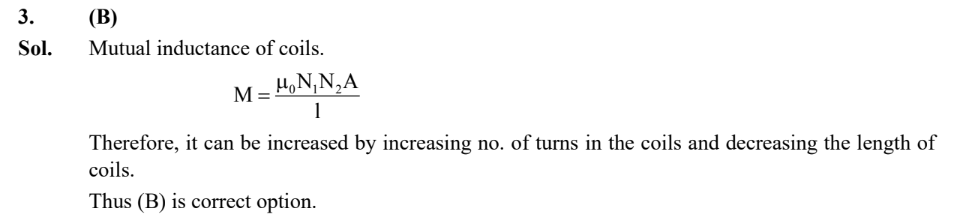
18. The mutual inductance of two coils can be increased by [Delhi 2014]
(A) increasing the length of coils
(B) increasing the no. of turns in the coils
(C) winding the coils on wooden cores
(D) decreasing the no. of turns in the coils
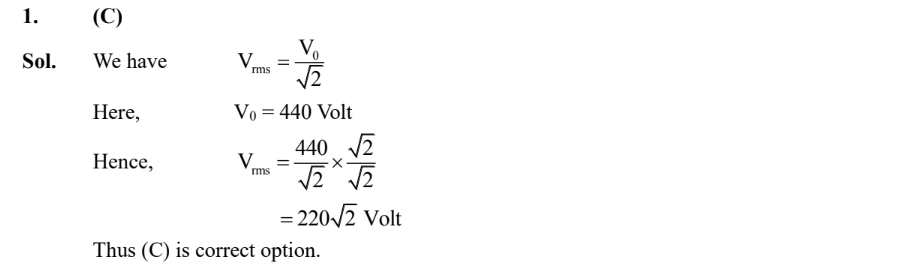
19. The peak voltage of an AC is 440 volt. Its virtual voltage is [OD 2012]

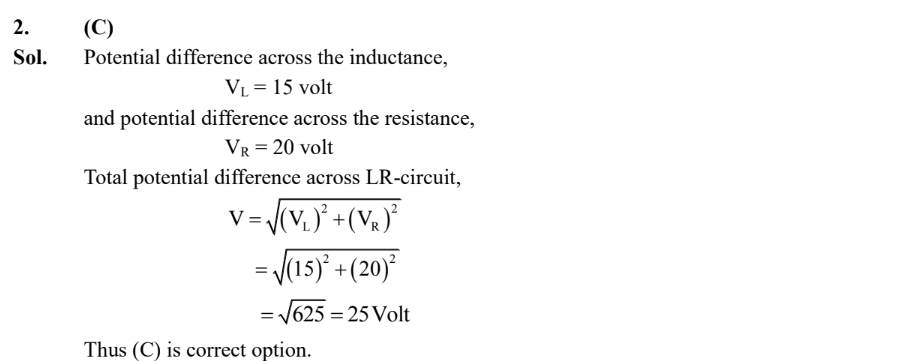
20. In an AC circuit, the potential difference across an inductance and resistance joined in series are 15 V and 25 V respectively. [Foreign 2005]
(A) 15 V
(B) 20 V
(C) 25 V
(D) 50 V
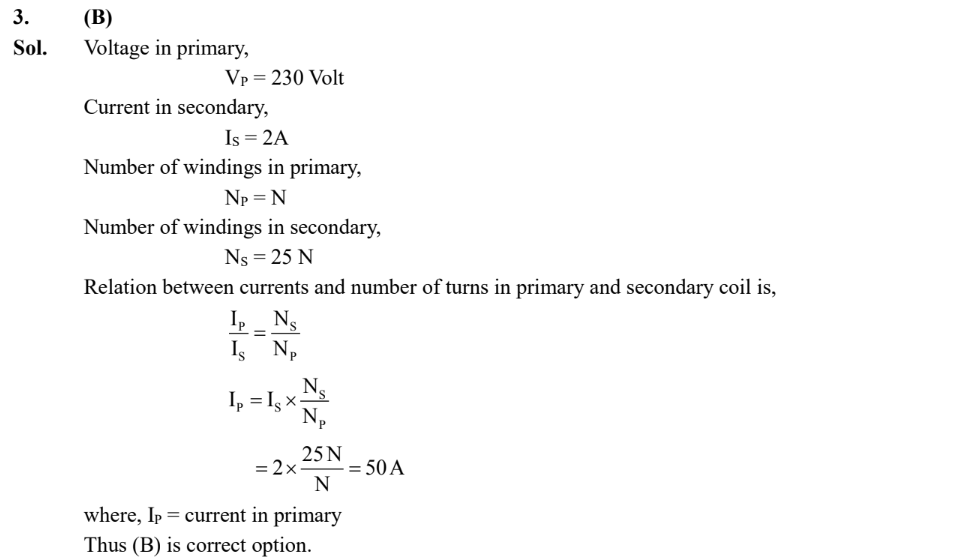
21. A step-up transformer operates on a 230 V line supplies a current of 2A. The ratio of primary and secondary winding is 1: 25. The current in the primary is [Foreign 2004, Delhi 2015]
(A) 15 A
(B) 50 A
(C) 75 A
(D) 125 A
22. The energy of emitted photo electron depends upon [Delhi 2001, SQP 2014]
(A) Intensity of light
(B) Wavelength of light
(C) Work-function of metal
(D) None of these
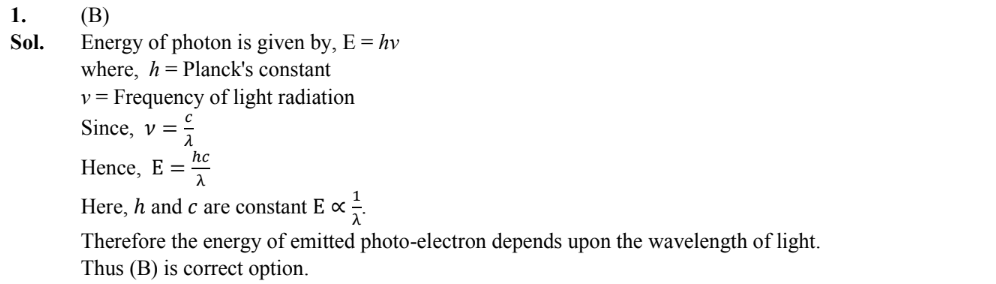
23. Mass of a photon of frequency ν is given by

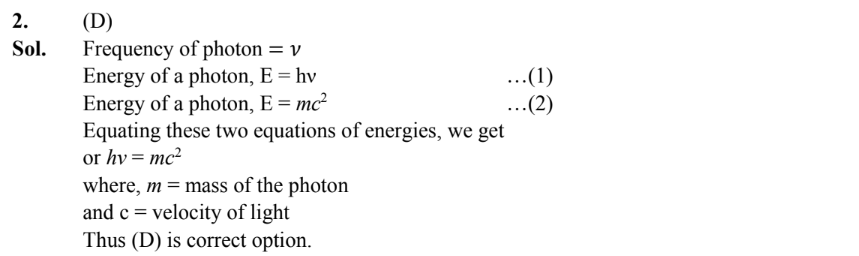
24. If the intensity of light falling on a metal is increased, then [Delhi 2016]
(A) K.E. of photoelectrons increases
(B) photoelectric current increases
(C) K.E. of photoelectrons decreases
(D) photoelectric current remains constant
(B)
Sol. For a given photosensitive material and frequency of incident radiation above the threshold frequency, emission of photoelectrons (i.e., photoelectric current) is directly proportional to the intensity of the incident light. Therefore if the intensity of light falling on a metal is increased, then photoelectric current will also increase. Thus (B) is correct option.
25.

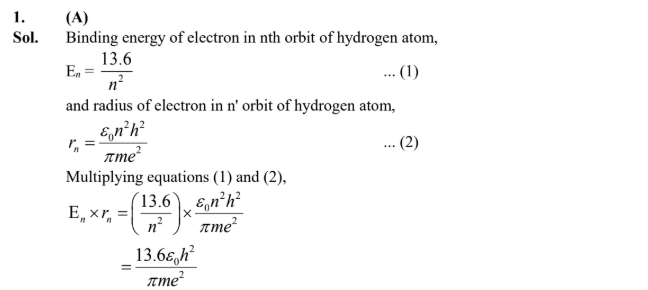
Thus, it is independent of n. Thus (A) is correct option.

(D)
Sol. Total energy of hydrogen atom in ground state,
E = –13.6 eV
Potential energy of the electron in ground state,
P = 2 × E
= 2 × (–13.6) = –27.2 eV
Thus (D) is correct option.
27. The total energy of an electron in the first excited state of hydrogen atom is about –3.4eV. Its kinetic energy in this state is [SQP 2010]
(A) –3.4 eV
(B) 3.4 eV
(C) –6.8 eV
(D) 6.8 eV
(B)
Sol. Total energy of electron in first excited state,
E = –3.4 eV
Kinetic energy of electron in first excited state,
EK = – E = – (–3.4) = 3.4 eV
Thus (B) is correct option.
28. Elements having different atomic number as well as different mass number, but same number of neutrons, are known as [OD 2007]
(A) isobars
(B) isotones
(C) isotopes
(D) isodiapheres
1. (B)
Sol. The elements having different atomic number as well as different mass number, but same number of neutrons, are known as isotones. Thus (B) is correct option.
29. If M is the atomic mass and A is the mass number, then the packing fraction is given by [SQP 2010]

2. (B)
Sol. Atomic mass = M and
Mass number = A
Packing fraction is the ratio of atomic mass M minus mass number A to the mass number A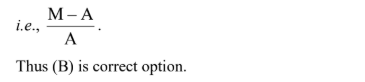
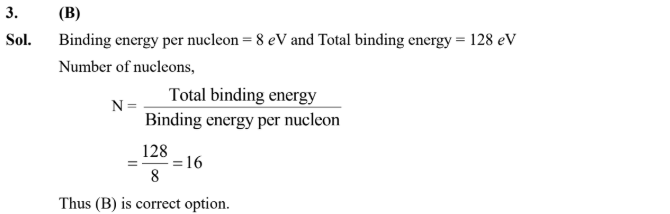
30. An element has binding energy 8 eV per nucleon. If it has total binding energy of 128 eV, then the number of nucleons are [Delhi 2011]
(A) 8
(B) 16
(C) 32
(D) 64
Last-Minute MCQ Preparation Strategy For Class 12th Physics
With the exam scheduled for tomorrow, follow this urgent revision plan:
-
Revise all formulas every morning.
-
Practice at least 30 mixed MCQs daily.
-
Attempt one full-length sample paper under timed conditions.
-
Focus on weak chapters first.
-
Review incorrect answers immediately.
Solving Most Important Class 12 Physics MCQ Questions With Answers under timed conditions simulates the real exam environment and builds confidence.
CBSE Class 12 Physics Notes Chapter 1 Electric Charges and Fields FAQs
Why are MCQs important for CBSE Class 12 Physics?
What types of MCQs are generally asked in Class 12 Physics?
How can practicing MCQs help in board exams?
Are these MCQs aligned with the latest CBSE syllabus for 2026?


Have questions about your prep?
Our experts can answer all your questions