







PW Class 7 Science Notes: Light: Shadows and Reflections
 Mehjabeen Hussain16 Sept, 2026
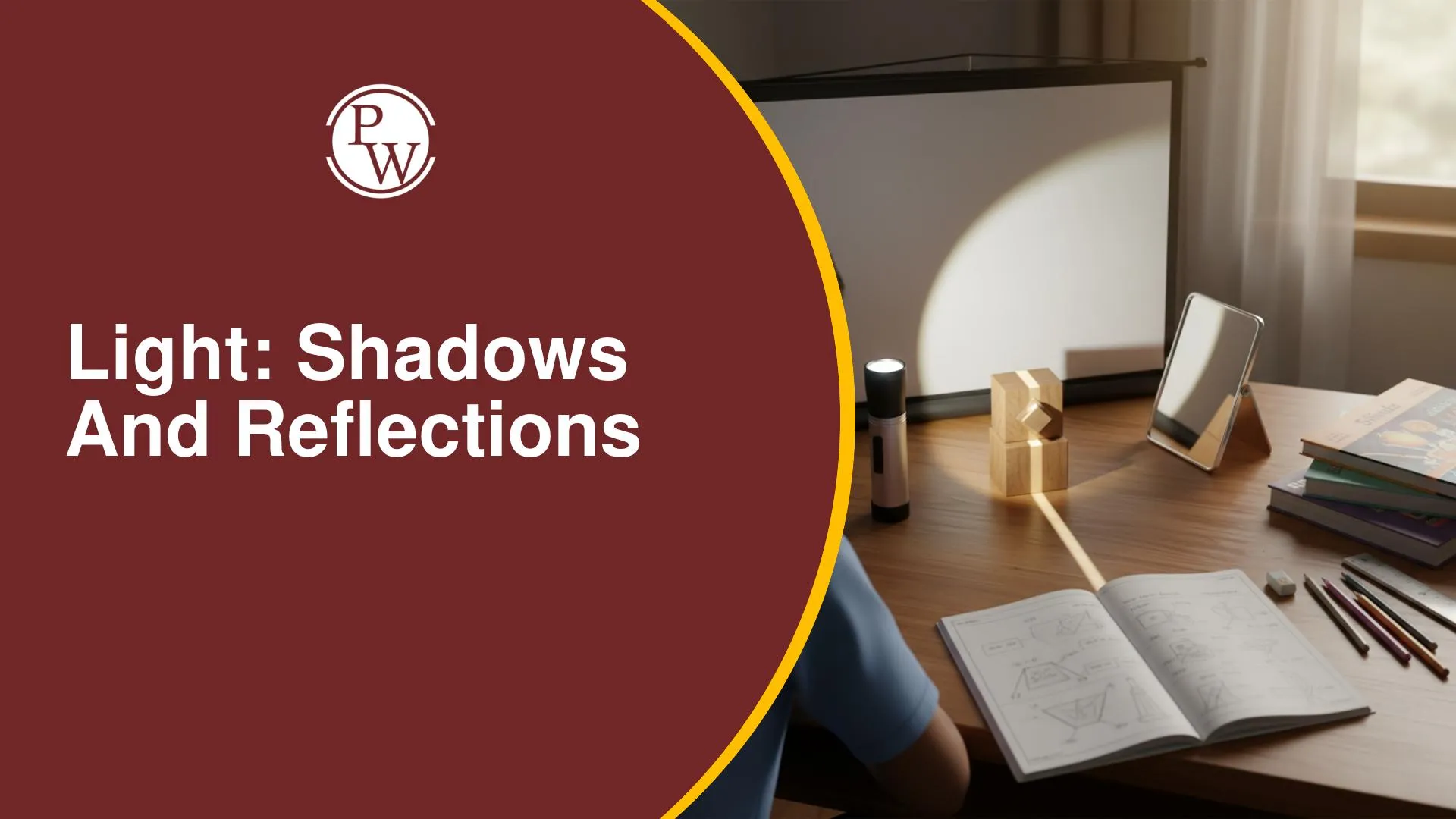
Light helps us see objects around us, while shadows are formed when an opaque object blocks the path of light. The notes also explain how light changes its direction when it falls on a reflecting surface and how mirrors form images.
PW Class 7 Science notes cover important concepts, definitions, examples, and key differences from the chapter. They can help Class 7 students revise the behaviour of light, formation of shadows, and reflection before tests and examinations.
What is Light?
Light is a form of energy that enables us to see objects. Objects that produce their own light are called luminous objects, while non-luminous objects become visible by reflecting light. The chapter Light: Shadows and Reflections explains the straight-line travel of light, formation of shadows, reflection, and the working of simple optical instruments.
Luminous and Non-Luminous Objects
Objects can be classified according to whether they produce their own light or reflect light from another source.
|
Object Type |
Definition |
Examples |
|
Luminous Objects |
Objects that produce their own light |
Sun, electric bulb, candle |
|
Non-Luminous Objects |
Objects that reflect light falling on them |
Book, table, Moon |
Rectilinear Propagation and Shadows
Light travels along straight paths. This property is known as rectilinear propagation of light.
When an opaque object blocks the path of light, it forms a dark region called a shadow. A shadow requires a source of light, an opaque object, and a screen or surface on which the shadow can form.
Transparent, Translucent and Opaque Objects
Materials differ in the way they allow light to pass through them.
-
Transparent objects: Allow light to pass through them clearly.
-
Translucent objects: Allow some light to pass through them.
-
Opaque objects: Do not allow light to pass through them.
Reflection of Light
Reflection is the process in which light bounces back from a surface. Smooth surfaces produce regular reflection and can form clear images, whereas rough surfaces scatter light in different directions and produce diffused reflection.
Plane Mirrors
A plane mirror is a flat reflecting surface that forms an image of an object. The image formed by a plane mirror is erect, virtual, and of the same size as the object. It is formed at the same distance behind the mirror as the object is in front of it. The image also shows lateral inversion, in which the left and right sides appear reversed.
Optical Instruments
Simple optical instruments use the properties of light and reflection to produce or view images.
-
Pinhole Camera: Uses the straight-line travel of light to form a real, inverted, and smaller image.
-
Periscope: Uses two plane mirrors placed at 45° angles to help observe objects that are blocked from direct view.
-
Kaleidoscope: Uses three plane mirrors inclined at 60° angles to produce symmetrical patterns.
Key Rules of Light
The behaviour of reflected light can be explained using specific laws and principles.
Laws of Reflection
Reflection follows two important laws:
-
Law 1: The angle of incidence is equal to the angle of reflection.
∠i = ∠r -
Law 2: The incident ray, reflected ray, and normal at the point of incidence all lie in the same plane.
Light: Shadows and Reflections Class 7 Notes PDF
The Light: Shadows and Reflections Class 7 Notes PDF by PW explains the key concepts covered in the chapter, including the behaviour of light, formation of shadows, and reflection. It also highlights essential terms, examples, and concepts for easier understanding and revision.
Light: Shadows and Reflections Class 7 Notes PDF
Study without using the internet
Why Choose PW Light: Shadows and Reflections Notes for Class 7?
The chapter introduces important ideas about how light travels, how shadows are formed, and how reflection allows us to see images in mirrors and other surfaces. Notes can make it easier to review these concepts and remember the key points from the chapter.
1. Learn About Light
Understand the basic role of light in helping us see objects and identify common sources of light.
2. Identify Different Sources of Light
Revise examples of natural and artificial sources of light and understand how they provide light.
3. Understand Transparent and Opaque Objects
Learn how different objects behave when light falls on them, including objects that allow light to pass through and those that block it.
4. Understand How Shadows Are Formed
Learn why a shadow appears when an opaque object comes in the path of light and blocks it.
5. Revise the Conditions for a Shadow
Remember the three main requirements for forming a shadow: a source of light, an object that blocks light, and a surface on which the shadow falls.
6. Learn About the Size of Shadows
Understand how the position of an object in relation to the light source can affect the size of its shadow.
7. Understand Reflection of Light
Revise how light behaves when it falls on a surface and is reflected back.
8. Learn About Mirrors and Images
Understand how mirrors reflect light and allow us to see images of objects.
9. Compare Shadows and Reflections
Differentiate between a shadow, which forms when light is blocked, and a reflection, which results when light bounces back from a surface.
10. Remember Important Terms
Use the notes to revise key terms such as light, shadow, transparent, opaque, reflection, mirror, and image.
The chapter Light: Shadows and Reflections explains how light travels, interacts with different materials, forms shadows, and undergoes reflection. Understanding these concepts helps students relate the behaviour of light to everyday observations such as shadows, mirrors, and simple optical instruments. Reviewing the key principles, types of objects, and laws of reflection can strengthen conceptual understanding of the chapter.
You may also like:
-
CBSE Class 7 Science Notes
-
CBSE Class 7 Science Important Questions
-
CBSE Class 7 Science Sample Papers
FAQs
What is Light: Shadows and Reflections about?
How is a shadow formed?
What are the requirements for forming a shadow?
What is reflection of light?






 Live & recorded classes available at easeDashboard for progress trackingMillions of practice questions at your fingertips

