







Chapter 4 A Tale of Valour NCERT Solutions is an important part of Class 8 English that highlights courage, patriotism, and sacrifice. The chapter narrates the heroic story of Major Somnath Sharma and his role in the Battle of Badgam.
Through this inspiring lesson, students learn about determination and selfless service to the nation. Understanding A Tale of Valour solutions not only helps in exams but also builds strong moral values.
Chapter 4 A Tale of Valour NCERT Solutions
The section on A Tale of Valour question answers focuses on helping students understand the key events, characters, and themes of the chapter in a simplified manner. These answers explain the bravery and leadership of Major Somnath Sharma and highlight the significance of the Battle of Badgam in India’s history.
A Tale of Valour Question Answers
By going through these A Tale of Valour solutions, students can improve their comprehension skills, learn how to frame accurate answers, and prepare effectively for exams. The explanations are designed to be clear and concise, ensuring better retention and understanding of the chapter.
Let us do these activities before we read.
1.Work in pairs. Share your answers with your classmates and teacher.
Question 1. What do you think about the Republic Day Parade on 26 January?
Answer: India became a republic on 26 January 1950, and this day is celebrated every year as Republic Day. To mark the occasion, a grand parade takes place at Rajpath in New Delhi. The President of India unfurls the National Flag during the celebration.
Question 2. What are the highlights of this parade?
Answer: A distinguished guest from another country is invited to attend the Republic Day parade. The armed forces participate in a march past, and different states present their cultural tableaux as part of the event.
Question 3. What bravery awards are given on this day, and who receives them?
Answer: On Republic Day, several bravery awards are presented, including the Param Vir Chakra, Mahavir Chakra, Vir Chakra, Ashoka Chakra, Kirti Chakra, and Shaurya Chakra. These honors are awarded to members of the armed forces.
II. Work in groups of four and discuss.
Question 1. What qualities do you think a soldier should have?
Answer: A soldier should possess qualities like bravery, discipline, and the ability to adjust to different situations in order to perform effectively.
Question 2. If you had to share a message with a soldier, what would it be?
Answer: I would tell a soldier that the entire nation respects and values their courage and readiness to sacrifice for the country. They always have the support and prayers of the people.
Let us discuss
I. Arrange the following events in chronological order. The first and the last events have been marked for you. Share your answers with your classmates and teacher.
-
Major Somnath Sharma was born in 1923 in Kangra, Himachal Pradesh. (1)
-
Even after losing Major Somnath Sharma, the soldiers fought bravely to save Srinagar for India.
-
The D Company, under the command of Major Somnath Sharma, was flown into Srinagar.
-
Major Somnath Sharma underwent training at the Royal Military College, Sandhurst.
-
Major Somnath Sharma requested air strikes to combat the enemy at Badgam.
-
Major Somnath Sharma was commissioned into the 19th Hyderabad Regiment in 1942.
-
Major Somnath Sharma was killed immediately after a mortar shell hit him.
-
Major Somnath Sharma was the first recipient of the Param Vir Chakra.
Answer: 1. → 4. → 6. → 3. → 5. → 7. → 2. → 8.
Let us think and reflect
I. Read the given extracts and answer the questions that follow.
Vastly outnumbered and facing devastating fire, Major Somnath Sharma and his men stood resolute. The air was thick with the sound of gunfire and the cries of battle, but Major Somnath Sharma’s voice cut through the chaos, urging his men to fight with tenacity and valour. Despite heavy casualties and his own injuries, Major Somnath Sharma displayed unparalleled bravery. He moved fearlessly through the battlefield, directing fire, filling magazines for his gunners, and encouraging his men to hold their ground.
1. What can be inferred about the conditions from the line: ‘The air was thick with gunfire...’
A. The gunshots had stopped for a while.
B. There was intense fighting on the battlefield.
C. The invaders were retreating from the fight.
D. The Indian soldiers had achieved victory.
Answer: B. There was intense fighting on the battlefield.
2. Complete the sentence with a suitable reason. Despite heavy casualties, Major Somnath Sharma continued to lead his men because .
Answer: he was deeply committed to his duty and wanted to inspire his soldiers to fight with courage and determination.
3. Select the correct option for both Assertion (A) and Reason (R) given below:
(A): Major Somnath Sharma moved fearlessly through the battlefield, even though he was injured.
(R): He believed his courage was important to motivate the soldiers.
A. Both (A) and (R) are true, and (R) is the correct explanation of (A).
B. Both (A) and (R) are true, but (R) is not the correct explanation of (A).
C. (A) is true, but (R) is false.
D. (A) is false, but (R) is true.
Answer: A. Both (A) and (R) are true, and (R) is the correct explanation of (A).
4. Fill in the blank with the correct word from those given in the brackets: Major Somnath Sharma was filling magazines, and encouraging his men to hold their ground despite . (injuries/worry)
Answer: injuries
Born on 31 January 1923, in the picturesque town of Dadh in Kangra, Himachal Pradesh, Somnath Sharma belonged to a family with a rich military legacy. His father, Major General Amar Nath Sharma, had served the nation with distinction, and young Somnath was deeply inspired by the valorous tales of the Mahabharata, imparted to him by his grandfather.
1. What can be inferred about Somnath Sharma’s early influences on his career?
A. He was primarily influenced by his father’s achievements in the military.
B. His inspiration came solely from the tales of the Mahabharata.
C. His family and heritage inspired his bravery and sense of duty.
D. He decided to join the military out of necessity rather than passion.
Answer: C. His family and heritage inspired his bravery and sense of duty.
2. Identify whether the following statement is true or false: Somnath Sharma belonged to a wealthy family.
Answer: False
3. What does the phrase ‘served the nation with distinction’ tell us about Major General Amar Nath Sharma? (He performed his duties with exceptional dedication, honour, and excellence./He was highly respected for his contributions to the country.)
Answer: Major General Amar Nath Sharma performed his duties with exceptional dedication, honour, and excellence.
4. Replace the underlined phrase with a word from the extract that has a similar meaning.
My family and I visited a popular hill station and stayed in an old but visually charming house surrounded by trees.
Answer: picturesque
II. Answer the following questions.
1. ‘Major Somnath’s legacy of courage and devotion to the nation remains forever alive, forever alive…’ What is the significance of the repetition in this line?
Answer: The repeated use of the phrase ‘forever alive’ highlights the enduring influence of Major Somnath’s courage and dedication. It suggests that his sacrifice is not limited to the past but continues to inspire people for generations to come.
2. Why do you think Major Somnath’s leadership was critical during the Battle of Badgam?
Answer: Major Somnath’s leadership played a vital role during the Battle of Badgam because he stayed composed in difficult situations, encouraged his soldiers to fight bravely despite being outnumbered, and made important tactical choices like calling for air support. His bravery and presence boosted the morale of his troops, helping them hold their position until reinforcements arrived to protect Srinagar.
3. What were Major Somnath’s last words? What do they reflect about his sense of duty?
Answer: Major Somnath’s final words were: “The enemy is only 50 yards from us. We are heavily outnumbered. We are under devastating fire. I shall not withdraw an inch but will fight to the last man and the last round.” These words show his strong dedication to his duty and his readiness to give everything for his country’s safety. They reflect his courage, determination, and leadership.
4. What might have been the outcome of the Battle of Badgam if Major Somnath and his company had not held their ground?
Answer: If Major Somnath and his unit had not stood firm, the attackers could have taken control of the Srinagar airport and nearby regions. This might have resulted in Kashmir falling to Pakistan in 1947, which could have greatly altered the course of India’s history.
5. Why do you think Major Somnath’s story continues to inspire soldiers and civilians today?
Answer: Major Somnath’s story continues to motivate people because it represents bravery, love for the country, and selfless sacrifice. Even while injured, he led his men from the front and chose to fight against difficult odds instead of retreating. His dedication serves as a strong example for both soldiers and ordinary citizens.
6. How can the values demonstrated by Major Somnath Sharma— courage, duty, and self-sacrifice—be applied in our daily lives?
Answer: These values can help us deal with difficulties with courage, be responsible for our actions, and think about others before ourselves. By helping those in need, standing for what is right, and staying focused on our goals, we can follow his example and live with honesty, responsibility, and kindness.
Let us learn (Pages 62-66)
I. Match the expressions from the text in Column 1 with the most suitable situations given in Column 2.
|
Column 1 |
Column 2 |
|
1. Fight to the last man |
(i) A sports team scores a last minute goal, giving them the lead and shaking the opponent’s confidence. |
|
2. Foil the plan |
(ii) The soldiers fought valiantly until each one laid down his life for the nation. |
|
3. Deliver a blow |
(iii) Soldiers stay in their position and fight back, even though the enemy is stronger. |
|
4. Hold their ground |
(iv) A spy disrupts the enemy’s efforts to invade a country by intercepting their communications. |
Answer:
|
Column 1 |
Column 2 |
|
1. Fight to the last man |
(ii) The soldiers fought valiantly until each one laid down his life for the nation. |
|
2. Foil the plan |
(iv) A spy disrupts the enemy’s efforts to invade a country by intercepting their communications. |
|
3. Deliver a blow |
(i) A sports team scores a last minute goal, giving them the lead and shaking the opponent’s confidence. |
|
4. Hold their ground |
(iii) Soldiers stay in their position and fight back, even though the enemy is stronger. |
Now, complete the following sentences using the expressions from Column 1.
A. The detective managed to ______________ by fiding the hidden evidence before the culprit could get rid of it.
B. The company’s new advertising campaign was meant to ______________ to their competitors’ sales.
C. The hikers chose to ______________ despite the heavy rain, refusing to turn back on their journey.
D. Despite being heavily outnumbered, the soldiers vowed to defend their homeland and ______________, refusing to surrender to the enemy forces.
Answer:
A. foil the plan
B. deliver a blow
C. hold their ground
D. fight to the last man
II. Read the highlighted words in the following sentence from the text.
A contingent of troops posted to Jammu and Kashmir was air-lifted into Srinagar…
There are many such collective nouns used in the context of armed forces.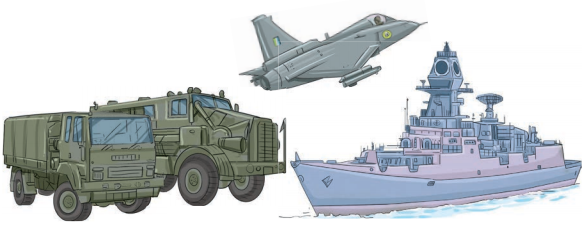
Match the collective nouns in Column 1 to their meanings in Column 2. You may refer to a dictionary.
|
Column 1 |
Column 2 |
|
1. regiment |
(i) a large body of troops ready for battle, especially an infantry unit |
|
2. squadron |
(ii) a permanent unit of an army typically commanded by a lieutenant colonel/colonel and divided into several companies |
|
3. fleet |
(iii) a small unit, typically comprising 12-24 aircrafts and their crews used in air force, naval, or army aviation services. |
|
4. battalion |
(iv) a group of ships sailing together, engaged in the same activity, or under the same ownership |
Answer:
|
Column 1 |
Column 2 |
|
1. regiment |
(ii) a permanent unit of an army typically commanded by a lieutenant colonel/colonel and divided into several companies |
|
2. squadron |
(iii) a small unit, typically comprising 12-24 aircrafts and their crews used in air force, naval, or army aviation services. |
|
3. fleet |
(iv) a group of ships sailing together, engaged in the same activity, or under the same ownership |
|
4. battalion |
(i) a large body of troops ready for battle, especially an infantry unit |
Now, fill in the blanks suitably with words from Column 1 in the table.
A. The commanding officer addressed the entire __________ of soldiers during the morning assembly.
B. The admiral ordered the entire __________ to set sail for battle.
C. The __________ of infantry advanced slowly through the dense forest.
D. A __________ of fighter jets was sent to intercept the enemy planes.
Answer:
A. regiment
B. fleet
C. battalion
D. squadron
III. Read the following words from the text and fill in the blanks with the correct words by taking clues from the meanings given below in the box.
Meanings
1. To take and seize control: __________
2. To invade or occupy an area in large numbers: __________
3. To flood or overpower someone or something emotionally: __________
Answer:
1. overthrow
2. overrun
3. overwhelm
Now, create a list of at least five other verbs that begin with ‘over’ and frame sentences of your own.
Answer:
1. Overestimate-Don’t overestimate your ability to finish the project in just one day.
2. Overlook – She overlooked a small detail that caused the entire plan to fail.
3. Overreact-//e tends to overreact to even minor criticism.
4. Overwork-//- you overwork yourself, you’ll end up feeling exhausted and burned out.
5. Overslept-/ missed the bus because I overslept this morning.
IV. In the following pairs of words, ‘c’ is used for nouns, while ‘s’ is used for verbs.
-
advice (noun) and advise (verb)
-
practice (noun) and practise (verb)
-
device (noun) and devise (verb)
-
council (noun) and counsel (verb)
Now, fill in the blanks correctly with the words given in the brackets.
1. The teacher’s (i) ____________ is always helpful, and she continues to (ii) ____________ students on their career choices. (advice/advise)
2. The musician believes that daily (i) ____________ helps a lot, so she is always ready to (ii) ____________ her harmonium lessons. (practice/practise)
3. The scientist uses a strange (i) ____________ for experiments and plans to (ii) ____________ new methods for his analysis. (device/devise)
4. The village (i) ____________ met to discuss issues and decided to (ii) ____________ the villagers on important matters. (council/counsel)
Answer:
1. (i) advice (ii) advise
2. (i) practice (ii) practise
3. (i) device (ii) devise
4. (i) council (ii) counsel
Read the highlighted word in the following sentence from the text.
Most importantly, his story is a reminder of the sacrifices made by countless men and women in defence of the motherland. In terms of meaning, there is no difference between the two words (defence, defense). In American English the word is spelt with an ‘s’, whereas in British English it is spelt with a ‘c’, which is the preferred spelling. The word has several different meanings, but it is mostly used to mean ‘the act of protecting someone or something against attack or criticism’.
V. Read the highlighted words in the following sentences from the text.
-
…ended with echoes of courage that serve as an inspiration…
-
A contingent of troops posted to Jammu and Kashmir was airlifted into Srinagar…
-
D Company with 90 soldiers was the last and they were expected to return by 2:00 p.m.
-
The life and sacrifice of Major Somnath Sharma embody the highest ideals of duty, honour, and patriotism.
The highlighted words are either singular verbs or plural verbs.
They are in agreement with the subject of the sentence. This is called Subject-Verb Agreement.
Now, fill in the blanks for the following sentences by choosing the correct verb given within brackets.
1. The bouquet of flowers __________ (is/are) beautiful.
2. Neither the teacher nor the students __________ (was/were) aware of the change in the schedule.
3. Each of the participants __________ (has/have) submitted their projects on time.
4. The data collected by the researchers __________ (shows/show) significant trends.
5. One of the players __________ (was/were) injured during the match.
6. Either the children or their guardian __________ (has/have) to attend the meeting.
7. A pair of shoes __________ (is/are) missing from the rack.
8. Neither of the statements __________ (is/are) true.
9. The members of the jury __________ (has deliver/have delivered) their verdict to the court.
10. Mathematics __________ (is/are) an interesting subject for many students.
Answer:
1. is
2. were
3. has
4. show
5. was
6. has
7. is
8. is
9. have delivered
10. is
VI. Read the following passage and correct the incorrect usage of verbs. One example has been done for you.
A battalion of soldiejs stand at attention as the National flag are raised.
A battalion of soldiers stands at attention as the National flag is raised.
Each soldier salute with pride while the commander and his assistants inspects the parade. The sound of marching feet echo through the air as a group of cadets prepare for their drill. Meanwhile, a convoy of military vehicles pass by, drawing cheers from the gathered crowd.
Answer:
Each soldier salutes with pride while the commander and his assistants inspect the parade. The sound of marching feet echoes through the air as a group of cadets prepares for their drill. Meanwhile, a convoy of military vehicles passes by, drawing cheers from the gathered crowd.
Let us listen (Page 66)
I. You will listen to a talk about the Param Vir Chakra. As you listen, complete the sentences by filling in the blanks with one or two exact words or phrases you hear. (Refer to the NCERT Textbook Page 98 for Transcript)
1. The Param Vir Chakra signifies the Wheel of the Ultimate __________.
2. The Param Vir Chakra is awarded to someone who shows exemplary bravery while fighting with the __________
3. The Param Vir Chakra was introduced as a Gallantry Medal in 1947 by the __________
4. The design of the Param Vir Chakra is inspired by Sage Dadhichi, who was a __________
5. The state emblem in the centre of the Param Vir Chakra is surrounded by the Vajra and __________
Answer:
1. Brave
2. Enemy
3. Dr. Rajendra Prasad, the then President of India.
4. a Vedic rishi
5. lotus flowers
NCERT Class 8 English Poorvi Chapter 4 Question Answer – Let us write (Pages 67-68)
I. Read about ;
A letter of enquiry is a formal letter written to seek detailed information about something the writer wants to know. For example, it can be used for joining a course, organising an event, knowing details about a trip, etc. The language used is formal and specific, with relevant queries.
Now, write a letter of enquiry. Your school wishes to organise a visit to a Memorial in your state/region. Write the letter to the incharge of that memorial requesting for information regarding available dates for visits, the duration of the tour, any entry fees, and guidelines for student groups.
-
Follow the given layout.
-
Use the cues given below to draft the letter.
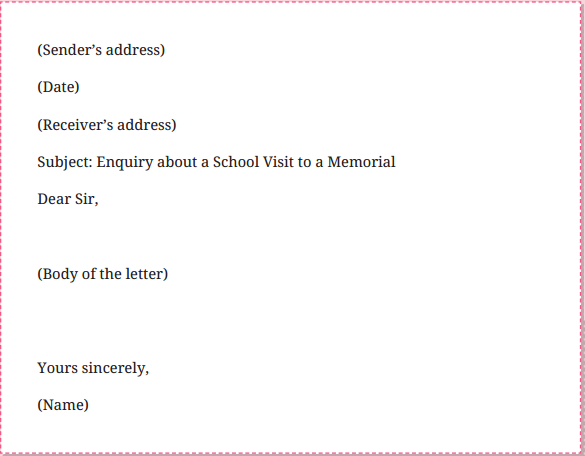
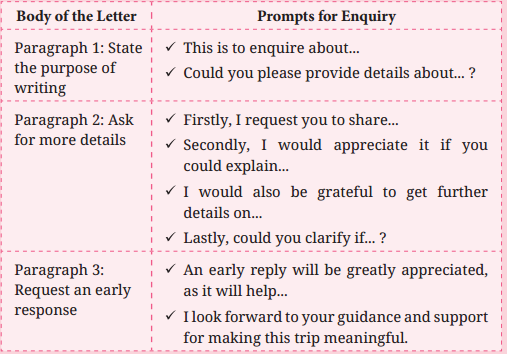
Now, write a letter of enquiry. Your school wishes to organise a visit to a Memorial in your state/region. Write the letter to the incharge of that memorial requesting for information regarding available dates for visits, the duration of the tour, any entry fees, and guidelines for student groups.
Green Valley Public School
Sector 10, Lakeview Road
Bhopal, Madhya Pradesh – 462003
17 May 2025
The Incharge
Shaheed Smarak Memorial
Central Square, Bhopal – 462001
Subject: Inquiry regarding a School Visit to a Memorial
Dear Sir,
I am writing to inquire about the possibility of arranging a visit to the Shaheed Smarak Memorial for students of classes IX and X from our school. The purpose of this visit is to help students understand the country’s history and pay tribute to the sacrifices made by our martyrs. Kindly provide information about the process and requirements for organizing such a visit.
Firstly, I would like to know the available dates for group visits in the upcoming month. Secondly, please inform us about the duration of the visit and whether guided tours are available.
I would also appreciate details regarding any entry charges and whether there are special concessions for school groups. In addition, please let us know if there are any rules or safety measures that must be followed while bringing students.
A prompt response would be highly appreciated, as it will assist us in planning and obtaining the necessary permissions. I look forward to your support in making this visit both educational and meaningful for our students.
Yours sincerely,
Ananya Sharma
Cultural Activities Coordinator
Green Valley Public School
Class 8 English Chapter 4 A Tale of Valour Summary
Chapter 4 A Tale of Valour NCERT Solutions is based on the inspiring real-life story of Major Somnath Sharma, who displayed extraordinary courage during the Battle of Badgam.
The chapter describes how Major Somnath Sharma, despite being injured, chose to lead his company in a critical military operation in Kashmir. Outnumbered by enemy forces, he and his team held their position with great determination. His leadership, bravery, and sense of duty played a crucial role in protecting Srinagar from enemy capture.
The story highlights themes of patriotism, sacrifice, and fearless leadership. It shows how one individual’s courage can make a significant difference in the face of overwhelming challenges. Through this chapter, students not only learn about an important historical event but also gain inspiration from the values of dedication and selflessness.