
Important Questions Class 12 Biology Chapter 6 focus on the chapter Evolution, one of the most concept-based and scoring units in the CBSE Class 12 Biology syllabus. With the Class 12 Biology board exam scheduled for February 25, 2026, this is the right time to strengthen your preparation through targeted practice.
The chapter covers key topics such as origin of life, theories of evolution, natural selection, Hardy-Weinberg principle, human evolution, and adaptive radiation.
By practicing Evolution Class 12 Biology Important Questions, students can improve conceptual clarity, prepare for application-based questions, and perform confidently in the final board exam.
Important Questions Class 12 Biology Chapter 6
Evolution explains the scientific basis of how life has changed over millions of years. Students should thoroughly practice Evolution Class 12 Biology Important Questions, diagram-based explanations, and theory-based answers to score maximum marks.
Below are Evolution Class 12 MCQs as well as important questions for effective practice:
1. The bones of forelimbs of whale, bat, cheetah and man are similar in structure, because:
(1) one organism has given rise to another
(2) they share a common ancestor
(3) they perform the same function
(4) the have biochemical similarities
Ans. (2) they share a common ancestor
2. (p+q)2 = p2 + 2pq + q2 = 1 represents an equation used in:
(1) population genetics
(2) mendelian genetics
(3) biometrics
(4) molecular genetics
Ans. (1) population genetics
3. Match the scientists listed under column ‘I’ with ideas listed column ‘II’.
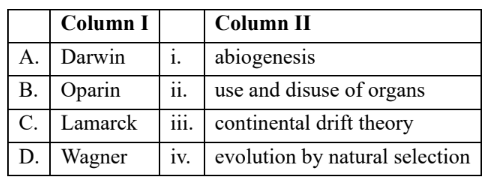
(1) A-i; B-iv; C-ii; D-iii
(2) A-iv; B-i; C-ii; D-iii
(3) A-ii; B-iv; C-iii; D-i
(4) A-iv; B-iii; C-ii; D-i
Ans. (2) A-iv; B-i; C-ii; D-iii
4. Rearrange the following in ascending order of the evolutionary tree. Reptiles, salamanders, Coelacanth, and frogs.
Ans. The given organisms arranged in ascending order of evolutionary tree are as follows: Coelacanth, Frogs, Salamander, and Reptiles.
5. Which is the earliest human fossil?
Ans. Dryopithecus is the earliest human fossil, and it is considered to be the common ancestor of apes, monkeys, and man.
6. Find out from newspapers and popular science articles any new fossil discoveries or controversies about evolution.
Ans. Fossil discovery of dinosaurs had some interesting revelations. It sheds light on the evolution of reptiles in the Jurrasic era. This revelation gave rise to the discovery of the evolution of other animals, such as mammals and birds. Two unfamiliar fossils recently unearthed in China led to a controversy over the evolution of birds. One such genus of primitive birds were Confuciusornis. These were crow-sized and thrived during the Cretaceous era in China.
7. Write a short note on Lamarckism.
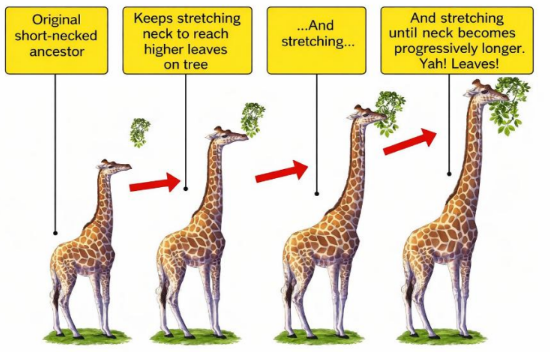
Ans. Before Darwin, a French naturalist Lamarck had said that evolution of life forms had occurred but was driven by the use and disuse of organs. He gave the examples of Giraffes who in an attempt to forage leaves on tall trees had to adapt by elongation of their necks. As they passed on this acquired character of elongated neck to succeeding generations, Giraffes, slowly, over the years, came to acquire long necks.
8. What is natural selection? Give one example also.
Ans. Natural selection is a process of selection by nature in which individuals with those characteristics which enable them to survive better in natural conditions would outnumber the others who are less adapted under the same natural conditions e.g. Resistance of microbes to pesticides
9. Distinguish between convergent and divergent evolution giving one example of each.
Ans. Divergent Evolution - The development of different functional structures from a common ancestral form is called divergent evolution. Homologous organs show divergent evolution.
Examples: Darwin’s Finches Convergent Evolution - The development of similar adaptive functional structures in unrelated groups of organisms is called convergent evolution. Analogous organs show convergent evolution. Examples: Australian Marsupials and Placental mammals
10. Describe one example of adaptive radiation.
Ans. When members of a single assemblage or lineage deviate evolutionarily into a range of different forms, it is adaptive radiation. These are the forms that are governed by natural selection and the usage of resources or habitats. The Darwin’s finches of the Galapagos islands had shared or common ancestors, whereas now, we have different sorts of modified beaks based on their food preferences. In order to suit their feeding habits, these finches have adopted different eating preferences and varied beak types. From a single seed-eating finch ancestor, different finch species with varied dietary habits have evolved, such as blood-sucking, insectivorous entities, etc.
How to Revise Evolution Class 12 for Board Exam
As CBSE 12th board exam is scheduled on February 25, 2026, revising the important chapters is essential:
-
Revise Key Theories: Focus on Darwin’s theory, Lamarckism, mutation theory, and modern synthetic theory.
-
Hardy-Weinberg Principle: Memorize the equation and conditions affecting genetic equilibrium.
-
Practice Important Questions of Evolution Class 12: Revise previously solved answers instead of learning new content.
-
Draw Flowcharts: Create effective revision charts for speciation and evolutionary mechanisms.
-
Solve Evolution Class 12 Question Answers Quickly: Practice writing structured answers in points.
-
Avoid New Topics: Use the final days only for strengthening what you already know.
Important Questions Class 12 Biology Chapter 6 FAQs
What are the most important topics in Evolution Class 12 for boards?
Are Evolution Class 12 Mcq important for board exams?
How can I quickly revise Important Questions of Evolution Class 12 before exams?
How many marks does Evolution usually carry in Class 12 Biology boards?
Is Evolution considered a scoring chapter?


Have questions about your prep?
Our experts can answer all your questions