Biotechnology Principles and Processes Class 12 Important Questions

Important Questions Class 12 Biology Chapter 9: With the board exams approaching, a focused revision strategy is essential to score well in Biology. Important questions Class 12 Biology Chapter 9 help students strengthen their understanding of Biotechnology: Principles and Processes by covering all high-weightage concepts.
These Biotechnology Principles and Processes class 12 important questions focus on core topics such as recombinant DNA technology, enzymes, vectors, cloning steps, and bioreactors, making them highly useful for exam-oriented preparation and concept clarity.
Biotechnology Principles and Processes Class 12 Question Answers
Biotechnology Principles and Processes class 12 question answers are designed to help students revise this chapter in an exam-oriented manner. Practising Biotechnology Principles and Processes MCQ strengthens conceptual understanding of topics like recombinant DNA technology, restriction enzymes, vectors, cloning steps, and bioreactors.
The questions given below are framed as per the latest CBSE pattern and help students improve accuracy, speed, and confidence while attempting objective and theory-based questions in the board examination.
1. Inbreeding is carried out in animal husbandry because it:
(1) increases vigour
(2) improves the breed
(3) increases heterozygosity
(4) increases homozygosity
Ans (4)
increases homozygosity
2. Which one of the following combination would a sugarcane farmer look for in the sugarcane crop?
(1) Thick stem, long internodes, high sugar content and disease resistant
(2) Thick stem, high sugar content and profuse flowering
(3) Thick stem, short internodes, high sugar content, disease-resistant
(4) Thick stem, low sugar, content, disease-resistant
Ans. (1)
Thick stem, long internodes, high sugar content and disease resistant
3. The term ‘totipotency’ refers to the capacity of a:
(1) cell to generate whole plant
(2) bud to generate whole plant
(3) seed to germinate
(4) cell to enlarge in size
Ans. (1)
cell to generate whole plant
4. Can exonuclease be used while producing a recombinant DNA molecule?
Ans. No, an exonuclease cannot be used while producing a recombinant DNA. This is because an exonuclease degrades the DNA. It cannot produce DNA fragments with sticky ends.
5. What are competent cells? What does the word “competent” refer to?
Ans. Competent cells are those that allow the foreign DNA to incorporate into the host by a slight alteration in the cell walls. “Competent” means the ability of a cell to intake foreign DNA.
6. How is Biotechnology useful in developing food crops and in agriculture process
Ans. Biotechnology extends its applications over a broad spectrum in the fields of agriculture and development of food crops.
In the agriculture field, it helps in improving food quality, quantity, and processing. Bio-fertilizers and Bio-pesticides are eco-friendly sources for agriculture, which contains the living microorganisms that help in promoting growth by increasing the supply or availability of primary nutrients. Farmers choose biotech crops to increase the yield and in lower production costs.
7. What do you understand by gene cloning?
Ans. Gene cloning or DNA cloning is the process in which the gene of interest is copied out of the DNA extracted from an organism. The process of gene cloning is carried out in the following steps:
Isolation of DNA fragment or gene
↓
Selection of the appropriate vector
↓
The isolated DNA fragment is incorporated into the vector
↓
The recombinant vector is transformed in the host cell
↓
The recombinant host cell is isolated
8. Identify the steps (i), (ii), (iii) in the following diagram
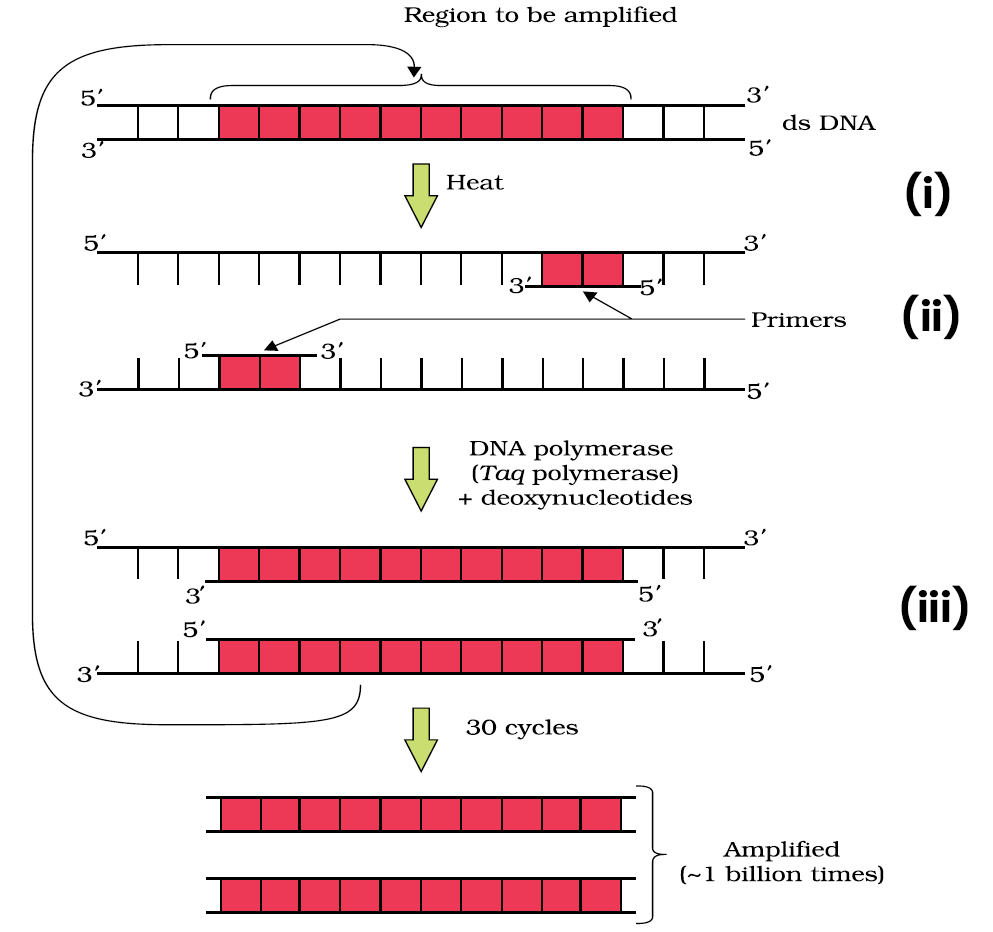
Ans. (i) – Denaturation - The DNA strands are treated with a temperature 94°C and the strands are separated.
(ii) – Annealing - The primers anneal to the complementary strands
(iii) – Extension - The DNA polymerase facilitates the extension of the strands
9. What is the role of Agrobacterium tumefaciens in plant transformation?
Ans. Agrobacterium tumefaciens is a plant pathogen that infects crops such as tomato, sunflower, cotton, soybean, etc. It causes crown gall disease in plants which are induced by Ti plasmid or the tumour-inducing plasmid. The Ti plasmid incorporates a DNA segment called the T-DNA into the DNA of the host plant cell. This T-DNA causes tumours.
10. Mention any three vector-less methods that are used to introduce recombinant DNA into a competent host cell.
Ans. The three vector-less methods include:
1. Transformation: This is the process by which bacteria takes up the genetic material directly from the surroundings. For this, the bacterial cells are treated with calcium chloride. The cells are then incubated in ice and then subjected to very high temperature. This creates pores in the bacterial cell wall and the foreign DNA is taken up by the bacterial cell.
2. Microinjection: In this, the recombinant DNA is directly injected into the nucleus of the animal cell with the help of a microneedle.
3. Biolistics/Gene gun Method: The cells are bombarded with very high-velocity microparticles of gold and tungsten coated DNA.
Exam Preparation Tips for Biotechnology Principles and Processes
Before starting your final revision, it is important to understand the concepts clearly and practice questions in an exam-focused manner. A smart preparation strategy can help you score better with less stress.
-
Focus on the steps of recombinant DNA technology and learn them in proper sequence.
-
Revise the functions of enzymes like restriction endonucleases, ligase, and polymerases.
-
Practice Biotechnology Principles and Processes MCQs to strengthen conceptual clarity and accuracy.
-
Learn the difference between vectors, plasmids, and bacteriophages with examples.
-
Practice neat and well-labeled diagrams of bioreactors, plasmids, and cloning vectors.
-
Go through previous years’ CBSE 12th questions to identify frequently asked topics.
-
Write answers in points with correct biological terms to improve presentation and scoring.
Important Questions Class 12 Biology Chapter 9 FAQs
Are Important questions Class 12 Biology Chapter 9 enough for board exam preparation?
Which topics are most important in Important questions Class 12 Biology Chapter 9?
Do Important questions Class 12 Biology Chapter 9 include MCQs and case-based questions?
Are diagrams important while answering Important questions Class 12 Biology Chapter 9?


Have questions about your prep?
Our experts can answer all your questions