








Important Questions Class 9 Science Chapter 7: Chapter 7 of Class 9 Science Motion explains the fundamental concepts of how objects move and the factors influencing their motion. Important questions, including class 9 motion important questions, cover topics like distance versus displacement, speed versus velocity, and the meaning of acceleration and deceleration. Students may need to solve problems to find average speed, read distance-time graphs, or use equations of motion for objects moving at a steady rate.

It is also important to understand concepts like frame of reference and different types of motion, such as uniform and non-uniform motion. By practicing these key questions from class 9 science chapter 7 important questions, students can strengthen their understanding of motion in the world around them.
Motion Class 9 Science Chapter 7 Important Questions PDF
Chapter 7 of Class 9 Science explains the basic ideas of how things move. It includes important questions on topics such as distance and displacement, speed and velocity, and acceleration and deceleration. These questions help students understand different types of motion like uniform and non-uniform motion. Practicing these important questions in PDF form can help students prepare well for exams and improve their grasp on the subject.
Download: Motion Class 9 Science Chapter 7 Important Questions PDF
Important Questions Class 9 Science Chapter 7 Motion
This section presents important questions and their solutions, designed to help students master the concepts of motion. Each question is followed by a detailed answer to ensure clear understanding.
-
Which of the following statements is correct?
(A) Both speed and velocity are same.
(B) Speed is a scalar quantity and velocity is a vector quantity.
(C) Speed is a vector quantity and velocity is scalar quantity.
(D) None of these
Ans. (B) -
What does area of velocity time graph give?
(A) Distance
(B) Acceleration
(C) Displacement
(D) None of the above
Ans. (C) -
When a body moves uniformly along a circle, then:
(A) Its velocity changes but speed remains the same.
(B) Its speed changes but velocity remains the same.
(C) Both speed and velocity changes.
(D) Both speed and velocity remains same.
Ans. (A) -
Which of the following statements is correct?
(A) Speed and distance are scalar, velocity and displacement are vector.
(B) Speed and distance are vector, velocity and displacement are vector.
(C) Speed and velocity are scalar, distance and velocity are vector.
(D) Speed and velocity are vector, distance and displacement are scalar.
Ans. (A) -
If a moving body comes to rest, then its acceleration during its motion is:
(A) Positive
(B) Negative
(C) Zero
(D) All of these depending upon initial velocity
Ans. (B) -
Under what condition(s) is the magnitude of average velocity of an object equal to its average speed?
Sol. If distance travelled by an object is equal to its displacement, then the magnitude of average velocity of an object will be equal to its average speed. -
During an experiment, a signal from a spaceship reached the ground station in five minutes. What was the distance of the spaceship from the ground station? The signal travels at the speed of light, that is, .
Sol.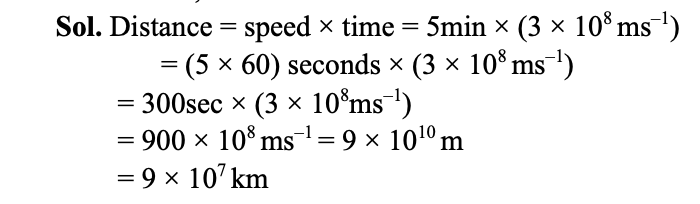
-
A bus decreases its speed from 80 km/h to 60 km/h in 5 s. Find the acceleration of the bus.
Sol.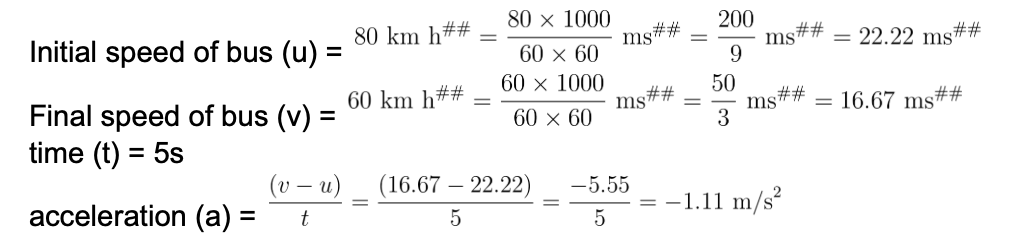
-
A bus starting from rest moves with a uniform acceleration of for 2 minutes. Find (a) the speed acquired, (b) the distance travelled.
Sol.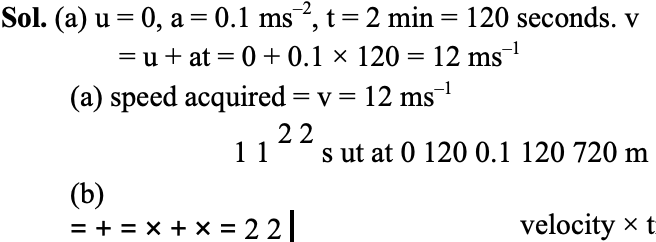
-
Calculate the acceleration of a body which starts from rest and travels 87.5m in 5 sec?
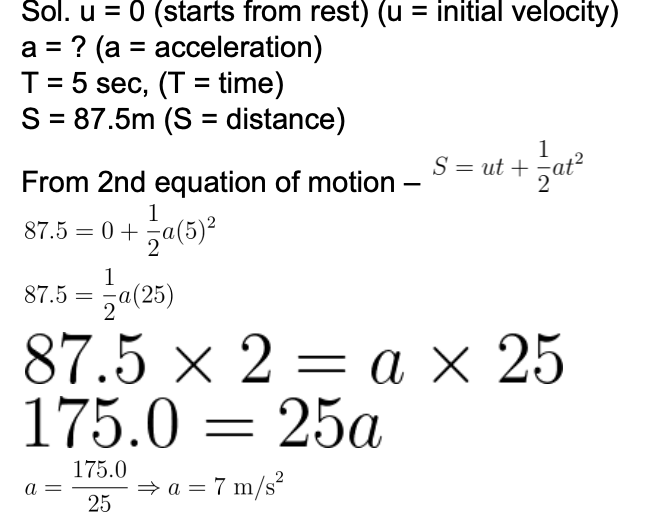
-
A car travels at a speed of 40 km/hr for two hour and then at 60 km/hr for three hours. What is the average speed of the car during the entire journey?
Sol. Sol. In first case; t1 = time = 2 hrs
v1 = speed = 40 km/hr
s1 = distance = speed × time
s1 =
In second case, t2 = time = 3 hrs
v2 = speed = 60 km/hr
s2 = distance = speed × time
s2 =
The total distance = s1 + s2 = 80 + 180 = 260 km
Total time, t1 + t2 = 2 + 3 = 5 hrs
Average speed =
-
Derive the second equation of motion, numerically?
Sol. Let at time t = 0, body has initial velocity = Vo
At time 't', body has final velocity = V
S = distance traveled in time 't'
We know, total distance traveled = Average velocity × time
Average velocity = 
Total distance 

Now from first equation of motion, 
Use the value of (V) from (ii) in (i)



Let 
13. A body is moving with a velocity of 12 m/s and it comes to rest in 18m, what was the acceleration?
Sol. Initial velocity = u = 12 m/s
Final velocity = V = 0
S = distance = 18m
a = acceleration = ?
From 3rd equation of motion; 





14. A farmer moves along the boundary of a square field of side 10 m in 40 s. What will be the magnitude of displacement of the farmer at the end of 2 minutes 20 seconds?
Sol. Distance covered by farmer in 40 seconds = 
Speed of the farmer = 
Total time given in the question = 2 min 20 seconds = 60 + 60 + 20 = 140 seconds
Since, he completes 1 round of the field in 40 seconds, so in he will complete 3 rounds in 120 seconds (2 mins) or 120 m distance is covered in 2 minutes. In another 20 seconds will cover another 20 m. So, total distance covered in 2 min 20 sec = 120 + 20 = 140 m.
Displacement = 

15. A train is travelling at a speed of 90 km/h. Brakes are applied so as to produce a uniform acceleration of – 0.5 m/s . Find how far the train will go before it is brought to rest.
Sol.






16. The velocity time graph of runner is given in the graph.
(a) What is the total distance covered by the runner in 16s?
(b) What is the acceleration of the runner at t = 11s?
(Note: Image link is placeholder, assume a graph showing velocity increasing from 0 to 10 m/s in 6s, then constant at 10 m/s till 16s)
Sol. (a) We know that area under v-t graph gives displacement:
So, Area = distance = s = area of triangle + area of rectangle
Area of triangle = 
Area of rectangle = length × breadth = 
Total area = 30 + 100 = 130 m
Total distance = 130 m
(b) Since at t = 11 sec, particle travels with uniform velocity, so, there is no change in velocity hence acceleration = zero.
17. Draw the graph for uniform retardation:
(1) Position – time graph
(2) Velocity – time
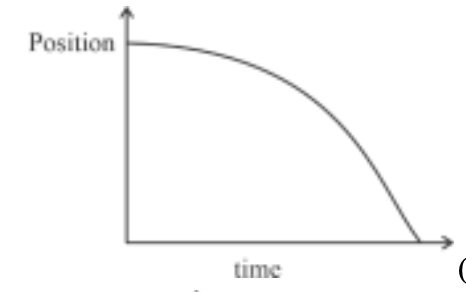
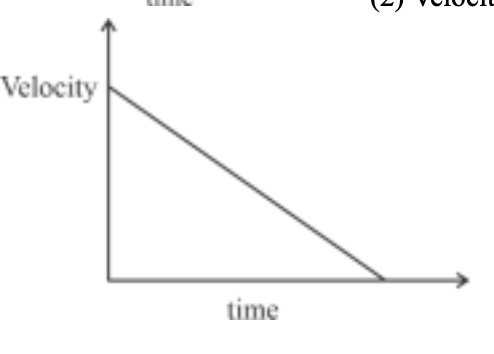
Sol. (1) Position – time, (2) Velocity – time
18. Derive the third equation of motion () graphically?
Sol. Let at time t = 0, body moves with initial velocity ‘u’ and at time 't' has final velocity 'v' and 't' covers a distance 's'.
(Diagram of velocity-time graph with initial velocity u, final velocity v, and time t. Area under the graph is a trapezium, or a rectangle and a triangle.)
AB = u
AC = v
DB = v – u
DB = t
S = distance
Area under v-t graph gives displacement
S = 


From graph, DB = t, BC = v – u, OA = t, AB = u
Now, 
Put the value of 't' in equation (i)



19. Abdul, while driving to school, computes the average speed for his trip to be  . On his return trip along the same route, there is less traffic and the average speed is
  . What is the average speed for Abdul's trip?
Sol. If we suppose that distance from Abdul's home to school = ‘x’ km
While driving to school: speed = 
On his return trip: speed = 
Total distance travelled = x + x = 2x
Total time = 

20. The position of a body at different times are recorded in the table given below:
|
Time (sec) |
Distance (m)
|
|---|---|
|
1 |
6 |
|
2 |
12 |
|
3 |
18 |
|
4 |
24 |
|
5 |
30 |
|
6 |
36 |
|
7 |
42 |
|
8 |
48 |
-
(a) Draw the displacement time graph for the above data?
(b) What is the slope of graph?
(c) What is the speed of the motion?
Sol. (a)
(Note: This would be a straight line passing through the origin with a positive slope, representing uniform speed.)
(b) Slope of the graph
Using points (4 sec, 24 m) and (6 sec, 36 m):
Slope
(c) Slope of the graph of a displacement-time graph = speed
Hence speed = 6 m/sec -
Assertion: An object may acquire acceleration even if it is moving at a constant speed.
Reason: With change in the direction of motion, an object can acquire acceleration.
(A) Both assertion and reason are true and reason is the correct explanation of assertion.
(B) Both assertion and reason are true but reason is not the correct explanation of assertion.
(C) Assertion is true but reason is false.
(D) Both Assertion and Reason are false.
Ans. (A)
Sol. Motion of an object in a circular path is such an example. In a uniform circular motion, the direction of motion of the object changes continuously and hence the velocity changes continuously even though the speed is constant. -
Assertion: Displacement of an object may be zero even if the distance covered by it is not zero.
Reason: Displacement is the shortest distance between the initial and final position.
(A) Both assertion and reason are true and reason is the correct explanation of assertion.
(B) Both assertion and reason are true but reason is not the correct explanation of assertion.
(C) Assertion is true but reason is false.
(D) Both Assertion and Reason are false.
Ans. (A)
Sol. When the final position of an object coincides with its initial position, displacement is zero, but the distance travelled is not zero. -
Assertion: The graph between two physical quantities P and Q is straight line, when P/Q is constant.
Reason: The straight line graph means that P is proportional to Q or P is equal to constant multiplied by Q.
(A) Both assertion and reason are true and reason is the correct explanation of assertion.
(B) Both assertion and reason are true but reason is not the correct explanation of assertion.
(C) Assertion is true but reason is false.
(D) Both Assertion and Reason are false.
Ans. (A) -
Assertion: Velocity versus time graph of a particle in uniform motion along a straight path is a line parallel to the time axis.
Reason: In uniform motion the velocity of a particle increases as the square of the time elapsed.
(A) Both assertion and reason are true and reason is the correct explanation of assertion.
(B) Both assertion and reason are true but reason is not the correct explanation of assertion.
(C) Assertion is true but reason is false.
(D) Both Assertion and Reason are false.
Ans. (C) -
Assertion: The speedometer of a car measures the instantaneous speed of the car.
Reason: Average speed is equal to the total distance covered by an object divided by the total time taken.
(A) Both assertion and reason are true and reason is the correct explanation of assertion.
(B) Both assertion and reason are true but reason is not the correct explanation of assertion.
(C) Assertion is true but reason is false.
(D) Both Assertion and Reason are false.
Ans. (B)
Sol. The speedometer of a car measures the instantaneous speed of the car. -
Assertion: An object may have acceleration even if it is moving with uniform speed.
Reason: An object may be moving with uniform speed but it may be changing its direction of motion.
(A) Both assertion and reason are true and reason is the correct explanation of assertion.
(B) Both assertion and reason are true but reason is not the correct explanation of assertion.
(C) Assertion is true but reason is false.
(D) Both Assertion and Reason are false.
Ans. (A)
Sol. The uniform motion only means that the object is moving at a constant speed but its direction of motion may be changing as in the case of uniform circular motion. Hence, acceleration is produced in uniform motion due to changes in velocity. -
Assertion: Motion with uniform velocity is always along a straight line path.
Reason: In uniform velocity, speed is the magnitude of the velocity and is equal to the instantaneous velocity.
(A) Both assertion and reason are true and reason is the correct explanation of assertion.
(B) Both assertion and reason are true but reason is not the correct explanation of assertion.
(C) Assertion is true but reason is false.
(D) Both Assertion and Reason are false.
Ans. (B)
Benefits of Important Questions Class 9 Science Chapter 7
- Enhanced Understanding : These questions help clarify important concepts related to motion, speed, velocity, and acceleration ensuring students grasp fundamental principles.
- Exam Preparation : Familiarity with important questions boosts confidence and readiness for tests, as students can anticipate similar questions in their exams.
- Time Management : Practicing these questions allows students to learn how to manage their time effectively during exams, ensuring they can complete all questions within the allotted time.
- Self-Assessment : Important questions enable students to assess their understanding and identify areas needing further review or practice.
Explore More Chapters
Important Questions Class 9 Science Chapter 7 FAQs
What is motion?
What is the difference between distance and displacement?
What is speed?
What is velocity?







Get Free Counselling Today
and Clear up all your Doubts
 Live & recorded classes available at easeDashboard for progress trackingLakhs of practice questions

