


As the academic session progresses, this is the phase where effective revision matters more than lengthy study sessions. It is important to prepare the important questions.
Practicing Electromagnetic Induction Class 12 Important Questions helps you master derivations like Faraday’s laws and Lenz’s law, along with numericals involving induced EMF, self-induction, and mutual induction. Since this chapter includes both theory and problem-solving, structured revision using accurate Electromagnetic Induction 12 Solutions is essential to score high.
Electromagnetic Induction Class 12 Important Questions
The chapter Electromagnetic Induction revolves around changing magnetic flux and induced EMF. Students must thoroughly practice all frequently asked Electromagnetic Induction Class 12 Important Questions, especially derivations and numericals. Below are the Electromagnetic Induction Class 12 Question Answers for exam preparation:
1. The Lenz's law gives [Foreign 2014]
(A) direction of induced E.M.F.
(B) magnitude of induced E.M.F.
(C) direction of induced current
(D) magnitude of induced current
Sol. (C)
Lenz's law gives the direction of the induced current in electromagnetic induction. According to this law, the direction of induced current is such that it opposes the cause which produces it. Thus (C) is correct option.
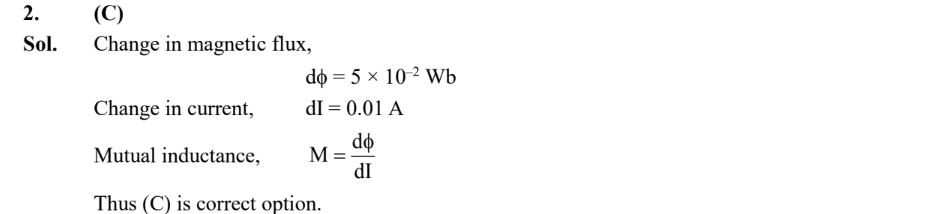
2. The mutual inductance, when the magnetic flux changes by 5×10⁻² Wb and current change by 0.01 A, is [OD 2004]
(A) 0.2 H
(B) 2.5 H
(C) 5 H
(D) 10 H
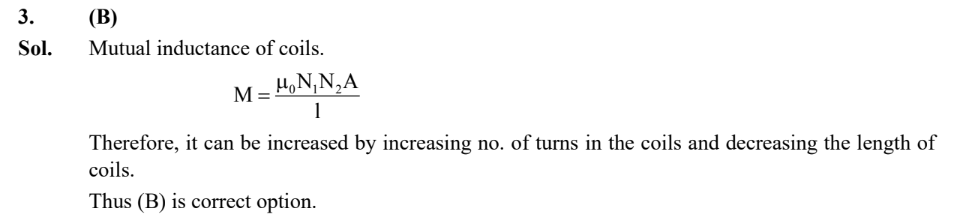
3. The mutual inductance of two coils can be increased by [Delhi 2014]
(A) increasing the length of coils
(B) increasing the no. of turns in the coils
(C) winding the coils on wooden cores
(D) decreasing the no. of turns in the coils
4. The electric current flowing in a wire in the direction from B to A decreasing. Find out the direction of the induced current in the metallic loop kept the wire as shown in the figure. [Delhi 2018]
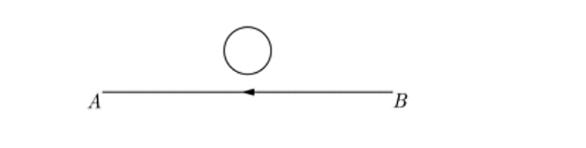
Sol. According to Lenz's law, the direction of induced current will oppose the cause of its production. So, the current in loop will induce in such a way that it will support the current flowing in the wire i.e., in the same direction. So, the direction of current in the loop will be clockwise.
5. In the given figure, a bar magnet is quickly moved towards a conducting loop having a capacitor. Predict the polarity of the plates A and B of the capacitor. [Delhi 2011]
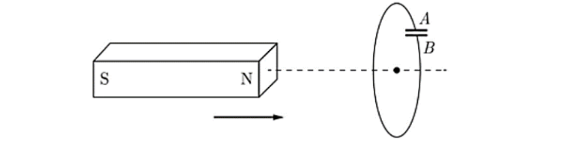
Sol. Here, the North pole is approaching the magnet, so the induced current in the face of loop viewed from left side will flow in such a way that it will behave like North pole, so south pole developed in loop when viewed from right hand side of the loop. The flow of induced current is clockwise, hence A acquires positive polarity and B requires negative.
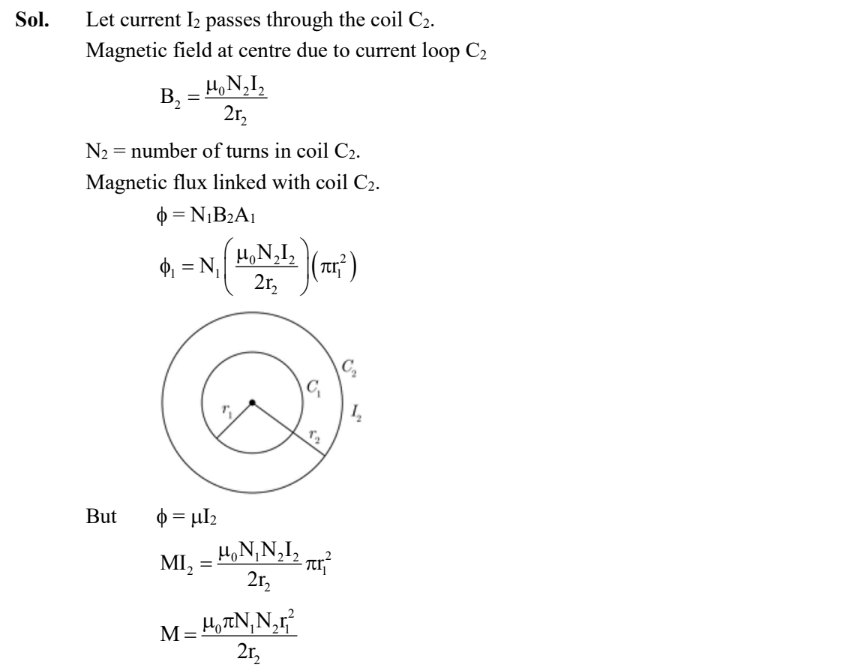
6. Define mutual inductance between two long coaxial solenoids. Find out the expression for the mutual inductance of inner solenoid of length $l$ having the radius n1 and the number of turns n1 per unit length due to the second outer solenoid of same length and n2 number of turns per unit length. [Delhi 2010]
Sol. The phenomenon of generation of induced emf in a long solenoid due to a change of current in another neighbouring coaxial solenoid is known as mutual induction. The mutual induction for the pair of the solenoid is

7. A bar magnet is moved in the direction indicated by the arrow between two coils PQ and CD. Predict the directions of induced current in each coil.
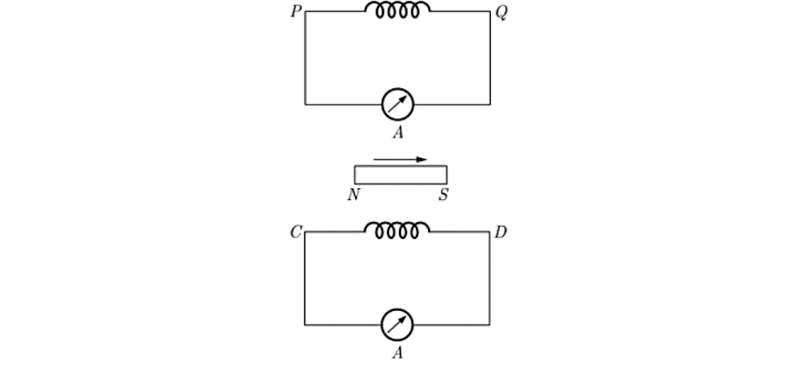
Sol. From the figure, it is clear that North pole of the magnet is moving away from coil PQ, so the direction of current at end Q will flow in such a way that it will oppose the away moment of North pole, so it has to act as South pole. Hence, the direction of current will be anti-clockwise. Again, the South pole is approaching towards coil CD, so end C of the coil will act as South pole (to oppose the approaching of South pole). Hence, the direction of current will be clockwise.
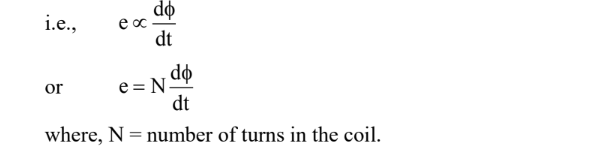
8. State the Faraday's law's of electromagnetic induction. [SQP 2008]
Sol. On the basis of his experiment, Faraday gave the following two laws:
1. Whenever magnetic flux linked with a circuit changes, an emf is induced in it which lasts, so long as change in flux continuous.
2. The emf induced in loop or closed circuit is directly proportional to the rate of change of magnetic flux linked with the loop

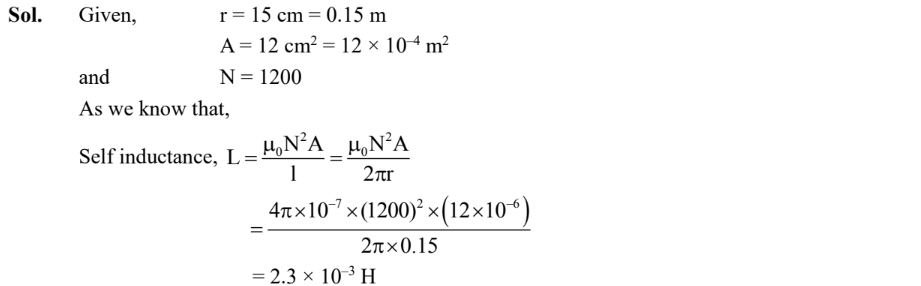
10. A toroidal solenoid with air core has an average radius of 15 cm, area of cross-section 12 cm2 and has 1200 turns. Calculate the self-inductance of the toroid. Assume the field to be uniform across the cross- section of the toroid. [Comp 2017]
Most Expected Questions for 12th Physics 2027 Board Exam
Focus on these repeated and high-probability questions:
-
State and explain Faraday’s laws of electromagnetic induction.
-
Explain Lenz’s law with example.
-
Derive expression for induced EMF in a rotating coil.
-
Define self-induction and mutual induction.
-
What is eddy current? Mention its applications.
-
Explain working of AC generator.
Important Questions for Class 12 Physics Chapter 6 FAQs
What is the weightage of Electromagnetic Induction in Class 12 Physics 2026 exam?
Which derivation is most important from Electromagnetic Induction?
Can I complete Electromagnetic Induction revision in 2 days?