







Class 6 English Chapter 12: Yoga—A Way of Life Important Questions by Physics Wallah
 Mishika Gupta31 Aug, 2026
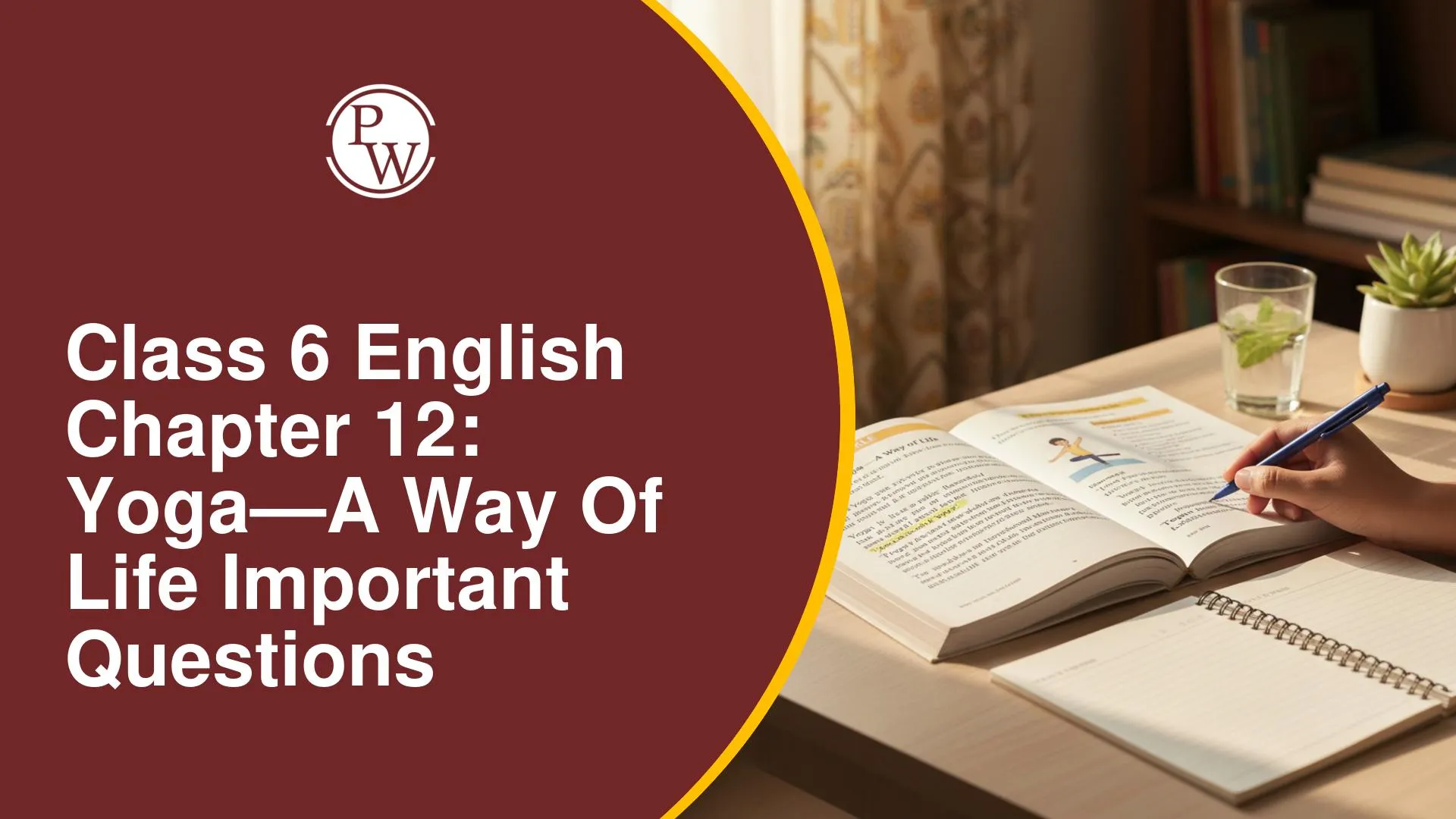
Yoga is more than a set of physical postures. The chapter explains how breathing, movement, concentration, and awareness can work together to support a healthy body and a calm mind. While reading the lesson, you may understand the broad idea but forget details about its origin, benefits, practice, or the role of modern resources such as the mYoga app.
The Class 6 English Chapter 12 Important Questions bring these ideas into one place for easier revision. The questions cover the meaning of yoga, its connection with the mind and body, physical and mental benefits, Sage Patanjali, and the WHO mYoga app. Use them to check your understanding and revise the chapter before your school examination.
Class 6 English Chapter 12 Important Questions
Work through the questions below to review the important concepts and details from Yoga—A Way of Life.
Important Questions
Q1. How does yoga help with weight loss?
(A) By improving metabolism
(B) By burning calories
(C) By improving digestion
(D) By building muscles
Answer: (B) By burning calories
Q2. What should be avoided while practising yoga to ensure its effectiveness?
(A) Coordination of breath and movements
(B) Using a yoga mat
(C) Practising without distractions
(D) Focusing solely on body stretches
Answer: (C) Practising without distractions
Q3. What is the main aim of the WHO mYoga app launched on 20th June 2021?
(A) To offer yoga certification courses
(B) To provide a collection of videos and audio files for yoga practice
(C) To sell yoga equipment
(D) To organise yoga retreats
Answer: (B) To provide a collection of videos and audio files for yoga practice
Q4. What does yoga help to do to the mind, according to Sage Patanjali?
Answer: According to Patanjali, yoga helps to make the mind quiet and free from distractions.
Q5. Name any two physical benefits of practising yoga.
Answer: Yoga increases flexibility and strengthens muscles. It can also improve balance and reduce body pains.
Q6. How does yoga help in reducing stress and anxiety?
Answer: Yoga uses breathing techniques and meditation, which help calm the mind and reduce stress and anxiety.
Q7. What is the WHO Yoga app meant to provide?
Answer: The WHO mYoga app provides free videos and audio files to teach and support yoga practice for people around the world.
Q8. Why should yoga be practised without distractions?
Answer: Yoga should be practised without distractions so that you can stay focused on your body, breathing, and movements.
Q9. How does yoga promote overall well-being?
Answer: Yoga supports physical fitness, mental calmness, and a healthy lifestyle, which together promote overall well-being.
Q10. The word Yoga comes from the Sanskrit root "yuj" which means
(A) To sleep
(B) To eat
(C) To join or unite
(D) To jump
Answer: (C) To join or unite
Q11. Yoga mainly aims at the unity of
(A) Man and machine
(B) Mind and body
(C) School and home
(D) Earth and moon
Answer: (B) Mind and body
Q12. Who presented the ancient tradition of yoga in a systematic way in the Yoga Sutras?
(A) Sage Valmiki
(B) Sage Vyasa
(C) Sage Patanjali
(D) Sage Agastya
Answer: (C) Sage Patanjali
Q13. Which organisation launched the WHO mYoga app in June 2021?
(A) UNESCO
(B) World Health Organization
(C) UNICEF
(D) World Bank
Answer: (B) World Health Organization
Q14. Yoga postures (asanas) mainly help to
(A) Increase homework
(B) Weaken muscles
(C) Stretch and strengthen muscles
(D) Spoil sleep
Answer: (C) Stretch and strengthen muscles
Q15. Which of these examples shows yoga working on both body and mind together?
(A) Doing only fast running to burn calories
(B) Holding a steady posture while breathing slowly and staying fully aware
(C) Lifting heavy weights while listening to loud music and chatting
(D) Learning only the history of yoga from a book
Answer: (B) Holding a steady posture while breathing slowly and staying fully aware
Class 6 English Chapter 12 Important Questions PDF
Use the Class 6 English Chapter 12 Important Questions PDF to review the lesson in a question-based format. Complete the questions independently and then go back to the chapter to clarify any concept or detail that you could not answer confidently.
Class 6 English Chapter 10 Important Questions PDF
Study without using the internet
Why Choose PW Class 6 English Important Questions for Revision?
Physics Wallah’s chapter-wise questions can make revision easier by bringing the main concepts and important details of the lesson into one practice set.
-
Understand Yoga Better: Revise the meaning of yoga and its connection with the mind and body.
-
Cover Its Benefits: Learn about the physical and mental benefits explained in the chapter.
-
Revise Yoga Practices: Focus on breathing, concentration, awareness, and practising without distractions.
-
Learn About Patanjali: Recall Sage Patanjali’s contribution and the Yoga Sutras.
-
Remember the Yoga App: Review why the WHO mYoga app was introduced and what it provides.
-
Practise Different Questions: Work on both MCQs and descriptive questions from the lesson.
-
Refresh Important Facts: Revisit key terms, ideas, and information before your assessment.
-
Support Exam Revision: Use the questions for quick preparation before class tests and school examinations.
Yoga—A Way of Life explains how yoga can support both physical fitness and mental well-being when practised with attention and proper breathing. These Class 6 English Chapter 12 Important Questions help you revise the chapter’s main concepts, important facts, and practical ideas. Work through them after reading the lesson and use the difficult questions to guide your revision.
Related Resources
Class 6 English Chapter 12 Important Questions FAQs
How can yoga benefit the body?
Who is associated with the Yoga Sutras?
How does yoga support mental well-being?
Why is concentration important during yoga?






 Live & recorded classes available at easeDashboard for progress trackingMillions of practice questions at your fingertips

