

Chapter 9 of the Class 9 English Beehive textbook, If I Were You, is a suspense-filled play written by Douglas James.
The chapter highlights the importance of presence of mind, intelligence, and courage in dangerous situations. It tells how a calm and clever man saves his life by outwitting a criminal.
The NCERT Solutions for Class 9 English Beehive Chapter 9 If I Were You are designed to help students understand the plot, characters, and message of the play in a simple and exam-oriented way.
These solutions follow NCERT guidelines and help students answer questions accurately in exams.
NCERT Solutions for Class 9 English Chapter 9 If I Were You Question Answer
If I Were You Class 9 Question And Answers are based strictly on the NCERT textbook. The answers are written in clear language and focus on character sketch, theme, and key events of the play.
NCERT Solutions for Class 9 English If I Were You Question Answer section is useful for exam preparation, as it includes both short and long answer questions commonly asked in exams.
I. Answer these questions.
Question 1. “At last, a sympathetic audience.”
(i) Who says this?
(ii) Why does he say it?
(iii) Is he sarcastic or serious?
Answer:
(i) Gerrard makes the said claim.
(ii) When the intruder presses him for a personal statement, he says it
(iii) He uses irony.
Question 2 . Why does the intruder choose Gerrard as the man whose identity he wants to take on?
Answer: The intruder decides to assume Gerrard's identity since he is a mysterious man who follows his commands, occasionally disappears quickly, and always returns.
Question 3 . “I said it with bullets.”
(i) Who says this?
(ii) What does it mean?
(iii) Is it the truth? What is the speaker’s reason for saying this?
Answer:
(i) Gerrard makes the said claim.
(ii) It implies that he shot someone to get away when he was in jeopardy.
(iii) It's not true, that much. In an attempt to talk the intruders out of killing him, Gerrard says this.
Question 4 . What is Gerrard’s profession? Quote the parts of the play that support your answer.
Answer: Gerrard’s profession is that of a dramatist.
The parts of the play that support that implication are: “In most melodramas, the villain is foolish enough to delay his killing long enough to be frustrated”. “Sorry I can’t let you have the props in time for rehearsal…” “I think I’ll put it in my next play.” “At last, a sympathetic audience!”
Question 5 . “You’ll soon stop being smart.”
(i) Who says this?
(ii) Why does the speaker say it?
(iii) What according to the speaker will stop Gerrard from being smart?
Answer:
(i) The trespasser makes the stated declaration. (ii) The intruder says this to get information about Gerrard and to frighten him. (iii) The speaker wants Gerrard dead. The speaker claims that Gerrard would get terrified and cease being intelligent if he learned that he had come to kill him and steal his identity.
Question 6 . “They can’t hang me twice.”
(i) Who says this?
(ii) Why does the speaker say it?
Answer:
(i) The person who enters makes the stated declaration. (ii) The speaker makes this claim because he has committed murder before. Therefore, it doesn't really matter if he kills another man. You cannot hang him twice.
Question 7 . “A mystery I propose to explain.” What is the mystery the speaker proposes to explain?
Answer: The speaker, Gerrard, suggests solving the enigma of why he is a mysterious man. He informs the trespasser that he is a wanted criminal himself. It is the reason he doesn't interact with tradespeople.
According to him, he killed someone and got away with it. However, he was again in difficulty, which is why he had his bag packed in preparation for another escape.
Question 8 . “This is your big surprise.”
(i) Where has this been said in the play? (ii) What is the surprise?
Answer:
(i) The play refers to this twice. The first time is when the intruder is attempting to frighten Gerrard, and the second time is when Gerrard is telling him why he won't murder him.
(ii) The fact that the intruder states that he intends to kill Gerrard is what surprises us about the initial statement. The unexpected part of the second comment is when Gerrard tells him that since he is a criminal on the run himself, killing him and stealing his identity won't help the intruder.
Thinking about Language
I. Consult your dictionary and choose the correct word from the pairs given in brackets.
1. The (site, cite) of the accident was (ghastly/ghostly).
2. Our college (principle/principal) is very strict.
3. I studied (continuously/continually) for eight hours.
4. The fog had an adverse (affect/effect) on the traffic.
5. Cezanne, the famous French painter, was a brilliant (artist/artiste).
6. The book that you gave me yesterday is an extraordinary (collage/college) of science fiction and mystery.
7. Our school will (host/hoist) an exhibition on cruelty to animals and wildlife conservation.
8. Screw the lid tightly onto the top of the bottle and (shake/shape) well before using the contents.
Answer:
1. The site of the accident was ghastly. 2. Our college principal is very strict. 3. I studied continuously for eight hours. 4. The fog had an adverse effect on the traffic. 5. Cezanne, the famous French painter, was a brilliant artist. 6. The book that you gave me yesterday is an extraordinary collage of science fiction and mystery. 7. Our school will host an exhibition on cruelty to animals and wildlife conservation. 8. Screw the lid tightly onto the top of the bottle and shake well before using the contents.
II. Irony is when we say one thing but mean another, usually the opposite of what we say. When someone makes a mistake and you say, “Oh! that was clever!”, that is irony. You’re saying ‘clever‘ to mean ‘not clever’.
Expressions we often use in an ironic fashion are:
• Oh, wasn’t that clever!/Oh that was clever!
• You have been a great help, I must say!
• You’ve got yourself into a lovely mess, haven’t you?
• Oh, very funny!/ How funny!
We use a slightly different tone of voice when we use these words ironically.
Read the play carefully and find the words and expressions Gerrard uses in an ironic way. Then say what these expressions really mean. Two examples have been given below. Write down three more such expressions along with what they really mean.
|
What the author says |
What he means |
|
Why, this is a surprise, Mr—er— |
He pretends that the intruder is a social visitor whom he is welcoming. In this way he hides his fear. |
|
At last a sympathetic audience! |
He pretends that the intruder wants to listen to him, whereas actually the intruder wants to find out information for his own use. |
Answer:
|
What the author says |
What he means |
|
You have been so modest. |
Gerrard says this to express how immodest the intruder has been by not talking about himself at all. |
|
At last a sympathetic audience! |
Gerrard says this sarcastically as the intruder is asking about Gerrard while holding a gun. |
|
You won’t kill me for a very good reason. |
Gerrard says this as if he has some ‘very good reason’ to be spared by the intruder. He says this so as to create a doubt in the intruder about killing him. |
Dictionary Use
A word can mean different things in different contexts. Look at these three sentences:
• The students are taught to respect different cultures.
• The school is organising a cultural show.
• His voice is cultured.
In the first sentence, ‘culture’ (noun) means way of life; in the second, ‘cultural’ (adjective) means connected with art, literature and music; and in the third, ‘cultured’ (verb) means sophisticated, well mannered. Usually a dictionary helps you identify the right meaning by giving you signposts.
Look at the dictionary entry on ‘culture’ from Oxford Advanced Learner’s Dictionary, 2005.
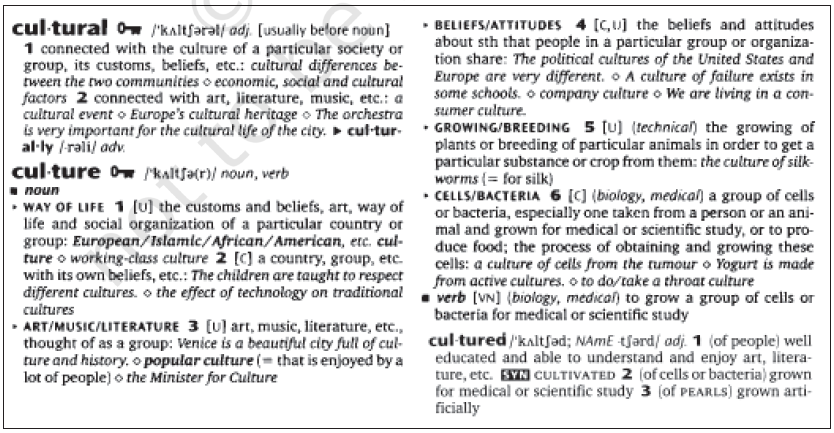
(Noun, verb, adjective, adverb, synonyms, etc. are signposts which help you locate the right meaning and usage, and give information about the part of speech that the word is.)
Look up the dictionary entries for the words sympathy, familiarity, comfort, care, and surprise. Use the information given in the dictionary and complete the table.
|
Noun |
Adjective |
Adverb |
Verb |
Meaning |
|
Sympathy |
||||
|
Familiarity |
||||
|
Comfort |
||||
|
Care |
||||
|
Surprise |
Answer:
|
Noun |
Adjective |
Adverb |
Verb |
Meaning |
|
Sympathy |
sympathetic |
sympathetically |
sympathize |
To feel pity for someone |
|
Familiarity |
familiar |
familiarly |
familiarize |
To know someone/ something |
|
Comfort |
comfortable |
comfortably |
comfort |
To make someone feel relaxed |
|
Care |
caring |
carefully |
care |
To be concerned about someone |
|
Surprise |
surprising |
surprisingly |
surprise |
To amaze someone |
Speaking
Question 1. Imagine you are Gerrard. Tell your friend what happened when the Intruder broke into your house. [Clues : Describe (i) the intruder — his appearance, the way he spoke, his plan, his movements, etc., (ii) how you outwitted him.]
Answer: Last night, while I was on the phone, an intruder broke into my cottage. He had a gun in his hand. He was a criminal on the run. He was planning to kill me and steal my identity. He kept threatening me with the gun and asked me to tell him everything about myself. I did not reveal my true profession and instead gave him a dodge. I told him that just like him, I too am a criminal and that is why killing me will not do any good to him. I told him that I was in trouble myself and had to escape. While trying to come out of the cottage, I locked him up in the cupboard and called the police. That’s how I was able to outwit him and save myself.
Question 2. Enact the play in the class. Pay special attention to words given in italics before a dialogue. These words will tell you whether the dialogue has to be said in a happy, sarcastic or ironic tone and how the characters move and what they do as they speak. Read these carefully before you enact the play.
Answer: Do it yourself.
Writing
I. Which of the words below describe Gerrard and which describe the Intruder?
Smart; humorous; clever
Beautiful; cool; confident
Flashy; witty; nonchalant
Write a paragraph each about Gerrard and the Intruder to show what qualities they have. (You can use some of the words given above.)
Answer:
Gerrard:
Gerrard is a smart and humorous person. He is clever and confident. Even in a life-threatening situation, he is cool and handles the situation in an amazing way. Instead of losing his mind and getting killed by the intruder, he quickly cooks up a story of being an on-the-run criminal. He is a witty person who saves himself and gets the intruder behind bars.
Intruder:
The intruder is a flashy person who tries to be very smart from the very beginning. He believes the cooked-up story of Gerrard and agrees to get out of the cottage with Gerrard. We see that the intruder is then locked up by Gerrard and the intruder even loses his gun to Gerrard.
II. Convert the play into a story (150–200 words). Your story should be as exciting and as witty as the play. Provide a suitable title to it.
Answer: Do it yourself.
If I Were You Class 9 Summary
If I Were You Class 9 revolves around Gerrard, a playwright who lives alone in a countryside cottage. One day, a criminal enters his house to kill him and take his identity. Instead of panicking, Gerrard uses his intelligence and calm behavior to confuse the intruder.
Through clever conversation, Gerrard makes the criminal realize that killing him would bring more trouble than benefit. The intruder finally surrenders, and Gerrard escapes safely. This story teaches that courage and presence of mind are more powerful than physical strength.
Related Links -
NCERT Solutions for Class 9 English Chapter 9 FAQs
What is the main theme of If I Were You Class 9?
Where can I find NCERT Solutions for Class 9 English Beehive Chapter 9 If I Were You?
Are these If I Were You Class 9 Question And Answer exam-oriented?
Is If I Were You Class 9 Pdf available for download?
Why is If I Were You important for exams?