RS Aggarwal Solutions for Class 8 Maths Chapter 15 Exercise 15.1 Quadrilaterals
 Neha Tanna7 Aug, 2024
Share
RS Aggarwal Solutions for Class 8 Maths Chapter 15 Exercise 15.1: The Physics Wallah academic team has produced a comprehensive answer for Chapter 15 Quadrilaterals in the RS Aggarwal class 8 textbook. The RS Aggarwal class 8 solution for chapter 15 quadrilaterals Exercise-15A is uploaded for reference only.
Before going through the solution of chapter 15 quadrilaterals Exercise-15A, one must have a clear understanding of the chapter 15 quadrilaterals. Read the theory of chapter 15 quadrilaterals and then try to solve all numerals of exercise-15A.RS Aggarwal Solutions for Class 8 Maths Chapter 15 Exercise 15.1 Quadrilaterals Overview
Exercise 15.1 of RS Aggarwal's Class 8 Maths Chapter 15 introduces students to the fundamental properties and types of quadrilaterals. This chapter focuses on understanding the different types of quadrilaterals, such as parallelograms, rectangles, rhombuses, squares, and trapeziums, and exploring their unique properties. The exercise begins with definitions, explaining that a quadrilateral is a four-sided polygon with distinct characteristics depending on the type. Through step-by-step solutions, students learn how to identify and differentiate between different quadrilaterals based on given conditions and properties. By working through these problems, students enhance their ability to apply geometric principles, improve their problem-solving skills, and gain confidence in tackling complex questions related to quadrilaterals. This exercise forms a crucial part of understanding geometry and lays the foundation for more advanced concepts.RS Aggarwal Solutions for Class 8 Maths Chapter 15 Exercise 15.1 PDF
Below we have provided RS Aggarwal Solutions for Class 8 Maths Chapter 15 Exercise 15.1 in detail. This chapter will help you to clear all your doubts regarding the chapter. Students are advised to prepare from these RS Aggarwal Solutions for Class 8 Maths Chapter 15 Exercise 15.1 before the examinations to perform better.RS Aggarwal Solutions for Class 8 Maths Chapter 15 Exercise 15.1 PDF
RS Aggarwal Solutions for Class 8 Maths Chapter 15 Exercise 15.1 (Ex 15A)
Below we have provided RS Aggarwal Solutions for Class 8 Maths Chapter 15 Exercise 15.1 Quadrialterals –(1) Fill in the blanks:
(i) A quadrilateral has four sides. (ii) A quadrilateral has four angles. (iii) A quadrilateral has four vertices, no three of which are collinear . (iv) A quadrilateral has two diagonals. (v) A diagonal of a quadrilateral is a line segment that joins two opposite vertices of the quadrilateral. (vi) The sum of the angles of a quadrilateral is 360 o .(2) In the adjoining figure, ABCD is a quadrilateral.
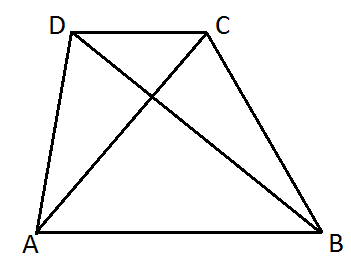
(i) How many pairs of adjacent sides are there? Name them.
Ans: Four; (AB, BC), (BC, CD), (CD, DA), (DA, AB)(ii) How many pairs of opposite sides are there? Name them.
Ans: Two; (AB, DC), (AD, BC)(iii) How many pairs of adjacent angles are there? Name them.
Ans: Four, (∠A, ∠B), (∠B, ∠C), (∠C, ∠D), (∠D, ∠A)(iv) How many pairs of opposite angles are there? Name them.
Ans: Two; (∠A, ∠C), (∠B, ∠D)(v) How many diagonals are there? Name them.
Ans: Two; (AC, BD)(3) Prove that the sum of a quadrilateral is 360 o .
 Solution: Let ABCD be a quadrilateral. Join AC.
Clearly, ∠1 + ∠2 = ∠A ……….(i)
And, ∠3 + ∠4 = ∠C ………..(ii)
We know that the sum of the angles of a triangle is 180
o
.
∴ From ∆ ABC, we have
∠1 + ∠3 + ∠B = 180
o
From ∆ACD, we have
∠1 + ∠3 + ∠D = 180
o
Adding the angles on either side, we get:
∠2 + ∠4 + ∠B + ∠1 + ∠3 + ∠D = 360
o
⇒ (∠1 + ∠2) + ∠B + (∠3 + ∠4) + ∠D = 360
o
⇒ ∠A + ∠B + ∠C + ∠D = 360
o
(proved)
Solution: Let ABCD be a quadrilateral. Join AC.
Clearly, ∠1 + ∠2 = ∠A ……….(i)
And, ∠3 + ∠4 = ∠C ………..(ii)
We know that the sum of the angles of a triangle is 180
o
.
∴ From ∆ ABC, we have
∠1 + ∠3 + ∠B = 180
o
From ∆ACD, we have
∠1 + ∠3 + ∠D = 180
o
Adding the angles on either side, we get:
∠2 + ∠4 + ∠B + ∠1 + ∠3 + ∠D = 360
o
⇒ (∠1 + ∠2) + ∠B + (∠3 + ∠4) + ∠D = 360
o
⇒ ∠A + ∠B + ∠C + ∠D = 360
o
(proved)
(4) The three of a quadrilateral are 76 o , 54 o and 108 o . Find the measure of the fourth angle.
Solution: Let the measure of the fourth angle be x o . ∴ 76 + 54 + 108 + x = 360 ⇒ x + 238 = 360 ⇒ x = 360 – 238 ⇒ x = 122 Hence, the measure of the fourth angle is 122 o .(5) The angles of a quadrilateral in the ratio 3 : 5 : 7 : 9. Find the measure of each of these angles.
Solution: Let the angles of the quadrilateral are 3x, 5x, 7x and 9x. ∴ 3x + 5x + 7x + 9x = 360 ⇒ 24x = 360 ⇒ x = 15 Therefore, measure of each angles are 3 × 15 = 45 o 5 × 15 = 75 o 7 × 15 = 105 o 9 × 15 = 135 o .(6) A quadrilateral has three acute angles, each measuring 75 o . Find the measure of the fourth angle.
Solution: Let the measure of the fourth angle be x o . ∴ x + (75 × 3) = 360 ⇒ x + 225 = 360 ⇒ x = 360 – 225 ⇒ x = 135 Therefore, measure of the fourth angle is 135 o .(7) Three angles of a quadrilateral are equal and the measure of the fourth angle is 120 o . Find the measure of each of equal angles.
Solution: Let the measure of each equal angle be x o . ∴ x + x + x + 120 = 360 ⇒ 3x = 360 – 120 ⇒ 3x = 240 ⇒ x = 80 Therefore, the measure of each of the equal angle is 80 o .(8) Two angles of a quadrilateral measure 85 o and 75 o respectively. The other two angles are equal. Find the measure of each of these equal angles.
Solution: Let the measure of each equal angle be x o . ∴ x + x + 85 + 75 = 360 ⇒ 2x + 160 = 360 ⇒ 2x = 360 – 160 ⇒ 2x = 200 ⇒ x = 100 Therefore, the measure of each equal angle is 100 o .(9) In the adjacent figure, the bisectors of ∠A and ∠B meet in a point P. If ∠C = 100 o and ∠D = 60 o , find the measure of ∠APB.
 Solution: Here,
 But, ∠BAP + ∠ABP + ∠APB = 180
o
⇒ 100
o
+ ∠APB = 180
o
⇒ ∠APB = 180
o
– 100
o
= 80
o
But, ∠BAP + ∠ABP + ∠APB = 180
o
⇒ 100
o
+ ∠APB = 180
o
⇒ ∠APB = 180
o
– 100
o
= 80
o
Benefits of RS Aggarwal Solutions for Class 8 Maths Chapter 15 Exercise 15.1
RS Aggarwal Solutions for Class 8 Maths Chapter 15 Exercise 15.1 on Quadrilaterals offer several benefits to students, enhancing their understanding and problem-solving skills in geometry. Here are the key benefits:Clear Conceptual Understanding: The solutions provide detailed explanations of different types of quadrilaterals, helping students grasp fundamental concepts and properties such as parallel sides, equal angles, and diagonal relationships.
Structured Approach: Each problem is solved step-by-step, allowing students to follow a logical progression and understand the methodology required for solving various quadrilateral-related problems.
Formula Application: The exercise emphasizes applying formulas for calculating the sum of interior angles and other specific properties of quadrilaterals, reinforcing mathematical reasoning and analytical skills.
Enhanced Problem-Solving Skills: By practicing diverse problems, students develop critical thinking and problem-solving abilities, essential for tackling more complex mathematical concepts in higher classes.
Exam Preparation: The solutions align with the curriculum and exam patterns, providing practice questions that help students prepare effectively for exams and improve their performance.
RS Aggarwal Solutions for Class 8 Maths Chapter 15 Exercise 15.1 FAQs
Who discovered quadrilaterals?
What are the facts about quadrilaterals Class 8?
Why is it important to understand quadrilaterals?
Who is the father of the quadrilateral?



 Live & recorded classes available at easeDashboard for progress trackingMillions of practice questions at your fingertips