
Vice Presidents of India, Complete List from 1952 to 2025
Vice Presidents of India, Complete List from 1952 to 2025. Check the names of all Vice Presidents, their tenure, and important details in chronological order.
 Parul Rishi20 Aug, 2025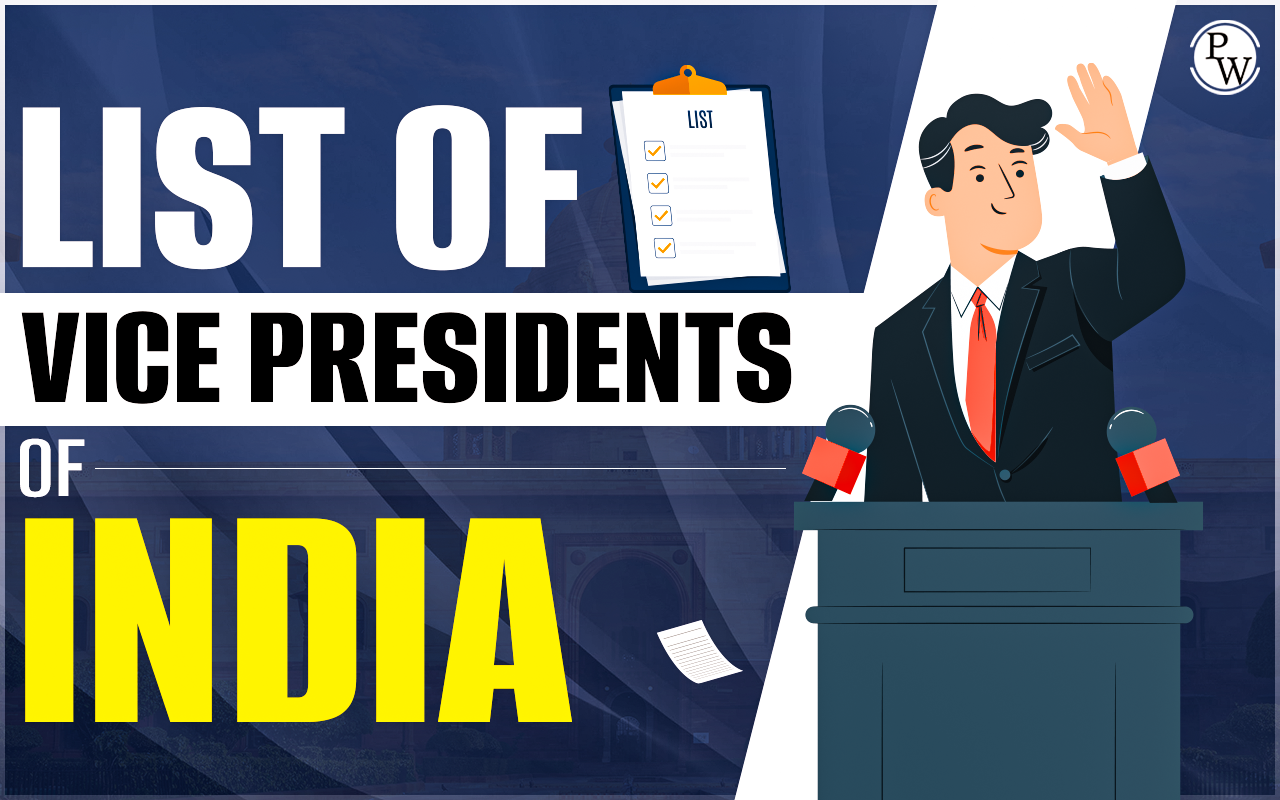
Vice Presidents of India: The Vice-President of India holds the second-highest authority in the country, following the President, in accordance with Article 65 of the Indian Constitution. The Vice-President also serves as the ex officio Chairman of the Rajya Sabha and takes charge of presidential duties in case of resignation, removal, demise, impeachment, or inability of the President to discharge responsibilities.
Vice Presidents of India
Vice-President of India serves as the ex-officio chairman of the Rajya Sabha. To be eligible for Vice President role in India, candidates must meet the following qualifications:- They must be a citizen of India and have reached the age of 35 years.
- They should not hold any position that provides financial gain under the jurisdiction of the central government, state government, public authority, or local authority.
Vice Presidents of India List
Vice President of India plays an important role in the country’s governance. Since 1952, India has had several Vice Presidents who have also served as the Chairpersons of the Rajya Sabha. The list below provides the names of all Vice Presidents of India, along with their tenure years, arranged in chronological order up to 2025:|
Vice Presidents of India List |
|
| Vice – President of India | Term of office |
| Sarvepalli Radhakrishnan (First Vice-President of India) | 13 May 1952 – 12 May 1957 13 May 1957 – 12 May 1962 |
| Zakir Hussain | 13 May 1962 – 12 May 1967 |
| V. V. Giri | 13 May 1967 – 3 May 1969 |
| Gopal Swarup Pathak | 31 August 1969 – 30 August 1974 |
| B. D. Jatti | 31 August 1974 – 30 August 1979 |
| Mohammad Hidayatullah | 31 August 1979 – 30 August 1984 |
| R. Venkataraman | 31 August 1984 – 24 July 1987 |
| Shankar Dayal Sharma | 3 September 1987 – 24 July 1992 |
| K. R. Narayanan | 21 August 1992 – 24 July 1997 |
| Krishan Kant | 21 August 1997 – 27 July 2002 |
| Bhairon Singh Shekhawat | 19 August 2002 – 21 July 2007 |
| Mohammad Hamid Ansari | 11 August 2007 – 11 August 2012 11 August 2012 – 11 August 2017 |
| Venkaiah Naidu | 11 August 2017 – 11 August 2022 |
| Jagdeep Dhankhar | 11 August 2022 – 22 July 2025 |
First Vice President of India
Sarvepalli Radhakrishnan held the distinction of being India's first Vice President. He was born on September 5, 1888, and his father's name was Shri S. Veerasamiah. Radhakrishnan was a renowned scholar and possessed a wealth of academic achievements. His educational qualifications included a Master of Arts (M.A.), an honorary Doctor of Letters (D. Litt.), a Doctor of Laws (LL.D.), a Doctor of Civil Law (D.C.L.), a Doctor of Literature (Litt. D.), a Doctor of Letters (D.L.), and memberships in various esteemed academic organizations such as F.R.S.L (Fellow of the Royal Society of Literature), F.B.A. (Fellow of the British Academy), and Hony. Fellow of All Souls College, Oxford.Present Vice President of India
The position of the Hon’ble Vice President of India is vacant since 22 July 2025, following the completion of the previous tenure.
Vice Presidents of India Power & Functions
The Vice President of India is the ex-officio Chairman of the Rajya Sabha, similar to how the Speaker leads the Lok Sabha. Like the U.S. Vice President who presides over the Senate, the Indian Vice President oversees the Upper House. If the office of the President becomes vacant due to removal, resignation, death, or any other reason, the Vice President takes over as Acting President for up to six months, until a new President is elected. The Vice President also performs the President’s duties during their absence or illness. An election to the Vice Presidency cannot be challenged because of vacancies in the Electoral College, and all actions taken before a court declares the election invalid remain valid.Vice Presidents of India Eligibility
The eligibility for a candidate to become the Vice President of India are outlined in the Indian Constitution, specifically in Article 66. Here are the essential qualifications:- Citizenship: Citizen of India.
- Age: The candidate should be at least 35 years of age.
- Eligible Member of the Rajya Sabha: To be eligible for the position of Vice President, the candidate must be qualified to be elected as a member of the Rajya Sabha (Council of States), which is the upper house of India's Parliament.
- Non-Membership in the Rajya Sabha: A candidate cannot be a sitting member of the Rajya Sabha at the time of their election as Vice President. This means they should not currently hold a seat in the Rajya Sabha.
- Absence of Office of Profit: The candidate should not hold any office of profit under the Government of India, the Government of any State, or under any local or other authority subject to the control of either of the governments mentioned above.
Vice President of India Constitutional Provision
The constitutional provision that governs the office of the Vice President of India is primarily outlined in Article 63 and Article 64 of the Indian Constitution:- Article 63 : This article establishes the office of the Vice President of India. Article 63 states that there shall be a Vice President of India.
- Article 64 : This article deals with the manner of the election of the Vice President. It specifies that the Vice President is elected by an electoral college consisting of members of both houses of Parliament, with each member having a weighted vote calculated based on the population they represent.
Vice President of India Tenure
The Vice President of India commences their office on the designated date, with a term lasting five years. However, they retain the option to resign from the position before the full five-year term elapses. The following circumstances also result in the Vice President's position becoming vacant:- Conclusion of the five-year term.
- Voluntary resignation.
- Removal from office.
- Demise.
- Election invalidated.
Vice President of India Important Facts
The Vice President of India is the second-highest constitutional office in the country, with duties and powers similar to that of the Speaker of the Lok Sabha (House of the People).- Ex-Officio Chairman of Rajya Sabha: One of the most significant roles of the Vice President is to serve as the ex-officio Chairman of the Rajya Sabha (Council of States), the upper house of India's Parliament. In this capacity, the Vice President presides over its sessions and ensures orderly conduct.
- Election Process: The Vice President is elected by an electoral college that consists of members from both houses of Parliament, i.e., the Rajya Sabha and the Lok Sabha. State legislatures do not participate in the Vice Presidential election.
- Term Duration: The term of the Vice President is five years, but they can continue in office until their successor assumes the role.
- Acting President: In the absence of the President of India due to travel, illness, or any other reason, the Vice President assumes the role of Acting President and exercises the powers and duties of the President during that period.
- Removal Process: The Vice President can be removed from office by a resolution passed by a majority of the members of the Rajya Sabha, but only if the resolution is agreed upon by the Lok Sabha as well.
- Qualifications: To be eligible for the position, a candidate must be an Indian citizen, at least 35 years old, eligible to be elected as a member of the Rajya Sabha, and shouln't hold any office of profit.
- Vice Presidents List: India has had several Vice Presidents since the position was established in 1950, with the first Vice President being Dr. Sarvepalli Radhakrishnan.
- Role in Legislation: The Vice President plays a crucial role in the legislative process by casting the deciding vote in case of a tie in the Rajya Sabha.
- Neutrality: While candidates may have political affiliations, the Vice President is expected to be non-partisan and uphold the dignity and integrity of the office.
| Other Related Links | |
| Tiger Reserves in India | National Parks in India |
| Biosphere Reserves in India | Elephant Reserves in India |
Vice Presidents of India 2025 FAQs
Who is the first woman Vice-President of India?
India never had a female Vice-President
Who is the 14th Vice President of India?
Jagdeep Dhankhar is the 14th vice President of India.
Who was the first Vice-President of India? -
Dr. Sarvepalli Radhakrishnan was the first Vice-President of India.
Who is the longest-serving Vice President of India?
Mohammad Hamid Ansari is the longest-serving Vice President of India.



Join 15 Million students on the app today!
 Live & recorded classes available at easeDashboard for progress trackingMillions of practice questions at your fingertips


Free Learning Resources
PW Books
Notes (Class 10-12)
PW Study Materials
Notes (Class 6-9)
Ncert Solutions
Govt Exams
Our Other Websites
Class 6th to 12th Online Courses
Govt Job Exams Courses
UPSC Coaching
Defence Exam Coaching
Gate Exam Coaching
Other Exams
Know about Physics Wallah
Physics Wallah is an Indian edtech platform that provides accessible & comprehensive learning experiences to students from Class 6th to postgraduate level. We also provide extensive NCERT solutions, sample paper, NEET, JEE Mains, BITSAT previous year papers & more such resources to students. Physics Wallah also caters to over 3.5 million registered students and over 78 lakh+ Youtube subscribers with 4.8 rating on its app.
We Stand Out because
We provide students with intensive courses with India’s qualified & experienced faculties & mentors. PW strives to make the learning experience comprehensive and accessible for students of all sections of society. We believe in empowering every single student who couldn't dream of a good career in engineering and medical field earlier.
Our Key Focus Areas
Physics Wallah's main focus is to make the learning experience as economical as possible for all students. With our affordable courses like Lakshya, Udaan and Arjuna and many others, we have been able to provide a platform for lakhs of aspirants. From providing Chemistry, Maths, Physics formula to giving e-books of eminent authors like RD Sharma, RS Aggarwal and Lakhmir Singh, PW focuses on every single student's need for preparation.
What Makes Us Different
Physics Wallah strives to develop a comprehensive pedagogical structure for students, where they get a state-of-the-art learning experience with study material and resources. Apart from catering students preparing for JEE Mains and NEET, PW also provides study material for each state board like Uttar Pradesh, Bihar, and others
Copyright © 2026 Physicswallah Limited All rights reserved.