IELTS Listening Maps and Navigation, Tips, Strategy & Common Mistakes
 Aarti .29 Apr, 2026
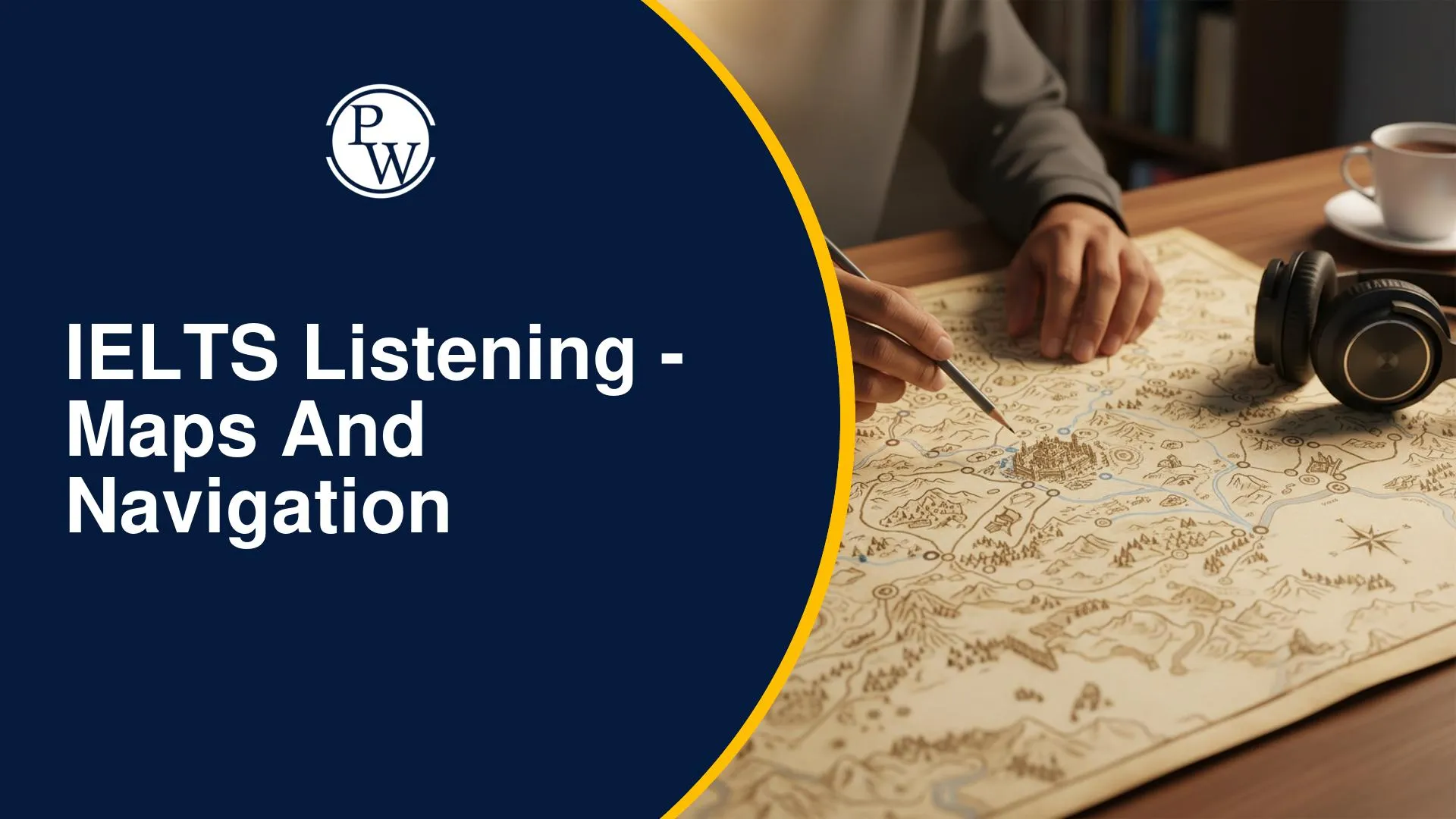
IELTS Listening Maps and Navigation questions can be tricky because they test your ability to follow directions, identify locations, and track movement in real time. Many test-takers lose marks by missing keywords, confusing left and right directions, or failing to use preparation time effectively.
Scoring well requires using the right strategy and staying focused throughout the audio. By understanding how to approach the map before the recording starts, following directions carefully during the audio, and avoiding common mistakes, you can improve both speed and accuracy.
Read on to learn effective pre-audio strategies, during-audio techniques, and common mistakes to avoid in IELTS Listening map and navigation questions.
IELTS Listening - Maps and Navigation Questions
A Maps and Navigation question in IELTS Listening presents a map with various locations marked (e.g., A, B, C, D). The audio provides navigation instructions to identify specific places like a café or library. Your task is to listen to these directions and mark the correct locations on the map.
Types of Maps
Maps in the IELTS 2026 Listening test generally fall into two categories:
-
Indoor Maps: These show internal layouts such as office premises, cafés, libraries, restaurants, or hotels.
-
Outdoor Maps: These typically show park layouts, road junctions, or general road arrangements.
Challenge Faced by Students in IELTS Listening Maps And Navigation Questions
In the IELTS Listening Test, distraction is a common challenge that can significantly impact performance, especially in the initial questions. Since the audio plays only once, even a brief loss of focus can lead to missed answers.
-
Distraction leads to incorrect answers or missing initial questions.
-
This lack of attention frequently results in 90% of the time people getting their first question wrong.
IELTS Listening Maps And Navigation Strategy
Here are the IELTS Listening Maps and Navigation Strategy to attempt questions and improve your score
Pre-Audio Strategy
In the IELTS Listening Test, the pre-audio stage sets the foundation for your performance. This is the time to understand the map, identify key details, and prepare mentally so that you can follow the directions confidently once the audio begins.
Utilising the 30-Second Buffer
Before the audio begins, a 30-second buffer is provided. This time is critical for preparation, not just reading. The first step is to read the title carefully. You must
-
Understand the question's content
-
Identify keywords
-
Highlight crucial words.
Analyzing the Map Title and Context
When reading the map title, identify what place it is (e.g., a museum, park, campus, hotel). It is also important to note if it represents a present layout, a future plan, or changes.
Analyzing the Map Layout
The goal is to avoid reading the map extensively during the audio. When studying a map, it's crucial to analyze the existing locations. Often, 30-50% of the locations are already marked. Before the audio starts,
-
Understand what kind of map it is
-
Identify all pre-labeled locations.
Identifying the Starting Point
Identifying the starting point or entrance is important for navigation.
-
Indoor Maps: Entrances might be labeled as Reception, Entrance, or "You are here" (often marked with an 'X').
-
Outdoor Maps: Entrances could be marked as Main Gate, "You are here", Entrance, or Welcome.
The map will always clearly indicate where to begin your navigation.
Marking Landmarks (Anchoring Strategy)
-
Underline and circle key landmarks to use as reference points
-
Examples: library, café, road, bridge, station
-
These anchors help track movement during listening
Sources of Navigation
-
Outdoor Maps: Include Roads (main road, footpath, streets, lanes).
-
Indoor Maps: Include Gallery, Lanes, Stairs.
Understanding Directions on the Map
Besides roads, buildings, rivers, and corners, directions are critical.
Comparison: Compass Direction vs. Left and Right Directions
-
Most maps include a compass direction (North, South, East, West). (Memory Tip: If a compass is not provided, draw one.)
-
The other type of direction is Right and Left. This is relative to your orientation on the map and your direction of travel.
During Audio Strategy
The during-audio stage is where accuracy depends on continuous focus and real-time tracking. Since the recording plays only once, you must listen carefully, follow directions step-by-step, and use map cues effectively to avoid missing or misinterpreting information.
Listening for Directional Cues
-
Straight: “go straight,” “walk along,” “cross past.”
-
Turns: “turn left/right,” “at the corner.”
-
Position: “next to,” “opposite,” “between.”
-
Expect 2–3 clues for one answer—listen fully before deciding
Active Tracking and Directional Language
During the active tracking stage, the speaker provides hints, sometimes two to three for a single location. You must listen for specific directional language:
-
Straight: "Go straight," "walk along," "cross past" (indicating something just passed).
-
Turn: "Turn left/right," "at the corner," "behind," "in front of."
-
Position: "Next to," "opposite," "between," "on the left/right."
-
Directional Prepositions: "Above, below, between, joining, move towards."
Common Mistakes to Avoid in IELTS Listening Maps And Navigation Questions
In the IELTS Listening Test, map and navigation questions require continuous attention from start to finish. Most errors happen in a sequence—right from missing the starting point to falling for distractors and losing track midway. Understanding these mistakes in the order they occur can help improve accuracy.
1. Losing the Starting Point
-
Not paying attention at the beginning leads to confusion later
-
Missing the initial location disrupts the entire route understanding
-
The starting point forms the base for all directions that follow
2. Falling for Distractors
-
Speakers often mention irrelevant landmarks to mislead
-
Example: mentioning a “school” when the key instruction is “turn right before it”
-
Self-corrections in audio can trick you into choosing the wrong answer
3. Jumping to Conclusions Too Early
-
Assuming answers before hearing the full instruction leads to errors
-
Misinterpreting phrases like “first turn” without context
4. Losing Focus Midway
-
Missing even a single direction breaks the sequence
-
Not following the map actively reduces accuracy
5. Confusing Directions and Landmarks
-
Mixing up left and right turns
-
Getting confused between similar-sounding places
-
Overlooking small but important differences in names
6. Spelling and Sequence Errors
-
Incorrect spelling can cost marks even if the answer is correct
-
Losing track of the order leads to mismatched answers
7. Not Actively Tracking the Route
-
Failing to trace the path with a pencil reduces concentration
-
Not refocusing quickly after missing a point leads to further mistakes
Band 7 Strategy Tips
To aim for a Band 7 score:
-
Predict directional vocabulary before the audio begins.
-
Stay aware of the compass directions (North, South, East, West).
-
Stay calm if an answer is missed; do not panic.
In the IELTS Listening Test, map-based questions require a structured approach across all stages. Use the pre-audio time to analyze the map, identify the starting point, and mark key landmarks.
During the audio, focus on directional cues, follow the route actively, and avoid distractors. Stay alert to common mistakes like confusing directions, losing sequence, or jumping to conclusions. If you miss a point, quickly refocus without panic. Consistent practice with these strategies improves accuracy, confidence, and overall performance.
Explore the IELTS Coaching Classes to access essential resources for IELTS exam preparation, including detailed insights and strategies. Dive into the IELTS 2026 for structured courses and focused study plans designed to help aspirants in their exams.
IELTS Listening Maps and Navigation FAQs
What are Maps and Navigation questions in IELTS Listening?
Why is the 30-second buffer important before the audio starts?
How do I identify the starting point on a map?
What are common types of distractions in these questions?