






IELTS Listening Maps Diagrams Practice Test: Simple Strategies
 Aarti .26 May, 2026
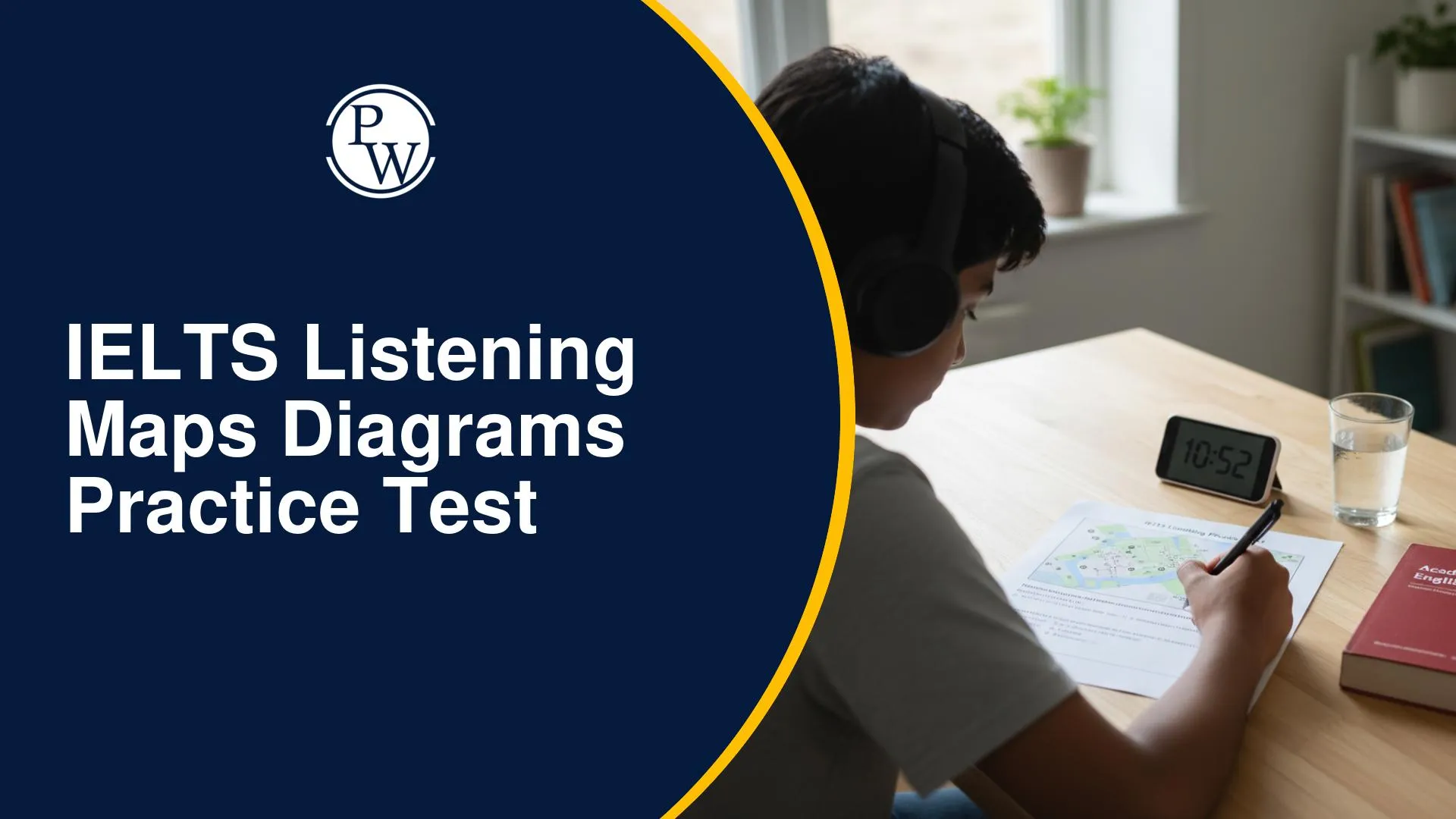
IELTS Listening Maps and Navigation questions test your ability to follow directions, understand locations, and track movement while listening. These questions can be tricky because the audio moves quickly and may include similar landmarks, left-right confusion, or sudden changes in direction.
To answer correctly, students must first study the map, identify the starting point, predict possible answers, and understand common directional words. This explains simple strategies to handle map-based listening questions with better focus and accuracy. With regular practice, you can avoid common mistakes, follow routes confidently, and improve your chances of getting a higher IELTS Listening band score.
Prediction Stage: Before the Audio Starts
The 30 seconds before the audio starts is a crucial "prediction stage" for Maps and Navigation questions. During this time, candidates should
-
Read the title carefully to understand the context.
-
Read the questions to know what information to listen for.
-
Read the map properly, identifying the place type (e.g., museum, park, campus, hotel).
Maps can generally be categorized as:
-
Indoor Maps: Typically used for offices, schools, clubs, sports complexes, or libraries.
-
Outdoor Maps: Usually depict junctions, parks, amusement parks, or zoos.
While identifying if a map shows a present layout or a future plan is relevant, the primary focus in IELTS listening for maps is on navigation.
Identify Your Starting Point
Identifying the starting point is paramount because it dictates the direction of movement throughout the map. Familiarity with North, South, East, West (compass directions) is essential, alongside understanding other directional terms like left and right.
Common starting points include:
-
An explicit entrance.
-
A marked location such as "you are here."
-
A reception area.
Look for signs indicating entry, such as "Entrance," "Enter," or "Welcome." Losing the starting point will lead to a complete loss of direction within the map.
Underline Landmarks
Landmarks serve as vital navigational anchors. Candidates should circle or highlight them on the map during the prediction stage.
Sources of navigation differ between map types:
-
Indoor Maps: Navigation sources can include floors, galleries, lanes, or stairs.
-
Outdoor Maps: Navigation sources can include roads, main roads, side paths, footpaths, lanes, or streets.
Ensure all marked navigation sources are properly identified. If a map does not include a compass, it is advisable to draw one for personal reference to establish North, South, East, West directions.
Directional and Prepositional Language
A precise understanding of directional and prepositional language is critical for accuracy in map questions. Candidates must be familiar with:
-
Various terms indicating straight movement.
-
Various terms indicating turns.
-
The precise meaning of prepositions that describe position, such as:
-
-
next to
-
beside
-
by
-
opposite
-
between
-
adjoining
-
A single misinterpretation of a preposition can lead to an incorrect answer. Mastering this language is key to achieving a high score in this question type.
Strategy: Pencil Tip / Follow Your Pencil
This highly effective strategy involves physically tracing the route on the map as the audio plays.
-
For Pen-Paper Based Tests: Place your pencil tip on the map's entrance and move it along the path as described in the audio.
-
For Computer-Based Tests: Place a pointer (like a pen or pencil) near the entrance on the screen (without touching it) and trace the path mentally or physically in the air, following the audio instructions.
The benefits of this strategy are significant:
-
It enhances concentration.
-
It reduces distraction.
-
It provides a high level of accuracy (approximately 90%).
-
It ensures the correct location is identified, leading directly to the right answer.
Common Traps in Maps and Navigation
Candidates should be aware of several common pitfalls that can lead to incorrect answers:
-
Do not get confused between left and right - Left and right can change depending on the direction you are moving on the map.
-
Practice imagining direction changes - Try to mentally turn yourself according to the speaker’s route.
-
Be careful with similar landmarks - The speaker may mention places that sound similar, like old library and new library.
-
Focus on the latest information - The correct answer usually depends on the current direction or new detail given by the speaker.
-
Do not depend on one word only - A small detail can change the correct location.
-
Check spellings carefully - Even if your answer is correct, wrong spelling can make you lose marks.
-
One letter can matter - Missing or incorrect letters may lead to a wrong answer.
-
Follow the order of directions- Map questions usually move step by step in the same sequence as the audio.
-
Do not panic if you miss one answer - Stay calm and continue listening.
-
Try to catch the next location - The next direction often starts from the previous point, so you can still recover and answer the remaining questions.
IELTS Listening Maps Diagrams Practice Test FAQs
Why is identifying the starting point crucial in IELTS Listening maps?
What types of landmarks should candidates look for on a map?
How does understanding directional and prepositional language impact map questions?
Explain the "Pencil Tip" strategy for map questions?






Get Free Counselling Today
and Clear up all your Doubts
 Live & recorded classes available at easeDashboard for progress trackingLakhs of practice questions

