IELTS Reading MCQ Tips & Tricks for Band 8+



IELTS Reading MCQs are one of the most common question types in the IELTS Reading module. In this format, students are given a question with multiple options, and they must select the correct answer based on the passage.
Understanding how to approach IELTS Reading MCQs is essential for achieving a high band score. Many candidates lose marks because they read the passage incorrectly or fail to eliminate wrong options. With the right strategy and practice, students can solve these questions quickly and accurately.
What Are IELTS Reading MCQs?
In the IELTS Reading section, IELTS Reading MCQs require students to choose the correct answer from four given options (A, B, C, or D). The answer must match the information in the passage.
These questions test several important skills, such as:
-
Understanding the main idea of a paragraph
-
Identifying keywords and synonyms
-
Locating specific information in the passage
-
Recognizing paraphrased statements
Because IELTS passages often use paraphrasing, the exact words from the question may not appear in the text. Therefore, students must develop the ability to identify similar meanings rather than identical words.
Step-by-Step Strategy to Solve IELTS Reading MCQs
To score well in IELTS Reading MCQs, students should follow a structured strategy instead of reading the entire passage first.
1. Read the Main Question First
Before looking at the answer options, carefully read the main question. This helps you understand what information you need to find in the passage.
For example, a question may ask about a specific person, event, or time period. Focusing on the question first makes it easier to locate the relevant section.
2. Identify Important Keywords
The next step in solving IELTS Reading MCQs is to identify keywords in the question. Good keywords include:
-
Proper nouns (names of people or places)
-
Numbers and dates
-
Unique terms or phrases
For example, names like Anne Kennedy or dates such as 1991 are strong keywords because they usually appear directly in the passage.
3. Use Scanning Technique in IELTS Reading MCQs
One of the most important techniques for IELTS Reading MCQs is scanning.
Scanning means quickly searching the passage for specific keywords instead of reading every line. Students should locate the keyword and then read the surrounding sentences carefully.
This technique saves time and allows candidates to focus only on the relevant section of the passage.
4. Understand Paraphrasing in IELTS Reading MCQs
A common challenge in IELTS Reading MCQs is paraphrasing. IELTS rarely repeats the same words from the question in the passage.
Instead, the test uses synonyms or similar expressions.
For example:
|
Question Word |
Possible Paraphrase in Passage |
|
Reminded |
Recalled / remembered |
|
Created |
Developed / established |
|
Closed |
Stopped operating |
Recognizing these paraphrases is essential for choosing the correct answer.
5. Elimination Technique for IELTS Reading MCQs
The elimination method is one of the most effective strategies for solving IELTS Reading MCQs.
Usually, out of four options:
-
Two options are clearly incorrect
-
The remaining two require careful comparison
Students should eliminate obviously wrong answers first. Then they should carefully compare the remaining options with the passage.
Example Approach
-
Remove options that contradict the passage
-
Remove options not mentioned in the passage
-
Compare the remaining options carefully
-
Select the answer that matches the passage exactly
Each word in the option matters, so students must read the choices very carefully.
IELTS Reading MCQs Practice Questions
The following IELTS Reading MCQs practice questions are based on the explanation and examples discussed in the lecture.
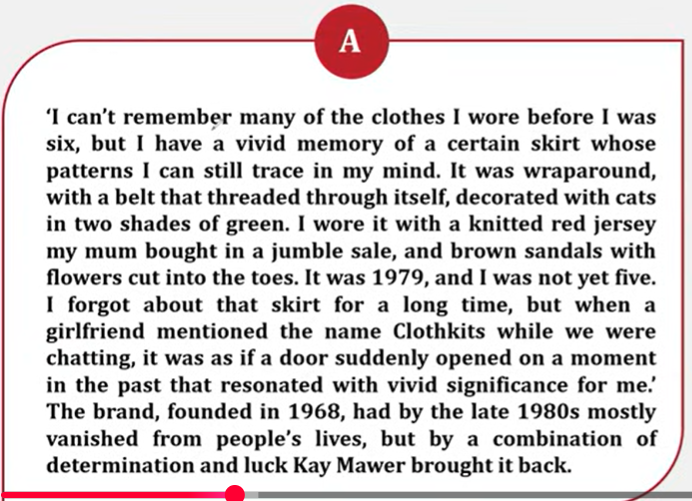
Question 1
In paragraph A, the writer says that K Moyer was reminded about Clothkits by:
A. A shop she visited
B. A purchase she made
C. An outfit someone was wearing
D. A conversation with someone she knew
Answer: D
The passage states that a girlfriend mentioned Clothkits while they were chatting, which reminded the writer of it.
Question 2
What does the reader learn about Clothkits in the 1960s and 1970s?
A. Its designs represented the attitudes of the time
B. Its products were only affordable for wealthy people
C. Its creator tried several times to launch the company
D. Its management was spread across many countries
Answer: A
The passage explains that Clothkits embodied the spirit of the late 1960s and 1970s.
Question 3
Why did Clothkits close in 1991?
A. There were unexpected staffing problems
B. Funding for sewing activities was insufficient
C. Freeman was an unsuitable partner
D. Records on the company database were lost
Answer: C
The passage states that the ethos of the corporate company did not match the artistic values of Clothkits.
Question 4
What point does the writer make in paragraph E?
A. Clothkits will reach more markets in the future
B. Clothkits will need larger business premises
C. People are more concerned about throwing away items than before
D. People do less sewing now than in the past
Answer: C
The paragraph explains that people are becoming dissatisfied with disposable culture and are showing renewed interest in sewing and crafting.
Common Mistakes in IELTS Reading MCQs
Many students lose marks in IELTS Reading MCQs because of common mistakes.
Some of the most frequent mistakes include:
-
Reading the answer options before understanding the question
-
Looking for exact words instead of synonyms
-
Choosing answers based on general understanding rather than specific details
-
Ignoring small words that change the meaning of a sentence
Avoiding these mistakes can significantly improve accuracy in IELTS Reading.
Key Tips to Score Band 8+ in IELTS Reading MCQs
Students aiming for a high score should remember these important IELTS Reading MCQ tips:
-
Always read the main question first
-
Identify strong keywords such as names and numbers
-
Use scanning instead of reading the whole passage
-
Watch for synonyms and paraphrasing
-
Eliminate incorrect options quickly
-
Read the final two options very carefully before choosing
Consistent practice using these strategies can greatly improve performance in IELTS Reading.
IELTS Reading MCQs may seem difficult at first, but they become manageable with the right strategy. By focusing on keywords, scanning the passage, understanding paraphrasing, and applying the elimination technique, students can answer questions more accurately.
Regular practice with IELTS Reading MCQs will help candidates build confidence and improve their speed in the IELTS Reading section. With these tips and techniques, students can significantly increase their chances of achieving a Band 8 or higher.