Let's Go Bats Reading Answers with IELTS Passage
Let's Go Bats Reading Answers explores how bats use echolocation to navigate in the dark. The passage is commonly featured in the IELTS Academic Reading section, testing skills like multiple choice, sentence completion, and inference. Practicing this passage helps boost accuracy, understand IELTS reading question types, and improve overall band scores.

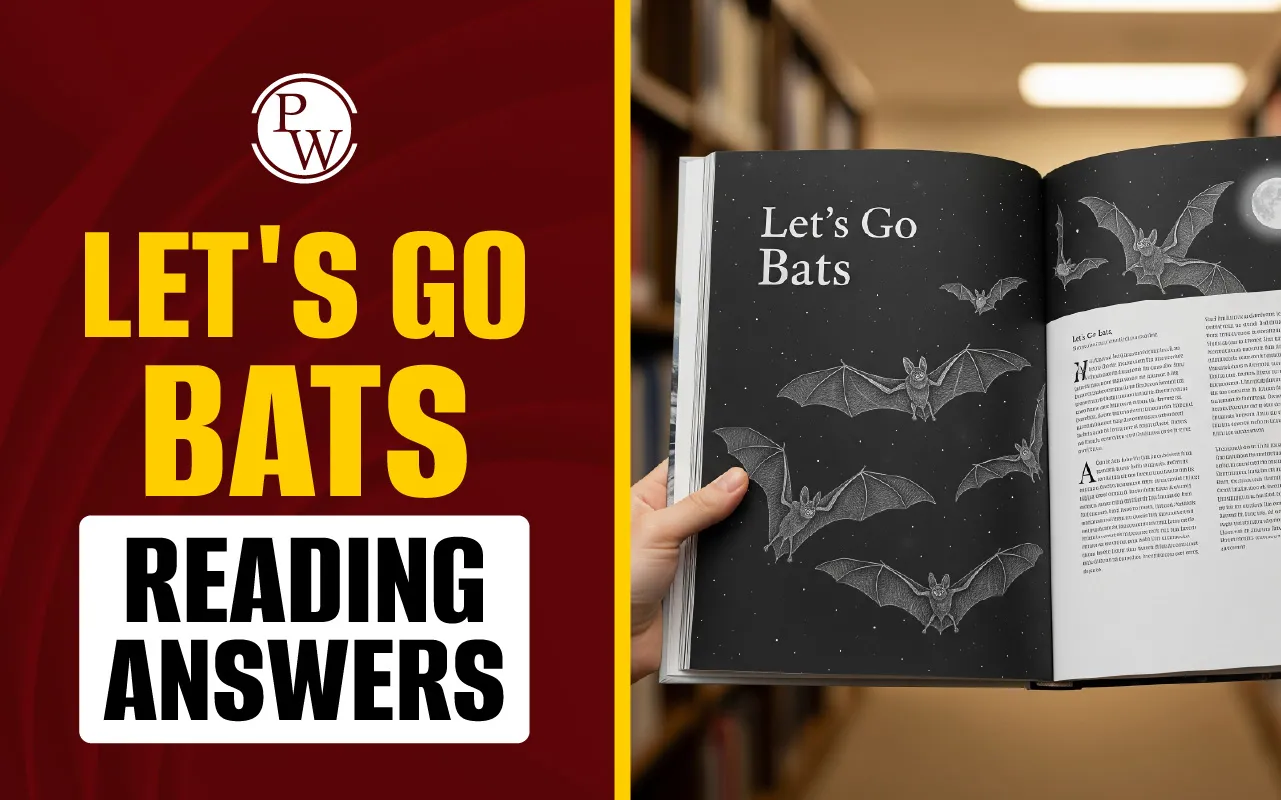
Let's Go Bats Reading Answers explores how bats navigate in the dark using echolocation, a fascinating natural adaptation. This bats IELTS reading passage is a popular choice in the IELTS academic reading test, often testing candidates on comprehension and inference skills.
By practicing bats passage reading answers, learners can sharpen their understanding of tricky IELTS reading question types. It aligns with common IELTS Reading Topics such as multiple choice questions, sentence completion, and understanding IELTS Reading structure for improving your overall IELTS Reading Band Score.
Let's Go Bats Reading Answer Passage
The bats IELTS reading passage is an exciting text that explains how bats use echolocation to survive in darkness. Practicing the let’s go bats reading test IELTS academic helps candidates strengthen skills in handling IELTS Reading Topics, mastering IELTS Reading structure, and boosting their IELTS Reading Band Score.
Let's Go Bats Reading Passage
A. Bats have a problem: how to find their way around in the dark. They hunt at night and cannot use light to help them find prey and avoid obstacles. You might say that this is a problem of their own making, one that they could avoid simply by changing their habits and hunting by day. But the daytime economy is already heavily exploited by other creatures such as birds. Given that there is a living to be made at night, and given that alternative daytime trades are thoroughly occupied, natural selection has favoured bats that make a go of the night-hunting trade. It is probable that the nocturnal trades go way back in the ancestry of all mammals. In the time when the dinosaurs dominated the daytime economy, our mammalian ancestors probably only managed to survive at all because they found ways of scraping a living at night. Only after the mysterious mass extinction of the dinosaurs about 65 million years ago were our ancestors able to emerge into the daylight in any substantial numbers.
B. Bats have an engineering problem: how to find their way and find their prey in the absence of light. Bats are not the only creatures to face this difficulty today. Obviously, the night-flying insects that they prey on must find their way about somehow. Deep-sea fish and whales have little or no light by day or by night. Fish and dolphins that live in extremely muddy water cannot see because, although there is light, it is obstructed and scattered by the dirt in the water. Plenty of other modern animals make their living in conditions where seeing is difficult or impossible.
C. Given the questions of how to manoeuvre in the dark, what solutions might an engineer consider? The first one that might occur to him is to manufacture light, to use a lantern or a searchlight. Fireflies and some fish (usually with the help of bacteria) have the power to manufacture their own light, but the process seems to consume a large amount of energy. Fireflies use their light for attracting mates. This doesn't require a prohibitive amount of energy: a male’s tiny pinprick of light can be seen by a female from some distance on a dark night, since her eyes are exposed directly to the light source itself. However, using light to find one's own way around requires vastly more energy, since the eyes have to detect the tiny fraction of the light that bounces off each part of the scene. The light source must therefore be immensely brighter if it is to be used as a headlight to illuminate the path than if it is to be used as a signal to others. In any event, whether or not the reason is the energy expense, it seems to be the case that, with the possible exception of some weird deep-sea fish, no animal apart from man uses manufactured light to find its way about.
D. What else might the engineer think of? Well, blind humans sometimes seem to have an uncanny sense of obstacles in their path. It has been given the name 'facial vision’, because blind people have reported that it feels a bit like the sense of touch, on the face. One report tells of a totally blind boy who could ride his tricycle at good speed round the block near his home, using facial vision. Experiments showed that, in fact, facial vision is nothing to do with touch or the front of the face, although the sensation may be referred to the front of the face, like the referred pain in a phantom limb.The sensation of facial vision, it turns out, really goes in through the ears.
Blind people, without even being aware of the fact, are actually using echoes of their own footsteps and of other sounds to sense the presence of obstacles. Before this was discovered, engineers had already built instruments to exploit the principle, for example, to measure the depth of the sea under a ship. After this technique had been invented, it was only a matter of time before weapons designers adapted it for the detection of submarines. Both sides in the Second World War relied heavily on these devices, under such codenames as Asdic (British) and Sonar (American), as well as Radar (American) or RDF (British), which uses radio echoes rather than sound echoes.
E. The Sonar and Radar pioneers didn't know it then, but all the world now knows that bats, or rather natural selection working on bats, had perfected the system tens of millions of years earlier; and their radar' achieves feats of detection and navigation that would strike an engineer dumb with admiration. It is technically incorrect to talk about bat 'radar', since they do not use radio waves. It is sonar. But the underlying mathematical theories of radar and sonar are very similar; and much of our scientific understanding of the details of what bats are doing has come from applying radar theory to them. The American zoologist Donald Griffin, who was largely responsible for the discovery of sonar in bats, coined the term 'écholocation' to cover both sonar and radar, whether used by animals or by human instruments.
Let's Go Bats Reading Sample Questions
The bats passage reading answers highlight how IELTS assesses comprehension through diverse formats like IELTS Reading multiple choice questions and IELTS Reading Sentence Completion Questions. Exploring the bat echolocation IELTS reading passage provides insights into IELTS Reading Question Types and helps learners focus on strategies to improve accuracy and IELTS Reading Test Format performance.
| Sample Questions on IELTS Let's Go Bats Reading Answers | ||
| Question Type | Question | Options / Instructions |
| Multiple Choice | According to the passage, why did early mammals likely adopt nocturnal habits? | A) To avoid predatory birds B) To escape dinosaurs C) To hunt insects D) To use echolocation early Answer: B |
| True / False / Not Given | Fireflies manufacture light primarily for the purpose of navigation. | Answer: False |
| Matching Information | Match the following with the correct paragraph: (i) Use of sonar in warfare (ii) Energy cost of producing light (iii) Mammals surviving at night | A) Paragraph A B) Paragraph B C) Paragraph C D) Paragraph D E) Paragraph E Answers: iii-A, ii-C, i-D |
| Sentence Completion | Blind people use _________ unconsciously to sense the presence of obstacles. | Answer: echoes of their own footsteps / sounds |
| Short Answer Question | Who coined the term “echolocation” to describe sonar and radar used by both animals and humans? | Answer: Donald Griffin |
| Multiple Choice | Why don’t most animals use manufactured light to navigate? | A) Lack of skill B) Too much energy required C) They are afraid of light D) Humans invented it first Answer: B |
| Yes / No / Not Given | The term “facial vision” was found to be directly related to the sense of touch in blind people. | Answer: No |
IELTS Let's Go Bats Reading Answers
The IELTS Let's Go Bats Reading Answers explore how bats survive at night using echolocation, making it a fascinating bats IELTS reading passage. Practicing this let’s go bats reading test IELTS academic improves understanding of IELTS Reading Topics, IELTS Reading Question Types, and helps candidates boost their overall IELTS Reading Band Score.
| IELTS Let's Go Bats Reading Answers | ||
| Question Type | Question (Short Form) | Answer |
| Multiple Choice | Why did early mammals likely adopt nocturnal habits? | B) To escape dinosaurs |
| True / False / Not Given | Fireflies manufacture light primarily for the purpose of navigation. | False |
| Matching Information | (i) Use of sonar in warfare (ii) Energy cost of producing light (iii) Mammals surviving at night | i-D, ii-C, iii-A |
| Sentence Completion | Blind people use _________ unconsciously to sense obstacles. | Echoes of their own footsteps / sounds |
| Short Answer Question | Who coined the term “echolocation”? | Donald Griffin |
| Multiple Choice | Why don’t most animals use manufactured light to navigate? | B) Too much energy required |
| Yes / No / Not Given | “Facial vision” directly related to touch in blind people. | No |
Guidance to PW IELTS Prep
IELTS Online Courses is a great initiative Physics Wallah took to help IELTS aspirants better prepare for the exam. Follow our below pages to learn more about the IELTS exam.| IELTS Reading Band Score | IELTS Listening Band Score |
| IELTS Speaking Band Score | IELTS Writing Band Score |
IELTS Let's Go Bats Reading Answers FAQs
What is the main theme of the bats IELTS reading passage?
Which IELTS Reading Question Types are common in the Lets Go Bats reading test IELTS academic?
Who introduced the term echolocation in the bat echolocation IELTS reading passage?
Why is practicing Bats Passage reading answers useful for IELTS learners?
What strategy helps in solving IELTS Reading multiple choice questions from this passage?




 Live & recorded classes available at easeDashboard for progress trackingMillions of practice questions at your fingertips