







Super TET CDP: Notes, Important Questions, PYQs & Preparation Tips
Super TET CDP covers Child Development, Learning Theories, Intelligence, Motivation, Inclusive Education, and Pedagogy. Prepare with the syllabus, notes, video classes, topic-wise MCQs, PYQs, practice sets, and mock tests to strengthen concepts and improve exam performance.
 Abhishek Kumar4 Aug, 2026
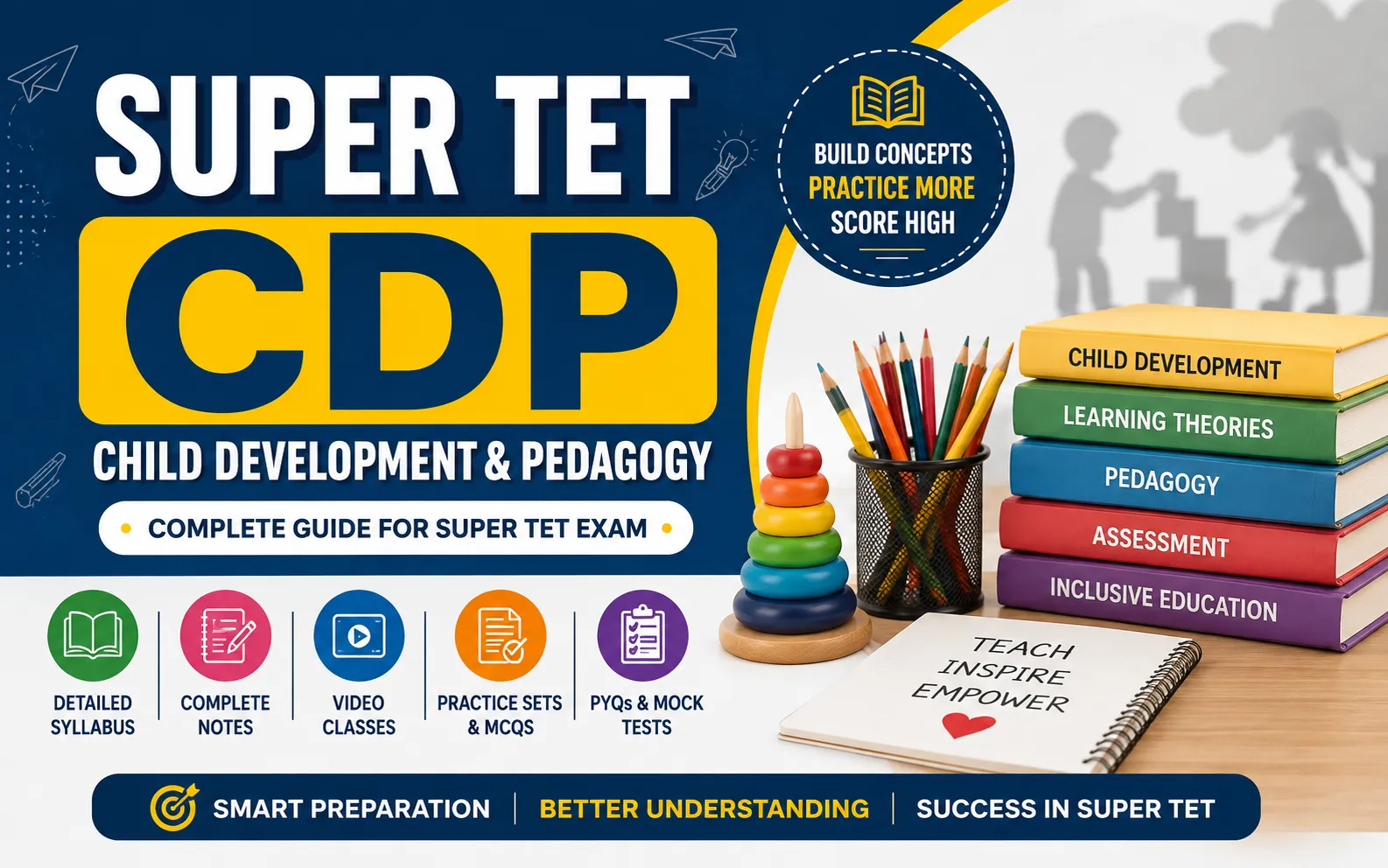
Super TET CDP, or Child Development and Pedagogy, is an important area of preparation for candidates appearing for the Super TET examination. It covers concepts related to child development, learning, individual differences, learning theories, inclusive education, teaching-learning processes, and pedagogy. A clear understanding of these concepts can help candidates solve conceptual and application-based questions more effectively.
This page provides a complete resource for Super TET CDP preparation, including the Super TET CDP Syllabus, Super TET CDP Notes, important topics, topic-wise video classes, Super TET CDP Questions, MCQs, Practice Sets, PYQs, Previous Year Papers, Mock Tests, and Preparation Tips.
Candidates can use this page as a central learning resource to understand the subject, strengthen their concepts, practise questions, and revise important topics for the examination.
Super TET CDP Overview
Child Development and Pedagogy focuses on understanding how children develop and learn and how teachers can create effective learning environments for students with diverse needs and abilities.
The subject broadly covers two interconnected areas: Child Development and Pedagogy. Child Development deals with the physical, cognitive, social, emotional, and language development of children, while Pedagogy focuses on teaching methods, learning processes, classroom practices, assessment, and inclusive education.
| Particular | Details |
|---|---|
| Subject | Child Development and Pedagogy (CDP) |
| Commonly Known As | CDP, Child Development, Pedagogy, बाल विकास एवं शिक्षाशास्त्र |
| Exam | Super TET 2026 |
| Key Areas | Child Development, Learning, Pedagogy, Learning Theories, Inclusive Education |
| Preparation Resources | Syllabus, Notes, Video Classes, Questions, PYQs, Practice Sets and Mock Tests |
Note: Candidates should check the latest official Super TET notification for the current examination pattern, subject-wise weightage, and syllabus details before beginning their preparation.
What is Child Development and Pedagogy in Super TET?
Child Development and Pedagogy is the study of children's development and the principles and practices involved in teaching and learning. For teacher recruitment examinations such as Super TET, CDP helps candidates understand how children learn, how individual differences affect learning, and how teachers can support students through appropriate teaching strategies.
Child Development
Child Development covers different aspects of a child's growth and development, including:
-
Physical and motor development
-
Cognitive development
-
Social and emotional development
-
Language development
-
Moral development
-
Intelligence and personality
-
Individual differences
-
Heredity and environment
-
Factors affecting development
Pedagogy
Super TET Pedagogy focuses on the teaching-learning process and the role of teachers in facilitating meaningful learning. Important areas include:
-
Child-centred education
-
Learner-centred teaching
-
Learning processes
-
Teaching methods
-
Learning theories
-
Classroom interaction
-
Individual differences
-
Inclusive education
-
Children with special needs
-
Assessment and evaluation
-
Remedial teaching
-
Motivation and learning
Understanding these concepts can help candidates approach Super TET CDP Questions that test both theoretical knowledge and practical classroom situations.
Super TET CDP Syllabus
The Super TET CDP Syllabus covers important concepts related to child development, learning, pedagogy, and inclusive education. Candidates should understand the syllabus before starting their preparation so that they can create a structured study plan.
| S. No. | Major Area | Topics Covered |
|---|---|---|
| 1 | Child Development | Concept of Development; Principles of Development; Stages of Child Development; Factors Influencing Development; Heredity and Environment; Physical Development; Cognitive Development; Social and Emotional Development; Language Development; Individual Differences |
| 2 | Learning and Development | Meaning and Concept of Learning; Factors Affecting Learning; Learning Processes; Intelligence; Personality; Motivation; Memory; Attention; Thinking; Creativity |
| 3 | Learning Theories | Jean Piaget – Cognitive Development Theory; Lev Vygotsky – Sociocultural Theory; Lawrence Kohlberg – Moral Development Theory; Jerome Bruner – Theory of Learning; Edward Thorndike – Laws of Learning; Ivan Pavlov – Classical Conditioning; B.F. Skinner – Operant Conditioning; Albert Bandura – Social Learning Theory |
| 4 | Inclusive Education | Meaning and Concept of Inclusive Education; Diverse Learners; Children with Special Needs; Learning Disabilities; Role of Teachers; Inclusive Classroom Practices; Supporting Individual Learning Needs |
| 5 | Pedagogy and Teaching-Learning Processes | Child-Centred Education; Learner-Centred Teaching; Teaching Methods; Classroom Interaction; Learning Difficulties; Assessment and Evaluation; Remedial Teaching; Motivation and Learning |
Super TET CDP Important Topics
Although candidates should cover the complete syllabus, some topics require special attention because they form the conceptual foundation of CDP.
The important areas for Super TET CDP preparation include:
-
Child development and its principles
-
Stages of development
-
Heredity and environment
-
Individual differences
-
Intelligence
-
Personality
-
Learning and motivation
-
Memory and thinking
-
Creativity
-
Major learning theories
-
Cognitive development
-
Social and emotional development
-
Inclusive education
-
Children with special needs
-
Learning disabilities
-
Assessment and evaluation
-
Child-centred education
-
Teaching-learning processes
Candidates should maintain short revision notes for important theories, definitions, characteristics, and educational implications.
Super TET CDP Topic-Wise Video Classes
Candidates can strengthen their understanding of Super TET CDP topics through topic-wise video lessons. Video classes can be particularly useful for understanding conceptual topics such as child development, learning theories, pedagogy, and inclusive education.
Use the video lessons below to study important CDP topics and revise concepts for the examination.
| S. No. | Super TET CDP Topic-Wise Video Classes | Watch Video |
|---|---|---|
| 1 | SUPER TET CDP Classes 2026 | Life Skills for UP SUPER TET 2026 | CDP for SUPER TET by Ashish Sir | Click To Watch Now |
| 2 | SUPER TET CDP Classes 2026 | Individual Differences for UP SUPER TET 2026 | CDP by Ashish Sir | Click To Watch Now |
| 3 | SUPER TET CDP Classes 2026 | Factors Affecting Child Development for UP SUPER TET | Click To Watch Now |
| 4 | SUPER TET CDP Classes 2026 | Principles of Child Development for UP SUPER TET | Click To Watch Now |
| 5 | SUPER TET CDP Classes 2026 | Heredity & Environment for UP SUPER TET 2026 | Click To Watch Now |
| 6 | SUPER TET CDP Classes 2026 | Sigmund Freud for UP SUPER TET 2026 | Click To Watch Now |
| 7 | SUPER TET CDP Classes 2026 | Erikson Psychosocial Development for UP SUPER TET | Click To Watch Now |
| 8 | SUPER TET CDP Classes | Jean Piaget Cognitive Development Theory for UP SUPER TET | Click To Watch Now |
| 9 | SUPER TET CDP Classes | Jean Piaget's Stages of Development for SUPER TET | Click To Watch Now |
| 10 | SUPER TET CDP Classes | Kohlberg's Theory Of Moral Development for SUPER TET | Click To Watch Now |
| 11 | SUPERTET CDP Classes 2026 | आयोग वाले कठिन शब्द for SUPERTET 2026 | Click To Watch Now |
| 12 | SUPER TET CDP Classes 2026 | अधिगम (LEARNING) for SUPER TET 2026 | Click To Watch Now |
| 13 | SUPER TET CDP Classes 2026 | Pavlov's Classical Conditioning Theory for SUPER TET | Click To Watch Now |
| 14 | SUPER TET CDP Classes 2026 | Skinner's Theory for SUPER TET 2026 | Click To Watch Now |
| 15 | SUPER TET CDP Classes 2026 | Kohler ka Siddhant for SUPER TET | Click To Watch Now |
| 16 | SUPER TET CDP Classes 2026 | बंडूरा का सिद्धांत for SUPER TET | Click To Watch Now |
| 17 |
SUPER TET CDP Classes 2026 | Thorndike & Pavlov Theory for SUPER TET
|
Click To Watch Now |
Tip: Candidates should watch the relevant video after studying the corresponding topic from their notes. This approach can help improve conceptual clarity and make revision more effective.
Super TET CDP Notes
Super TET CDP Notes can help candidates revise important concepts quickly. Instead of trying to memorise every topic, candidates should prepare concise notes covering definitions, theories, important thinkers, characteristics, and educational implications.
While preparing CDP notes, focus on:
-
Important definitions and concepts
-
Principles of child development
-
Developmental stages
-
Major psychologists and their theories
-
Key characteristics of learning theories
-
Educational implications of different theories
-
Inclusive education concepts
-
Learning disabilities
-
Important pedagogy terms
-
Assessment and evaluation concepts
Candidates should revise these notes regularly and update them after solving PYQs and practice questions.
Super TET CDP Questions
Regular practice of Super TET CDP Questions, MCQs, and Practice Sets is essential for effective preparation. It helps candidates understand the question pattern, strengthen conceptual clarity, and identify topics that need more revision. While practising, candidates should focus on understanding the concepts behind the answers rather than simply memorising them.
Important areas for Super TET CDP Questions include Child Development, Learning, Learning Theories, Intelligence, Motivation, Personality, Individual Differences, Inclusive Education, Learning Disabilities, Pedagogy, and Assessment and Evaluation.
| Topic | Key Areas to Practise |
|---|---|
| Child Development | Principles, stages, growth, development, heredity, environment, and individual differences |
| Learning & Theories | Learning concepts, Piaget, Vygotsky, Kohlberg, Bruner, Thorndike, Pavlov, Skinner, and Bandura |
| Intelligence & Motivation | Intelligence, personality, motivation, memory, and learning |
| Inclusive Education | Diverse learners, children with special needs, and inclusive classroom practices |
| Pedagogy | Child-centred teaching, teaching methods, classroom interaction, and learning difficulties |
| Assessment | Assessment methods, evaluation, and formative and summative assessment |
Candidates should also practise Super TET Child Development Questions covering developmental stages, cognitive development, social and emotional development, language development, and developmental theories. Application-based questions related to classroom situations should receive special attention.
For revision, focus on Super TET CDP Important Questions related to child development principles, Piaget's cognitive development, Vygotsky's Zone of Proximal Development, learning theories, motivation, inclusive education, learning disabilities, child-centred education, and assessment.
After completing each topic, solve Super TET CDP Topic Wise Questions and MCQs, followed by Super TET CDP PYQs, Practice Sets, and Mock Tests. Analyse incorrect answers and revise weak areas regularly to improve accuracy and overall preparation.
Super TET CDP Practice Set
A Super TET CDP Practice Set can help candidates evaluate their preparation after completing individual topics. Candidates should begin with topic-wise practice and gradually move towards mixed practice sets.
While attempting practice sets:
-
Read every question carefully.
-
Identify the concept being tested.
-
Avoid spending too much time on a single question.
-
Review incorrect answers after completing the set.
-
Note down concepts that require revision.
-
Reattempt incorrect questions after a few days.
Candidates should maintain an error notebook containing questions they answered incorrectly or concepts they frequently forget.
| S. No. | Super TET CDP Practice Set | Watch Video |
|---|---|---|
| 1 | SUPER TET CDP Classes 2026 | CDP Practice Set for UP SUPER TET 2026 - 1 | Click To Watch Now |
| 2 | SUPER TET CDP Classes 2026 | CDP Practice Set for UP SUPER TET 2026 - 2 | Click To Watch Now |
| 3 | SUPER TET CDP Classes 2026 | CDP Practice Set for UP SUPER TET 2026 - 3 | Click To Watch Now |
Super TET CDP Question Paper
Solving a Super TET CDP Question Paper helps candidates understand the question pattern, assess their conceptual knowledge, and identify important topics from Child Development and Pedagogy. Candidates should attempt previous year question papers and practice papers under timed conditions to improve speed and accuracy.
After completing a question paper, candidates should analyse their performance, identify incorrect and difficult questions, revise the related concepts, and attempt similar questions again. Regular practice of Super TET CDP Question Papers and PYQs can help candidates understand recurring concepts and identify areas that require additional preparation.
Candidates can also refer to Super TET Previous Year Question Papers to practise questions and understand the examination trends.
Super TET CDP Mock Test
Candidates should include the Super TET CDP Mock Test in their preparation plan after completing the major topics. Mock tests provide an opportunity to practise under exam-like conditions.
A good mock test strategy includes:
-
Attempting the test within the prescribed time.
-
Avoiding unnecessary guesswork.
-
Recording the score.
-
Analysing incorrect answers.
-
Identifying weak topics.
-
Revising weak concepts.
-
Retaking similar tests after revision.
Mock tests should be treated as an assessment tool rather than simply a way to measure scores.
Super TET CDP Preparation Tips
Candidates preparing for Super TET CDP can follow these preparation tips to make their study plan more structured.
1. Start with the Syllabus: Begin by understanding the complete Super TET CDP Syllabus. Divide the syllabus into smaller topics and prepare a realistic study schedule.
2. Build Conceptual Clarity: CDP questions often require an understanding of concepts and their application. Focus on understanding theories and principles instead of relying entirely on memorisation.
3. Focus on Learning Theories: Give special attention to important theories of cognitive, social, moral, and behavioural development. Prepare short comparison tables for major thinkers and theories.
4. Prepare Short Notes: Create concise Super TET CDP Notes for quick revision. Include important definitions, theories, characteristics, and educational implications.
5. Practise Topic-Wise Questions: After completing each topic, solve Super TET CDP Topic Wise Questions. This will help you evaluate your understanding before moving to the next topic.
6. Solve PYQs: Practise Super TET CDP PYQs and previous year question papers to understand the question style and identify important concepts.
7. Attempt Practice Sets: Regularly solve Super TET CDP Practice Sets and review every incorrect answer.
8. Take Mock Tests: Once you have covered the syllabus, attempt Super TET CDP Mock Tests to improve speed, accuracy, and time management.
9. Use Video Classes for Difficult Topics: If a topic is difficult to understand through books or notes, use topic-wise video classes to strengthen your conceptual understanding.
10. Revise Regularly: CDP preparation requires continuous revision. Revisit important theories, concepts, and questions at regular intervals.
Super TET CDP FAQs
What are the important topics in Super TET CDP?
How can I prepare for the Super TET CDP?
Where can I find Super TET CDP Notes?
Are Super TET CDP PYQs important?
How can I practise Super TET CDP Questions?






Get Free Counselling Today
and Clear up all your Doubts
 Live & recorded classes available at easeDashboard for progress trackingLakhs of practice questions

