







Super TET SST: Notes, Questions, Important Topics & Preparation Tips
Super TET SST preparation covers Geography, History, Constitution & Governance, Economy, Culture, Environment, and Disaster Management. Study with notes and videos, then practise MCQs, topic-wise questions, PYQs, practice sets, and mock tests to improve accuracy and exam readiness.
 Abhishek Kumar12 Aug, 2026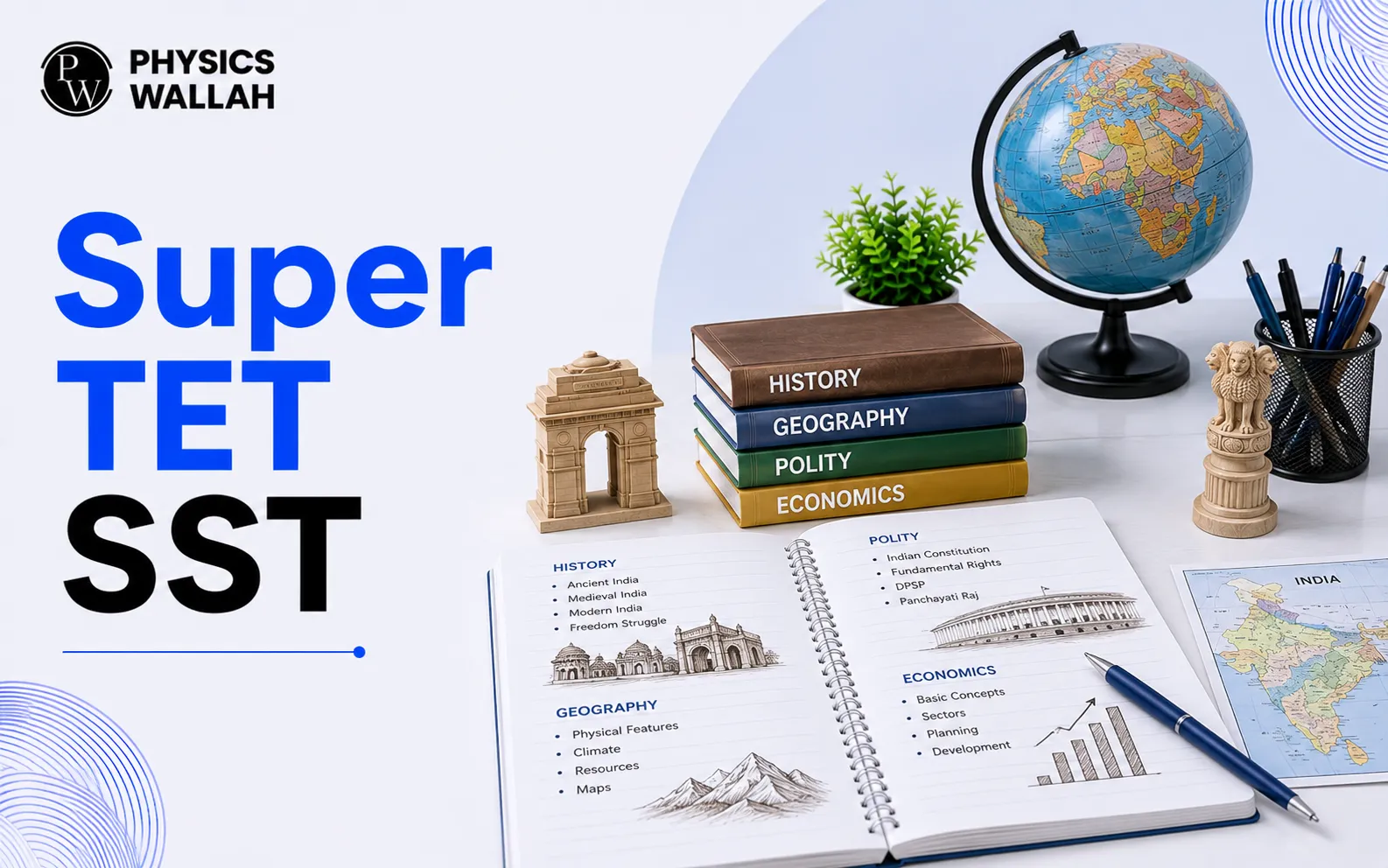
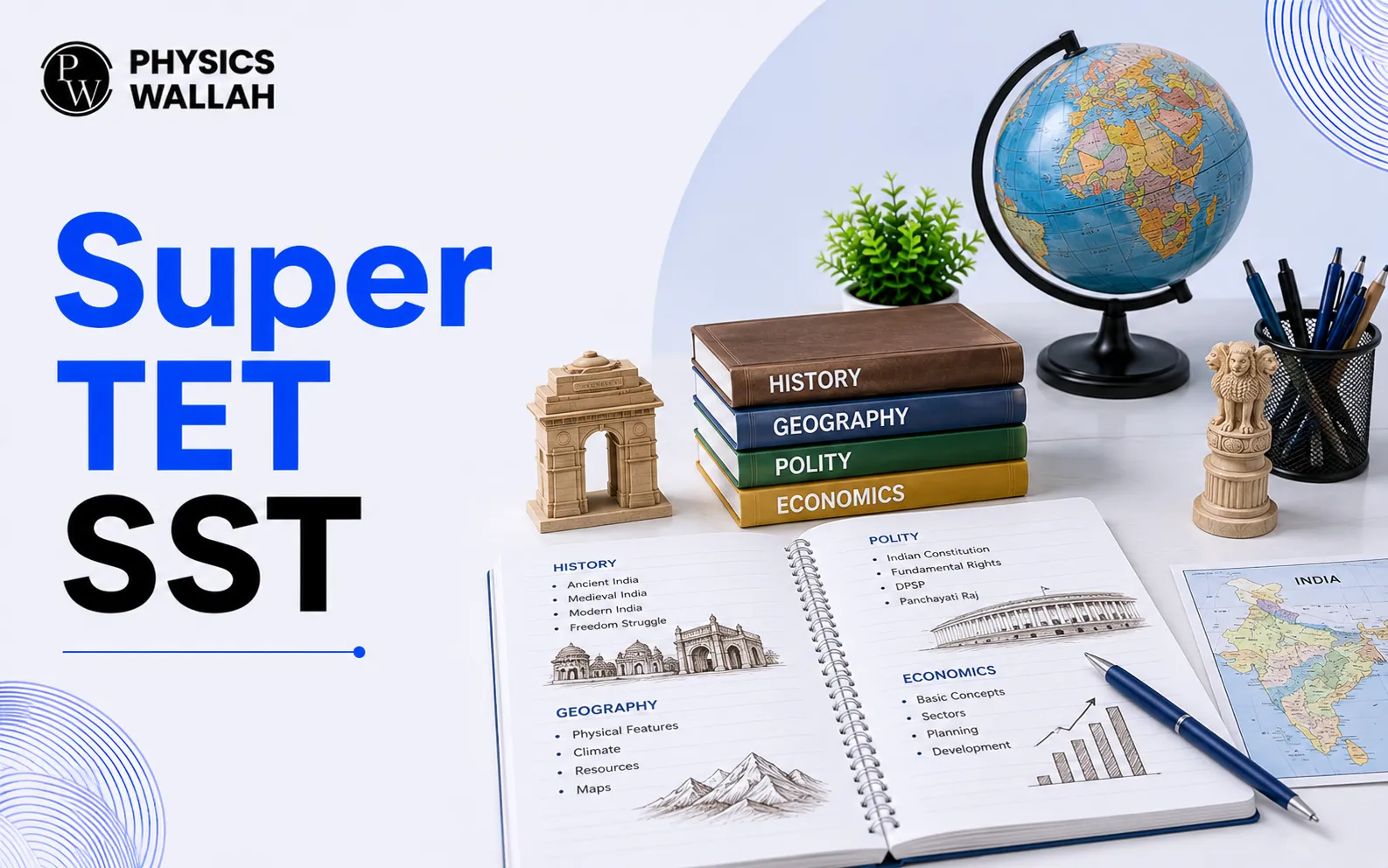
Super TET SST covers important areas of Social Studies and related Environmental Studies concepts, including History, Geography, Indian Constitution and Governance, Economy, Culture, Environment, and Disaster Management. Along with subject knowledge, candidates should also understand Super TET SST Pedagogy and Teaching Methodology.
This page provides a complete resource for Super TET SST preparation, including the Super TET SST Syllabus, Notes, Important Questions, MCQs, Practice Sets, PYQs, Previous Year Papers, Question Papers, Mock Tests, Pedagogy, Teaching Methodology, and Preparation Tips.
Super TET SST Overview
Super TET SST preparation requires a combination of conceptual understanding and factual revision. Candidates should focus on important historical events, geographical concepts, constitutional topics, economic concepts, cultural heritage, environmental conservation, and disaster management.
| Particular | Details |
|---|---|
| Subject | Social Studies / Environment & Social Studies |
| Exam | Super TET |
| Key Areas | History, Geography, Polity, Economy, Culture & Environment |
| Additional Focus | SST Pedagogy and Teaching Methodology |
| Preparation Resources | Syllabus, Notes, Video Classes, MCQs, Practice Sets, PYQs and Mock Tests |
According to the current revised Super TET syllabus, Environment & Social Studies carries 10 questions for 10 marks.
Super TET SST Syllabus
The Super TET SST Syllabus covers major areas of Social Studies, including Indian Geography, Freedom Struggle, Indian Constitution and Governance, Indian Economy, Cultural Heritage, Environmental Conservation, and Disaster Management.
| Major Area | Topics Covered |
|---|---|
| Geography | Earth Structure, Rivers, Mountains, Oceans and Indian Geography |
| History | Freedom Struggle and important historical developments |
| Polity | Indian Constitution, Democracy and Governance |
| Economy | Indian Economy and major economic challenges |
| Culture | Indian Cultural Heritage and traditions |
| Environment | Natural Resources, Environmental Conservation and Sustainability |
| Disaster Management | Types of disasters, preparedness, prevention and management |
| Transport & Safety | Transport and Road Safety |
Super TET SST Important Topics
Candidates should cover the complete syllabus while giving special attention to the following Super TET SST Important Topics:
-
Earth Structure
-
Rivers, Mountains and Oceans
-
Indian Geography
-
Freedom Struggle
-
Indian Constitution and Governance
-
Indian Economy
-
Cultural Heritage
-
Natural Resources
-
Environmental Conservation
-
Transport and Road Safety
-
Disaster Management
Candidates should combine conceptual learning with regular revision of important facts, dates, events, places, and terminology.
Super TET SST Topic-Wise Video Classes
Topic-wise video classes can help candidates understand difficult concepts and revise important Social Studies topics. Candidates can use the Super TET SST playlist along with their notes and regular question practice.
| S. No. | Super TET SST Topic | Video Class | Watch Video |
|---|---|---|---|
| 1 | Indian Geography | Add relevant playlist video | Watch Now |
| 2 | Earth Structure | Add relevant playlist video | Watch Now |
| 3 | Rivers, Mountains & Oceans | Add relevant playlist video | Watch Now |
| 4 | Indian History | Add relevant playlist video | Watch Now |
| 5 | Freedom Struggle | Add relevant playlist video | Watch Now |
| 6 | Indian Constitution | Add relevant playlist video | Watch Now |
| 7 | Indian Governance | Add relevant playlist video | Watch Now |
| 8 | Indian Economy | Add relevant playlist video | Watch Now |
| 9 | Cultural Heritage | Add relevant playlist video | Watch Now |
| 10 | Environment & Natural Resources | Add relevant playlist video | Watch Now |
| 11 | Disaster Management | Add relevant playlist video | Watch Now |
| 12 | SST Pedagogy | Add relevant playlist video | Watch Now |
| 13 | SST Practice Set | Add relevant playlist video | Watch Now |
Candidates should watch the relevant video after completing a topic and then solve questions to strengthen their understanding.
Super TET SST Notes
Super TET SST Notes can help candidates revise important facts, concepts, events, geographical information, and constitutional topics. Candidates should prepare short and organised notes for:
-
Important historical events and movements
-
Indian geographical features
-
Rivers, mountains and oceans
-
Constitutional concepts
-
Governance and democracy
-
Important economic terms
-
Indian culture and heritage
-
Environmental conservation
-
Natural resources
-
Disaster management
-
Important facts and definitions
Candidates can also maintain separate revision notes for difficult topics and frequently incorrect questions.
Super TET SST Questions
Regular practice of Super TET SST Questions and MCQs helps candidates assess their conceptual understanding, improve accuracy, and identify topics requiring further revision.
| Topic | Key Areas to Practise |
|---|---|
| Geography | Earth, rivers, mountains, oceans, Indian geography and natural resources |
| History | Freedom Struggle, important events, movements and personalities |
| Polity | Constitution, democracy, governance and administration |
| Economy | Indian economy and major economic challenges |
| Culture | Cultural heritage, traditions and important cultural aspects |
| Environment | Conservation, sustainability, natural resources and environmental issues |
| Disaster Management | Disaster types, preparedness, prevention and management |
| SST Pedagogy | Teaching methods, classroom activities, learning difficulties and assessment |
While solving Super TET SST MCQs, candidates should understand the concept behind the correct answer instead of relying only on memorisation.
Super TET SST Practice Set
A Super TET SST Practice Set helps candidates apply concepts in an exam-oriented format. Candidates should first practise individual topics and then attempt mixed practice sets.
While attempting practice sets:
-
Read the question carefully.
-
Identify the topic being tested.
-
Avoid spending too much time on one question.
-
Mark difficult questions for review.
-
Analyse incorrect answers.
-
Revise the related concept.
-
Reattempt difficult questions.
Regular practice can help improve accuracy and confidence.
Super TET SST Question Paper
Practising Super TET SST PYQ, Previous Year Papers, and Question Papers helps candidates understand the question pattern, identify important concepts, and evaluate their preparation.
Candidates should attempt the Super TET SST Question Paper under timed conditions and analyse:
-
Topics from which questions were asked
-
Difficult questions
-
Repeated concepts
-
Factual or conceptual mistakes
-
Time taken to solve questions
-
Topics requiring further revision
A simple approach is Attempt → Check → Analyse → Revise → Reattempt. Candidates should first solve the paper without referring to notes, review incorrect or doubtful questions, revisit the related concepts, and practise similar questions again.
PYQs should be used not only for practice but also to understand question trends and prioritise important topics.
Super TET SST Mock Test
A Super TET SST Mock Test helps candidates evaluate their preparation in a time-bound environment. Candidates should attempt mock tests after completing the major topics.
After each mock test, analyse:
-
Incorrect answers
-
Unattempted questions
-
Factual mistakes
-
Weak topics
-
Time taken
-
Questions that required excessive time
Use this analysis to revise weak areas and improve speed and accuracy.
Super TET SST Pedagogy and Teaching Methodology
Super TET SST Pedagogy focuses on effective approaches for teaching Social Studies and helping students understand concepts through activities, discussion, observation, and real-life examples.
Important areas include:
-
Child-centred Social Studies teaching
-
Activity-based learning
-
Discussion and questioning
-
Use of maps, timelines and teaching-learning materials
-
Connecting lessons with real-life situations
-
Critical thinking and reasoning
-
Identifying learning difficulties
-
Classroom interaction
-
Assessment and evaluation
-
Remedial teaching
Super TET SST Teaching Methodology questions may present classroom situations and require candidates to select the most appropriate teaching approach. Therefore, candidates should understand both subject concepts and their practical application in teaching.
Super TET SST Preparation Tips
Candidates can follow these Super TET SST Preparation Tips for structured preparation:
-
Understand the Syllabus: Divide SST into Geography, History, Polity, Economy, Culture, Environment, and Disaster Management.
-
Build conceptual clarity: Understand concepts instead of memorising isolated facts.
-
Use maps and timelines: Use maps for Geography and timelines for historical events.
-
Prepare short notes: Make concise notes for important facts and concepts.
-
Revise regularly: Revisit factual information and difficult topics frequently.
-
Practise topic-wise: Solve MCQs after completing each topic.
-
Solve PYQs: Use previous year questions to understand question trends.
-
Attempt practice sets: Move from topic-wise questions to mixed practice.
-
Take mock tests: Practise under timed conditions to improve accuracy and time management.
-
Analyse mistakes: Maintain an error notebook and revise frequently incorrect topics.
Super TET SST FAQs
What are the important topics in Super TET SST?
How can I prepare for Super TET SST?
How can I improve my Super TET SST preparation?
What is Super TET SST Pedagogy?
How should I practise Super TET SST MCQs?






Get Free Counselling Today
and Clear up all your Doubts
 Live & recorded classes available at easeDashboard for progress trackingLakhs of practice questions

