







UPSC Prelims GS Paper 1 2027: Syllabus, Pattern, Books, PYQs & Preparation Strategy
 Prashant Pathak28 Aug, 2026
UPSC Civil Services Preliminary Examination (CSE Prelims) is the first stage of the UPSC Civil Services Examination and serves as a screening test for candidates appearing for the Main Examination. UPSC Prelims GS Paper 1 2027 consists of 100 objective-type questions carrying 200 marks, with a duration of two hours. The paper covers Current Affairs, History, Geography, Polity and Governance, Economic and Social Development, Environment and Ecology, and General Science. Marks obtained in GS Paper 1 are considered for determining the Prelims cut-off, subject to qualifying CSAT.
UPSC Prelims 2027 Important Dates
The table below provides important details about the UPSC Prelims 2027.
| Event | Date |
| UPSC CSE Notification Release | 13 January 2027 |
| Online Application Starts | 13 January 2027 |
| Last Date to Apply | 2 February 2027 |
| Application Correction Window | As notified by UPSC |
| UPSC Prelims Admit Card | May 2027 (Expected) |
| UPSC Prelims Exam Date | 23 May 2027 |
| UPSC Prelims Result | June 2027 (Expected) |
| UPSC Mains Exam Begins | 20 August 2027 (continues for 5 days) |
Candidates must also appear for General Studies Paper 2 (CSAT) and secure the prescribed qualifying marks. CSAT marks are not included in determining the Prelims cut-off.
UPSC Prelims GS Paper 1 Exam Pattern 2027
GS Paper 1 is conducted along with CSAT on the same day in two separate sessions.
The table below provides a quick overview of the UPSC Prelims Examination.
| Paper | Subject | Marks | Questions | Marks per Question | Negative Marking | Duration | Nature |
| Paper I | General Studies | 200 | 100 | 2 Marks | –0.66 Marks (1/3rd of allotted marks) | 2 Hours | Merit |
| Paper II | CSAT | 200 | 80 | 2.5 Marks | –0.83 Marks (1/3rd of allotted marks) | 2 Hours | Qualifying (33%) |
Key Highlights of UPSC Prelims GS Paper 1
-
The paper consists of 100 objective-type questions.
-
The maximum marks are 200.
-
Each question carries 2 marks.
-
One-third of the marks assigned to a question is deducted for an incorrect answer.
-
No marks are deducted for unanswered questions.
-
GS Paper 1 marks are considered for determining the Prelims cut-off.
-
Candidates must separately qualify CSAT.
UPSC Prelims Exam Pattern 2027
UPSC Prelims GS Paper 1 Syllabus 2027
The UPSC Prelims GS Paper 1 syllabus covers seven broad areas:
-
Current Events of National and International Importance
-
History of India and Indian National Movement
-
Indian and World Geography
-
Indian Polity and Governance - Constitution, Political System, Panchayati Raj, Public Policy, Rights, Issues, etc.
-
Economic and Social Development - Sustainable Development, Poverty, Inclusion, Demographics, Social Sector Initiatives, etc.
-
General issues on Environmental ecology, Bio-diversity and Climate Change - that do not require subject specialization.
-
General Science
UPSC Prelims GS Paper 1 2026: Subject-Wise Question Analysis
Number of questions asked from major subjects in UPSC Prelims GS Paper 1, 2026.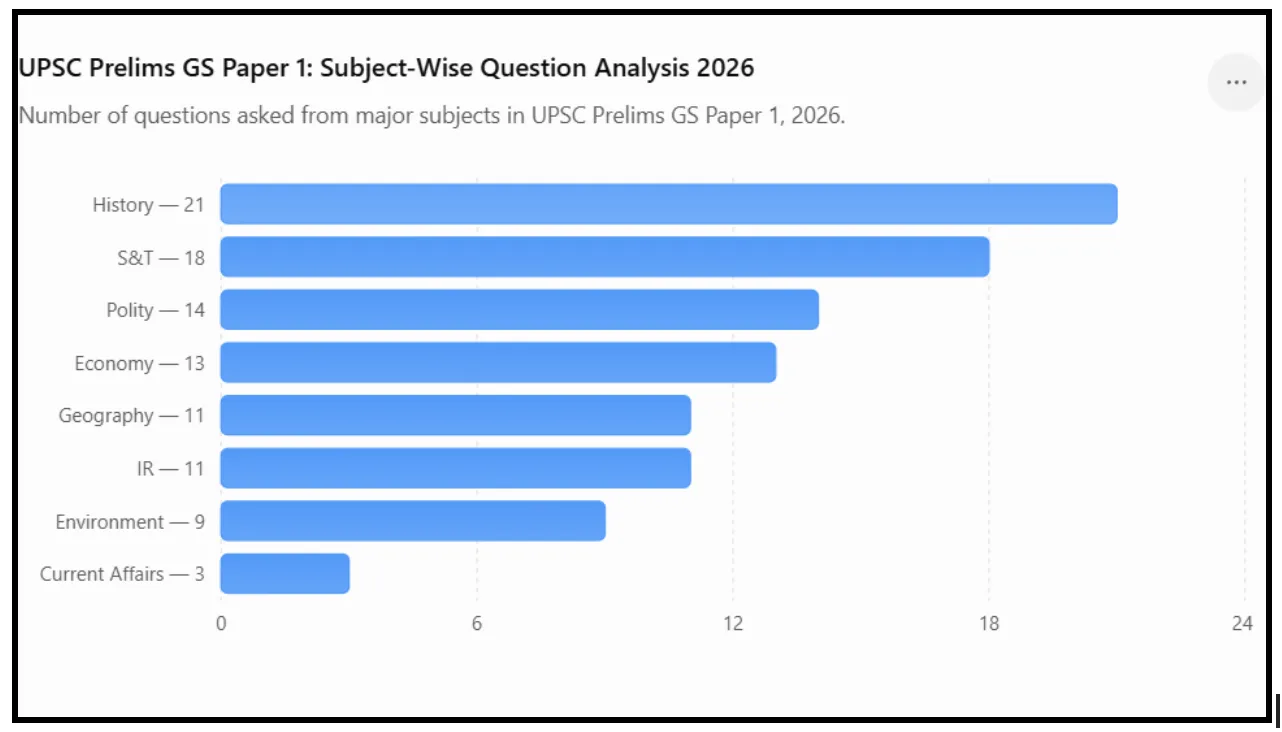
UPSC Prelims GS Paper 1 PYQ Analysis - Last 10 years
What Does the UPSC Prelims 2026 Trend Mean for 2027?
The 2026 paper reinforces the importance of moving beyond rote memorisation. Aspirants preparing for 2027 should focus on understanding concepts, connecting current affairs with static topics, and developing the ability to analyse statements.
The key preparation lessons are:
-
Understand concepts instead of memorising isolated facts.
-
Integrate current affairs with static subjects.
-
Practise statement-based MCQs.
-
Analyse every option in PYQs.
-
Develop elimination techniques.
-
Revise important sources multiple times.
-
Avoid excessive dependence on multiple study materials.
-
Take regular mock tests and analyse mistakes.
UPSC Prelims GS Paper 1 PYQs
Previous Year Questions (PYQs) are essential for understanding UPSC's question-framing approach, recurring themes, statement-based questions, and difficulty level. Regular PYQ analysis also helps aspirants identify important concepts and improve elimination skills.
Candidates should ideally analyse at least the last 10 years of GS Paper 1 PYQs.
UPSC Prelims PYQs with Answer Keys (2014-2026)
UPSC Prelims GS Paper 1 2027 Booklist
A limited and well-revised set of standard books is more effective than referring to multiple sources. Candidates should prioritise revision rather than continuously adding new books. For subject-wise recommendations, refer to the UPSC Prelims Booklist and select resources based on your preparation level and subject requirements.
For structured study resources, notes, and preparation support explore Complete UPSC Prelims Study Material 2027 – Click Here
UPSC Prelims GS Paper 1 2027 Preparation Strategy
A systematic preparation strategy can help candidates complete the syllabus while leaving sufficient time for revision and mock-test practice.
| Preparation Area | Strategy |
| Understand the Syllabus | Read the official syllabus carefully and map each topic to a reliable source. |
| Build Fundamentals | Begin with NCERTs and develop conceptual clarity before moving to advanced sources. |
| Use Standard Books | Select one reliable source for each subject and revise it repeatedly. |
| Integrate Current Affairs | Connect important news and developments with static concepts. |
| Solve PYQs | Analyse at least 10 years of questions and identify recurring themes. |
| Practise MCQs | Begin with topic-wise questions and gradually move to full-length tests. |
| Improve Elimination | Practise analysing statements and eliminating incorrect options. |
| Revise Regularly | Follow multiple revision cycles instead of continuously adding new sources. |
| Take Mock Tests | Attempt full-length tests under exam-like conditions. |
| Analyse Mistakes | Maintain an error log and revise frequently repeated mistakes. |
Enhance your preparation with the daily practice for UPSC by PhysicsWallah. Practice current affairs and static-based questions to strengthen your preparation.
How to Improve Accuracy in UPSC Prelims GS Paper 1?
Knowledge alone is not sufficient to perform well in GS Paper 1. Candidates must also develop accuracy, time management, and question-selection skills.
To improve performance:
-
Read questions carefully before looking at the options.
-
Identify keywords and qualifiers in the question.
-
Eliminate clearly incorrect options first.
-
Avoid making assumptions based only on partial knowledge.
-
Do not attempt questions merely to increase the attempt count.
-
Practise statement-based questions regularly.
-
Analyse mistakes after every mock test.
-
Develop an attempt strategy through repeated practice.
Join PhysicsWallah's UPSC Prelims Test Series Now
Common Mistakes to Avoid in GS Paper 1 Preparation
Aspirants often make the following mistakes while preparing for Prelims:
-
Referring to too many books and sources.
-
Ignoring the official syllabus.
-
Treating current affairs as a completely separate subject.
-
Solving PYQs without analysing the options.
-
Taking mock tests without reviewing mistakes.
-
Neglecting revision while continuously studying new material.
-
Ignoring weaker subjects.
-
Attempting too many questions because of overconfidence.
-
Preparing only according to predicted subject-wise weightage.
Conclusion
The UPSC Prelims GS Paper 1 2027 requires conceptual clarity, current affairs integration, PYQ analysis, regular MCQ practice, and repeated revision. The 2026 paper further highlighted the importance of statement interpretation and elimination skills. Aspirants should therefore focus on understanding the syllabus and practising consistently rather than relying on rote learning or predicted question weightage.
PhysicsWallah provides comprehensive study material, current affairs, PYQ discussions, test series, and expert guidance to help aspirants prepare effectively for UPSC Prelims 2027.
UPSC Prelims GS Paper 1 2027 FAQs
How many questions are asked in UPSC Prelims GS Paper 1?
What is the syllabus of UPSC Prelims GS Paper 1?
Is GS Paper 1 qualifying in UPSC Prelims?
Is there negative marking in GS Paper 1?







 Live & recorded classes available at easeDashboard for progress trackingMillions of practice questions at your fingertips

