







World War 1: Time Period, Reason, Countries, Consequence
World War 1 started in 1914 and lasted till 1918. Read on to learn the time period, reasons, participating countries, key events, and consequences of World War 1.
 Deeksha Dixit18 Dec, 2024
World War 1 (WW1), commonly known as the First World War, is one of the most significant events in world history. It changed the political, social, and economic landscapes of many countries. The war involved multiple countries and lasted for four long years, from 1914 to 1918.
Understanding the causes, key events, and consequences of World War 1 is essential, especially for UPSC aspirants preparing the world history section. Keep reading for the cause, consequences, and India's role in World War 1.What Was World War 1?
World War 1, also known as the Great War , was one of the most devastating conflicts in history. It involved two major alliances: the Central Powers and the Allied Powers . WW1 resulted in millions of deaths, widespread destruction, and significant geopolitical changes. The conflict arose from a complex web of alliances, militarism, imperialism, and nationalism. The immediate spark for the war was the assassination of Archduke Franz Ferdinand , the heir to the Austro-Hungarian throne, in June 1914. World War 1 marked the first large-scale use of modern weaponry and introduced trench warfare.First World War Period
World War 1 began on 28th July 1914 and lasted until 11th November 1918 , spanning over four years. The war began with Austria-Hungary’s war on Serbia and soon expanded. From the assassination of Archduke to the signing of the Treaty of Versailles, each event played a significant role in shaping the course of the war. World War 1 war lasted until November 1918, when a ceasefire was signed, leading to the end of hostilities.Reason Behind World War 1
The causes of World War 1 were complex and involved multiple factors. The primary reasons behind World War 1 include:- Nationalism: Nationalism was one of the primary causes of World War 1. European countries were driven by intense nationalist sentiments leading to tensions between nations.
- Militarism: Countries engaged in an arms race, building large armies and navies.
- Alliances : The formation of two rival blocs – the Allied Powers and the Central Powers – created a fragile balance.
- Imperialism: Competition for colonies heightened tensions among European powers.
- The Assassination of Archduke Franz Ferdinand: This event in Sarajevo acted as the immediate trigger, leading Austria-Hungary to declare war on Serbia.
World War 1 Countries
World War 1 saw the involvement of many countries, divided into two major alliances: the Central Powers and the Allied Powers. Countries in these main blocs were: Allied Powers World War 1- France
- Russia (until 1917)
- Great Britain
- Italy (joined in 1915)
- United States (joined in 1917)
- Japan
- Several other nations including Serbia, Belgium, and Greece.
- Germany
- Austria-Hungary
- Ottoman Empire
- Bulgaria
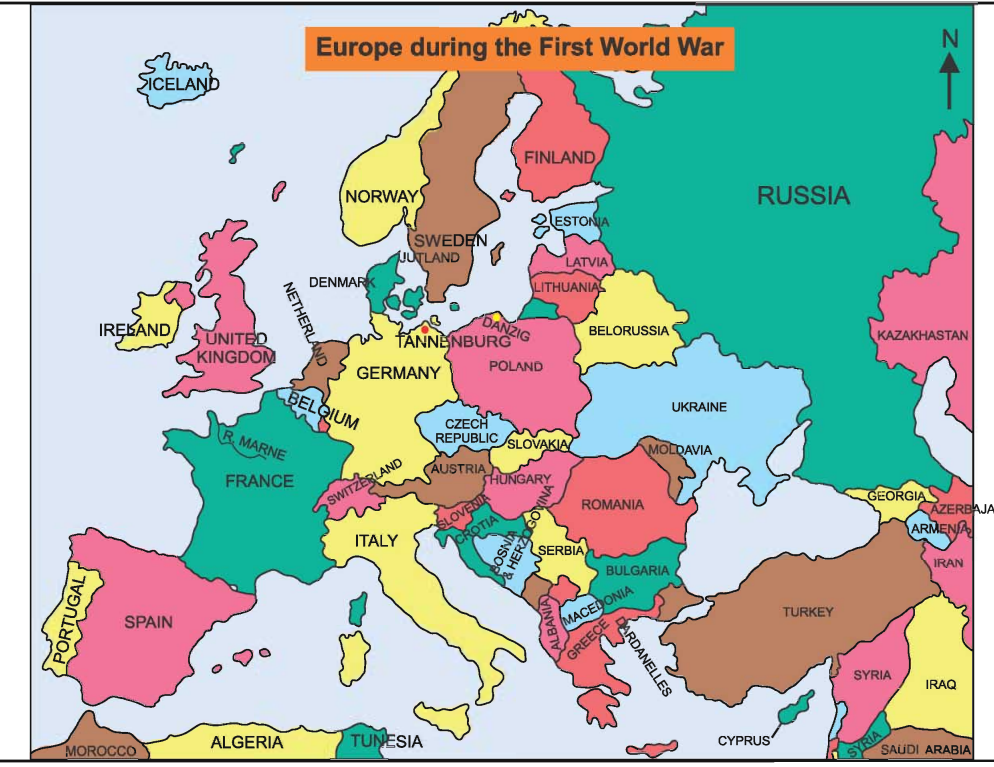 Image Credit: Tamil Nadu Board’s Class X Book
Key Events of World War 1
Several key events shaped the course of World War 1. These events are critical for understanding the impact of the war on global history.| Event | Timeline | Significance |
| First Battle of the Marne | September 1914 | Marked the beginning of trench warfare on the Western Front. |
| Battle of Verdun | February to December 1916 | One of the longest battles with massive casualties. |
| Battle of the Somme | July to November 1916 | Notable for its high casualty rate and introduction of tanks. |
| U.S. Entry into the War | April 1917 | The U.S. declared war on Germany following unrestricted submarine warfare. |
| Treaty of Brest-Litovsk | March 1918 | Russia withdrew following the Bolshevik Revolution. |
| Armistice | November 11, 1918 | Ceasefire agreement that ended hostilities |
Consequences of the World War 1
World War 1 had serious consequences, both immediate and long-term. These consequences reshaped the world order, leading to the fall of empires and the creation of new nations.- Human Cost: Approximately 10 million military deaths and over 20 million wounded, along with millions of civilian casualties.
- Economic Impact : It led to massive debts for the participating countries. European economies were devastated, and the war contributed to the Great Depression in the 1930s.
- Political Changes: The war led to the collapse of several empires, including the Austro-Hungarian Empire, the Ottoman Empire, and the Russian Empire.
- Rise of New Powers: The U.S. emerged as a significant global power.
- Social Effects: Women entered the workforce in large numbers, challenging traditional roles.
- Rise of Extremist Ideologies : The aftermath of war saw the rise of extremist ideologies, including Fascism and Communism.
Treaty of Versailles
World War 1 officially ended with the Treaty of Versailles on 28th June 1919 . This peace treaty officially concluded the war but imposed harsh terms on Germany. Key provisions included:- Germany accepted full responsibility for the war.
- Reparations payments to Allied nations.
- Territorial losses for Germany.
- Limitations on Germany’s military capabilities.
- Establishment of the League of Nations.
India in World War 1
India participated in World War 1 as part of the British Empire. Over 1.3 million Indian soldiers and labourers served in various theatres, including Europe, Africa, and the Middle East. India supplied significant resources, including food, clothing, and funds. Despite their sacrifices, Indian soldiers faced discrimination, and their contributions were often overlooked. The war also stirred nationalist sentiments, laying the groundwork for India’s independence movement.World War 1 UPSC PYQs
UPSC Mains 2015 : To what extent can Germany be held responsible for causing the two World Wars? Discuss critically. (150 words, 10 marks) UPSC Mains 2024 : How far is it correct to say that the First World War was fought essentially for the preservation of balance of power? ?si=fojpRnNNhueJ5bjN Want to learn world history for UPSC exams? Explore PW UPSC Courses today!| UPSC Related Articles | ||
| Female Freedom Fighters of India | Round Table Conference | Places of Worship Act |
| Parliament Sessions | One Nation One Election Bill | Anti-Defection Law |
World War 1 FAQs
Why did World War 1 start?
World War 1 started due to militarism, alliances, imperialism, and nationalism, with the assassination of Archduke Franz Ferdinand acting as the trigger.
What was the date of World War 1?
World War 1 began on 28th July 1914 and ended on 11th November 1918.
Who were the Central Powers in World War 1?
The Central Powers included Germany, Austria-Hungary, the Ottoman Empire, and Bulgaria.
When did World War 1 end and how?
World War 1 ended on November 11, 1918, when an armistice was signed between the Allied Powers and Germany, effectively halting the fighting. The war officially concluded with the signing of the Treaty of Versailles.
What was the Treaty of Versailles?
The Treaty of Versailles, signed on 28th June 1919, was the peace agreement that officially ended World War 1.




Talk to a counsellorHave doubts? Our support team will be happy to assist you!


Check out these Related Articles






Join 15 Million students on the app today!
 Live & recorded classes available at easeDashboard for progress trackingMillions of practice questions at your fingertips


Free Learning Resources
PW Books
Notes (Class 10-12)
PW Study Materials
Notes (Class 6-9)
Ncert Solutions
Govt Exams
Our Other Websites
Class 6th to 12th Online Courses
Govt Job Exams Courses
UPSC Coaching
Defence Exam Coaching
Gate Exam Coaching
Other Exams
Know about Physics Wallah
Physics Wallah is an Indian edtech platform that provides accessible & comprehensive learning experiences to students from Class 6th to postgraduate level. We also provide extensive NCERT solutions, sample paper, NEET, JEE Mains, BITSAT previous year papers & more such resources to students. Physics Wallah also caters to over 3.5 million registered students and over 78 lakh+ Youtube subscribers with 4.8 rating on its app.
We Stand Out because
We provide students with intensive courses with India’s qualified & experienced faculties & mentors. PW strives to make the learning experience comprehensive and accessible for students of all sections of society. We believe in empowering every single student who couldn't dream of a good career in engineering and medical field earlier.
Our Key Focus Areas
Physics Wallah's main focus is to make the learning experience as economical as possible for all students. With our affordable courses like Lakshya, Udaan and Arjuna and many others, we have been able to provide a platform for lakhs of aspirants. From providing Chemistry, Maths, Physics formula to giving e-books of eminent authors like RD Sharma, RS Aggarwal and Lakhmir Singh, PW focuses on every single student's need for preparation.
What Makes Us Different
Physics Wallah strives to develop a comprehensive pedagogical structure for students, where they get a state-of-the-art learning experience with study material and resources. Apart from catering students preparing for JEE Mains and NEET, PW also provides study material for each state board like Uttar Pradesh, Bihar, and others
Copyright © 2026 Physicswallah Limited All rights reserved.