
PW NSAT Mock Test 2026 for Class 7th to 12th: Practice Tests, Exam Pattern & Preparation
Practice PW NSAT Mock Test 2026 for Class 7th-12th & droppers. Level 1 carries 40-60 MCQs for 60 mins (+4/0 scheme). Qualify for PWNSAT Prodigy, 100% scholarships & ₹2.5 Cr cash rewards. Check details here.

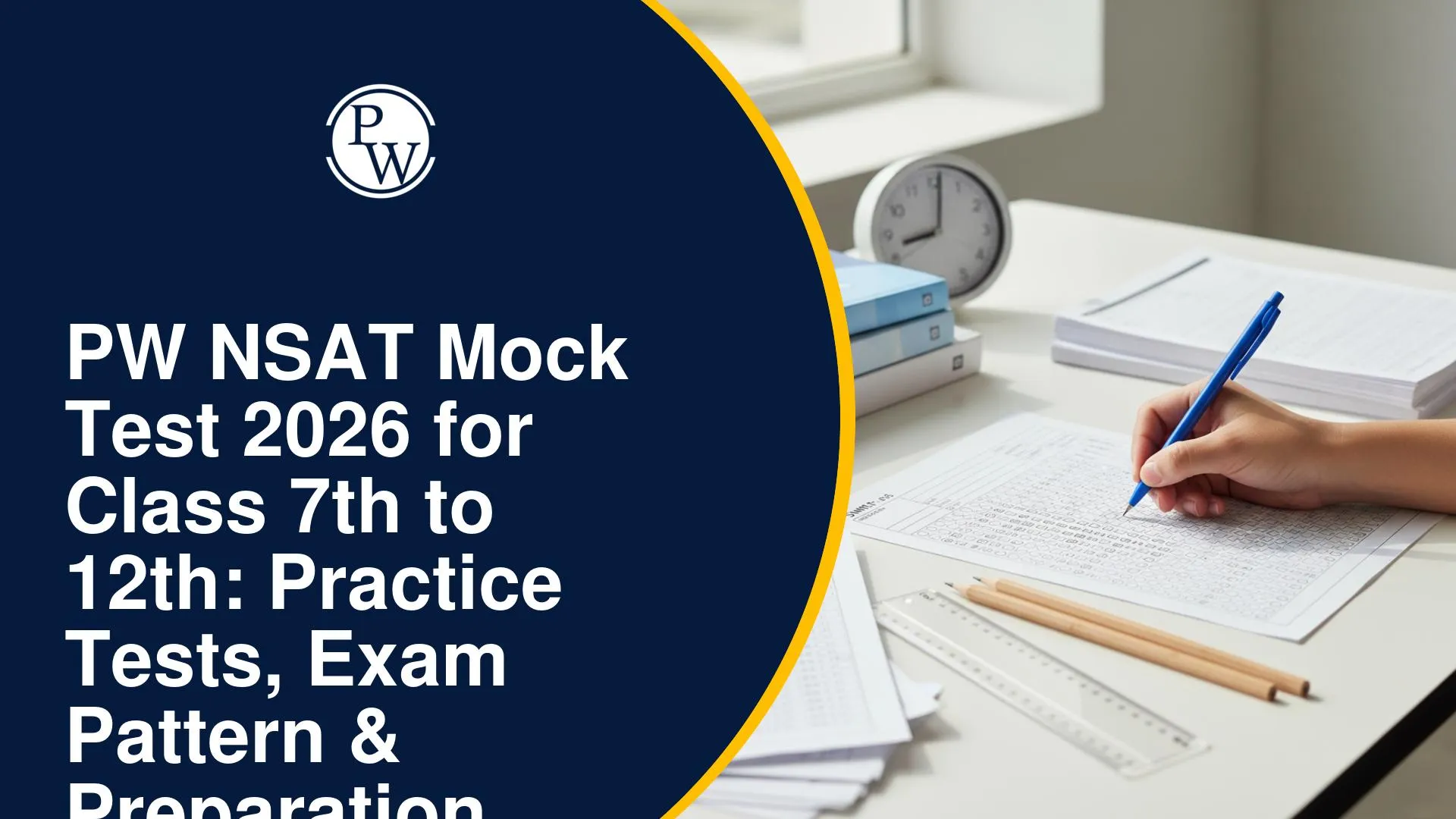
Appearing for a national-level competitive exam requires a clear strategy, concept clarity, and regular testing under exam-like conditions. For students enrolled in secondary and senior secondary schools across India, taking the PW NSAT Mock Test 2026 for Class 7th to 12th serves as the most effective dress rehearsal before sitting for the main scholarship test.
The Physics Wallah National Scholarship cum Admission Test (PWNSAT 2026) offers up to 100% fee waivers across PW Vidyapeeth offline centers, Pathshala hybrid modules, and online courses, along with cash rewards from a ₹2.5 Crore pool. By practicing official mock tests, students from Class 7th through 12th and JEE/NEET droppers can gauge their performance, analyze subject-wise weaknesses, and build exam-day speed.
Also Check- PWNSAT Biology Weightage for NEET aspirants
PW NSAT Mock Test 2026 for Class 7th to 12th
Taking the official practice tests on the pw.live portal or the Physics Wallah app provides real-time benchmarking against peers nationwide.
-
Mockk Test Access: The PW NSAT Mock Test 2026 for Class 7th to 12th is accessible immediately upon completing basic registration.
-
Level 1 Exam Window: Online exam daily from 1st October to 15th October 2026 (24-hour window); Offline exam on 3rd, 4th, 10th & 11th October 2026.
-
No Negative Marking in Level 1: Every correct answer yields +4 marks, while incorrect answers incur zero penalty.
-
Level 2 (PWNSAT Prodigy) Entry: High scorers in Level 1 qualify for the offline Level 2 exam which includes negative marking (+4 / -1 scheme).
-
Total Scholarship Pool: Up to ₹250 Crore in academic scholarships and ₹2.5 Crore in cash rewards for rankers.
Class-Wise PW NSAT Mock Test Exam Pattern & Question Distribution
The structure of the PW NSAT Mock Test 2026 for Class 7th to 12th varies based on academic grade and stream specialization (Engineering vs. Medical).
| Academic Grade / Stream | Physics | Chemistry | Biology / Science | Mathematics | Mental Ability (MAT) | Total Questions | Total Duration | Marking Scheme |
| Class 7th to 9th | 8 | 7 | 7 | 10 | 8 | 40 MCQs | 60 Mins | +4 / 0 (160 Marks) |
| Class 10th (Foundation) | 5 | 5 | 5 | 15 | 10 | 40 MCQs | 60 Mins | +4 / 0 (160 Marks) |
| Class 11th & 12th (JEE Track) | 10 | 10 | — | 10 | — | 30 MCQs | 60 Mins | +4 / 0 (120 Marks) |
| Class 11th & 12th (NEET Track) | 15 | 15 | 30 | — | — | 60 MCQs | 60 Mins | +4 / 0 (240 Marks) |
How to Access and Attempt the Official PW NSAT Mock Test Online
Follow this step-by-step guide to take the practice test on your laptop, desktop, or mobile device:
-
Register for PWNSAT: Visit the official registration link at pw.live/scholarship/vidyapeeth/pwnsat or open the PW app.
-
Complete Basic Details: Enter your name, target class, stream (JEE/NEET/Foundation), mobile number, and preferred test mode (Online or Offline).
-
Log In to Candidate Dashboard: Use the OTP sent to your registered mobile number to log in.
-
Navigate to the Test Section: Click on the PWNSAT 2026 Batch or Mock Test / Sample Paper section on your dashboard.
-
Start Timed Test: Attempt the 60-minute test in a distraction-free environment to simulate real exam pressure.
-
Analyze Detailed Scorecard: Post-submission, review your subject-wise score, speed metrics, accuracy percentage, and detailed step-by-step solutions.
Key Benefits of Attempting the PW NSAT Mock Test
-
Real Exam Simulation: Replicates the actual user interface and 60-minute timer for the online CBT exam, reducing test-day anxiety.
-
Identifies Concept Gaps: Provides immediate diagnostic feedback on weak topics in NCERT Physics, Chemistry, Biology, and Mathematics.
-
Zero Negative Marking Practice: Teaches students in Level 1 to attempt all questions strategically without leaving blank responses.
-
Prepares for Level 2 Screening: Helps high-performing students build the conceptual depth required to clear Level 1 and qualify for PWNSAT Prodigy (Level 2).
Also Check- PWNSAT 2026 Syllabus
Effective Strategy to Maximize Your PW NSAT Mock Test Score
-
Master Core NCERT Concepts: Align your revision strictly with your school syllabus and NCERT textbook chapters.
-
Focus Heavy on Mental Ability (MAT): For Class 7th to 10th students, Logical Reasoning and MAT account for a significant portion of questions—practicing puzzles, series, and direction tests yields quick marks.
-
Time Allocation Strategy: Do not spend more than 1.5 minutes on a single question. Complete straightforward, memory-based questions (such as Biology or Chemistry) first, then dedicate remaining time to numericals in Physics and Mathematics.
-
Review Solution Explanations: Spend at least 30 minutes after each mock test analyzing every wrong answer to avoid repeating similar mistakes in the final exam.
PW NSAT Mock Test 2026 for Class 7th to 12th FAQs
Is the PW NSAT Mock Test 2026 free for all students?
Can I attempt the PW NSAT mock test multiple times?
Is there negative marking in the PW NSAT Level 1 Mock Test?
What subjects are included in the Class 10th PW NSAT mock paper?





Get Free Counselling Today
and Clear up all your Doubts
 Live & recorded classes available at easeDashboard for progress trackingLakhs of practice questions