






Understanding the Indian Tax Regime 2024-25
Indian tax regime 2024-25 consists of various tax structures and provisions that apply to individuals, businesses, and entities. Checkout the article to know more about new Indian tax regime.
 Shruti Dutta31 Jul, 2024
Share
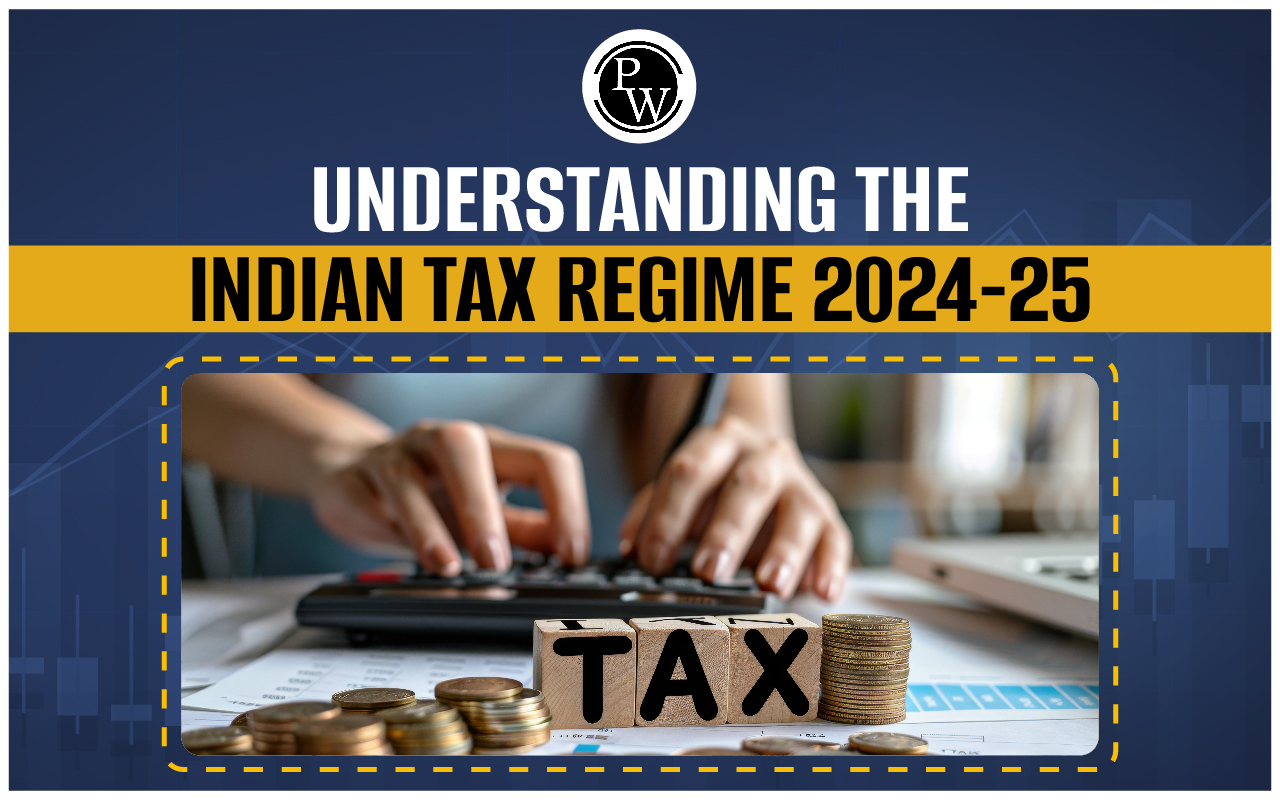
Indian Tax Regime 2024-25: The Indian tax regime is a structured revenue collection system involving various taxes levied by central and state governments. It includes direct taxes, such as income and corporate tax, imposed on individual and corporate earnings. Additionally, indirect taxes like the Goods and Services Tax (GST), customs duties, and excise duties are applied to the sale of goods and services.
Direct taxes are collected directly from individuals and businesses based on income and profits. In contrast, indirect taxes are charged on transactions, ultimately impacting consumers. The implementation of GST in 2017 marked a significant reform, streamlining the indirect tax framework by consolidating multiple state and central taxes into a single unified system.Indian Tax Regime 2024-25
The Government of India introduced an optional new tax rate system for individuals and Hindu Undivided Families (HUFs) Starting April 1, 2020 (FY 2020-21). This led to the inclusion of Section 115 BAC in the Income Tax Act of 1961, which provides lower tax rates for taxpayers and HUFs who forgo certain deductions and exemptions. As of the Union Budget 2023 revisions, the Indian Tax Regime has been the default option. Taxpayers wishing to stick to the old tax regime must explicitly choose it. However, opting for the new tax system means taxpayers cannot claim various exemptions and deductions, such as HRA, LTA, Section 80C, and Section 80D. Due to limited support for the new regime, the government introduced five significant changes in Budget 2023 to make it more attractive- Increased Tax Rebate Limit The Indian Tax Regime now offers a rebate of up to Rs.7 lakh, compared to Rs.5 lakh under the previous regime. This means individuals earning up to Rs.7 lakh will pay no tax under the new system.
- Simplified Tax Slabs The tax exemption limit has been raised to Rs.3 lakh. The revised tax slabs are as follows:
| Annual Income | Old Regime | New Regime |
| Up to Rs.3 lakh | Nil | Nil |
| Rs.3 – 6 lakh | 5% | 5% |
| Rs.6 – 9 lakh | 20% | 10% |
| Rs.9 – 12 lakh | 30% | 15% |
| Rs.12 – 15 lakh | 30% | - |
| Above Rs.15 lakh | 30% | - |
- Standard Deduction and Family Pension Deduction
-
- Salary Income : The Rs.50,000 standard deduction, previously available only under the old regime, is now also applicable under the new Indian Tax Regime. Combined with the rebate, this results in Rs.7.5 lakh of tax-free income under the new regime.
- Family Pension : Individuals receiving a family pension can now claim a deduction of Rs.15,000 or one-third of the pension, whichever is lower.
- Reduced Surcharge for High-Net-Worth Individuals : The surcharge rate on income exceeding Rs.5 crore has been reduced from 37% to 25%, lowering their effective tax rate from 42.74% to 39%.
- Higher Leave Encashment Exemption : The exemption limit for leave encashment for non-government employees has been increased significantly from Rs.3 lakh to Rs.25 lakh.
| Also Read | |
| IT tax Act | TDS |
| Capital Tax Gains | MSMEs |
Indian Old Tax Regime
This system provides around 70 exclusions and deductions, including those for HRA (House Rent Allowance) and LTA (Leave Travel Allowance), which can help reduce taxable income and lower tax liabilities. One of the most significant deductions under the old regime is Section 80C, which allows taxpayers to reduce their taxable income by up to Rs.1.5 lakh. Taxpayers can choose between the old and new Indian tax regimes based on which is more beneficial for their financial situation.Tax Slab Rate for FY 2024-25 as per Budget 2024
The Budget 2024 introduced revised tax slab rates for the financial year 2024-25, aiming to simplify the tax structure and provide relief to individual taxpayers. These changes are part of the government's ongoing efforts to streamline the taxation process and ensure a fairer distribution of the tax burden. The new tax slabs offer different rates for various income brackets, allowing taxpayers to choose between the old and new Indian Tax Regime 2024-25 based on their financial situation and preferences.| Income Range | Tax Rate |
| Up to Rs. 3 lakh | Nil |
| Rs. 3 lakh - Rs.7 lakh | 5% |
| Rs. 7 lakh - Rs.10 lakh | 10% |
| Rs. 10 lakh - Rs.12 lakh | 15% |
| Rs.12 lakh - Rs.15 lakh | 20% |
| More than Rs.15 lakh | 30% |
What Deductions Are Available Under The Revised New Indian Tax Regime?
The revised new Indian Tax Regime 2024-25, introduced to simplify the tax structure and provide relief to taxpayers, offers a lower tax rate but with limited deductions and exemptions compared to the old regime. Taxpayers must choose between the old regime, which allows various deductions, and the new regime, which provides lower tax rates but restricts most deductions. The new tax regime offers several deductions and exemptions for salaried individuals and other taxpayers. Here is a summary of the available deductions:| Deduction | Description |
| Standard Deduction for Salaried Individuals | Up to Rs.50,000. |
| Standard Deduction on Pension | Rs.15,000 or 1/3rd of the pension amount, whichever is lower. |
| Interest on Home Loan | Deductible under section 24(b) for let-out properties. |
| Employer's Contribution to NPS | Deductible for contributions made by the employer to NPS. |
| Contributions to Agniveer Corpus Fund | Deductible under section 80CCH. |
| Leave Encashment | Exempt under section 10(10AA). |
| Gratuity | Exempt under section 10(10). |
| Transport Allowances for Persons with Disabilities | Deductible. |
| Exemptions for Voluntary Retirement Scheme (VRS) | Under section 10(10C). |
| Gifts | Exempt up to Rs.50,000. |
| Also Read | |
| Taxation | Cash Flow Statement |
| Activity and Profitability Ratio | Abnormal Loss And Abnormal Gains |
Indian Tax Regime 2024-25 FAQs
What are direct taxes?
Direct taxes are levied directly on individuals and corporations based on income and profits. Examples include income tax and corporate tax.
What are indirect taxes?
Indirect taxes are imposed on the sale of goods and services, ultimately affecting consumers. Examples include GST, customs duties, and excise duties.
What is the Goods and Services Tax (GST)?
GST is a unified tax system introduced in 2017 to replace multiple state and central taxes. It simplifies the indirect tax structure by consolidating them into a single tax.
🔥 Trending Blogs


Talk to a counsellorHave doubts? Our support team will be happy to assist you!


Check out these Related Articles





Join 15 Million students on the app today!
 Live & recorded classes available at easeDashboard for progress trackingMillions of practice questions at your fingertips


Free Learning Resources
PW Books
Notes (Class 10-12)
PW Study Materials
Notes (Class 6-9)
Ncert Solutions
Govt Exams
Our Other Websites
Class 6th to 12th Online Courses
Govt Job Exams Courses
UPSC Coaching
Defence Exam Coaching
Gate Exam Coaching
Other Exams
Know about Physics Wallah
Physics Wallah is an Indian edtech platform that provides accessible & comprehensive learning experiences to students from Class 6th to postgraduate level. We also provide extensive NCERT solutions, sample paper, NEET, JEE Mains, BITSAT previous year papers & more such resources to students. Physics Wallah also caters to over 3.5 million registered students and over 78 lakh+ Youtube subscribers with 4.8 rating on its app.
We Stand Out because
We provide students with intensive courses with India’s qualified & experienced faculties & mentors. PW strives to make the learning experience comprehensive and accessible for students of all sections of society. We believe in empowering every single student who couldn't dream of a good career in engineering and medical field earlier.
Our Key Focus Areas
Physics Wallah's main focus is to make the learning experience as economical as possible for all students. With our affordable courses like Lakshya, Udaan and Arjuna and many others, we have been able to provide a platform for lakhs of aspirants. From providing Chemistry, Maths, Physics formula to giving e-books of eminent authors like RD Sharma, RS Aggarwal and Lakhmir Singh, PW focuses on every single student's need for preparation.
What Makes Us Different
Physics Wallah strives to develop a comprehensive pedagogical structure for students, where they get a state-of-the-art learning experience with study material and resources. Apart from catering students preparing for JEE Mains and NEET, PW also provides study material for each state board like Uttar Pradesh, Bihar, and others
Copyright © 2026 Physicswallah Limited All rights reserved.