







NIMCET 2027 Alphanumeric Series: Concepts, Tricks, PYQs and Practice Questions
NIMCET 2027 Alphanumeric Series covers alphabets, numbers, symbols, position-based questions, preceded/followed rules, patterns, and counting. Learn direction rules, number-based problems, solved PYQs, common mistakes, and practice questions for Logical Reasoning.

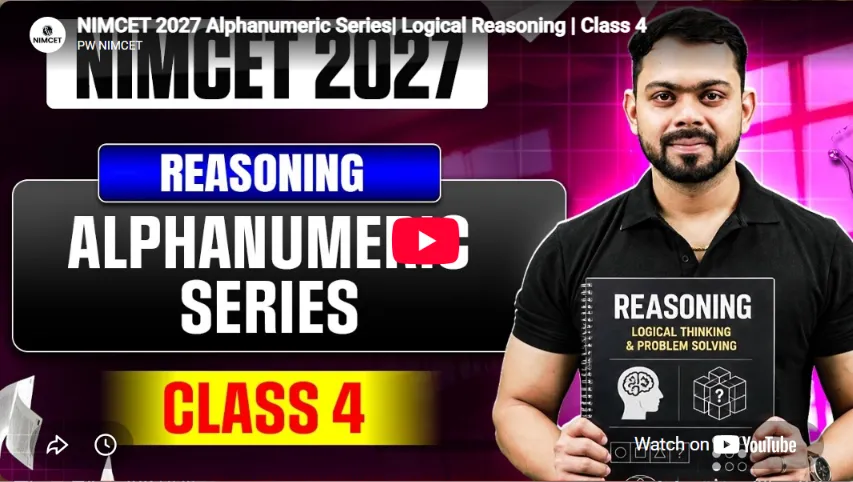
NIMCET 2027 Alphanumeric Series is an important topic in the Logical Reasoning section. Questions from this topic can include letters, numbers, symbols, or a combination of all three. You may be asked to identify a pattern, find the position of an element, count elements based on a condition, or determine the missing term.
To solve these questions, you need to understand the arrangement carefully. Terms such as preceded by, followed by, left of, and right of are also important. A small mistake in understanding the position can change the answer.
Understand the major concepts of NIMCET 2027 Alphanumeric Series, along with solved previous-year questions and practice questions.
NIMCET 2027 Alphanumeric Series: Basic Concepts
An alphanumeric series contains a combination of alphabets, numbers, and symbols. For example:
A * 5 9 I N & E @ # U 1 &
Here, the series contains:
-
Alphabets
-
Numbers
-
Symbols
-
Vowels
-
Consonants
Questions are generally based on the position or relationship between these elements.
Some common question types are:
| Question Type | What You Need to Check |
| Missing element | Identify the pattern |
| Position-based question | Count elements from left or right |
| Counting question | Check elements satisfying a condition |
| Odd one out | Find the option that breaks the pattern |
| Number arrangement | Rearrange or calculate using digits |
| Letter arrangement | Identify the relationship between letters |
You should first number the elements in the given series. This makes position-based questions easier to solve.
Preceded By and Followed By in NIMCET Alphanumeric Series
The terms preceded by and followed by are frequently used in these questions.
Preceded by means the element immediately before the given element.
Followed by means the element immediately after the given element.
Consider the series: @ 1 8 H L I 6 K * & ? U E
Here, 6 is preceded by I and followed by K.
Therefore, if a question asks:
How many numbers are preceded by a vowel and followed by a consonant?
The number 6 satisfies both conditions.
You should check both conditions before counting an element. If even one condition is not satisfied, that element should not be counted.
Position-Based Questions in NIMCET 2027 Alphanumeric Series
Position-based questions require you to count elements from the left or right. Suppose a series contains 13 elements. The 6th element from the right will be:
13 − 6 + 1 = 8th element from the left
This conversion can make questions easier.
For example, consider: A * 5 9 I N & E @ # U 1 &
There are 13 elements. The 6th element from the right is the 8th element from the left, which is E. The second element to the left of E is N.
Therefore, the answer is N.
Direction Rules
You may also get questions that combine directions.
| Directions | Calculation |
| Left and Left | Subtract positions |
| Right and Right | Subtract positions |
| Left and Right | Add positions |
| Right and Left | Add positions |
For example, if you are asked for the 14th element to the right of the 13th element from the left, add the two positions:
13 + 14 = 27
So, you need to check the 27th position from the left. When the question says with respect to a particular element, start counting from that element as instructed.
Pattern Identification in NIMCET 2027 Alphanumeric Series
Finding the underlying pattern is the main step in solving these questions. The pattern may involve:
-
Increasing or decreasing letters
-
Fixed gaps between letters
-
Increasing gaps
-
Alternating numbers
-
Alternating symbols
-
Repeated arrangements
-
Separate patterns for different positions
For example: ABD EFH IJL MNP QRT?
Each group has three letters. Within every group, the first letter changes by +1 and the second changes by +2.
The starting letters are: A, E, I, M, Q
They increase by 4 each time. Therefore, the next group starts with U.
Applying the same internal pattern gives: U V X
Hence, the missing term is UVX.
You should avoid looking at the entire series as one pattern when the series is divided into groups. Check each position separately when required.
NIMCET Alphanumeric Series PYQ
Previous-year questions can help you understand the type of reasoning expected in the examination.
Question 1
ZA5, Y4B, XC6, W3D, ___, ___
A) VE7 and U2E
B) V2E and U7F
C) VE7 and U2F
D) VF7 and U2E
Answer: C) VE7 and U2F
-
The first letters decrease by 1: Z, Y, X, W, V, U
-
The last letters increase by 1: A, B, C, D, E, F
-
The numbers follow an alternating pattern: 5, 4, 6, 3, 7, 2
-
Therefore, the missing terms are VE7 and U2F.
Question 2
ELFA, GLHA, ILJA, _____, MLNA
A) OLPA
B) KLMA
C) LLMA
D) KLLA
Answer: D) KLLA
-
The first letters are: E, G, I, K, M
-
They increase by 2.
-
The second letter remains L.
-
The third letters are: F, H, J, L, N
-
They also increase by 2.
-
The last letter remains A.
-
Therefore, the missing term is KLLA.
Question 3
HEM, JGP, OLT, NKS
Which one is different?
A) HEM
B) JGP
C) OLT
D) NKS
Answer: B) JGP
In HEM: H → E = −3, E → M = +8
The same pattern is seen in OLT and NKS.
But in JGP: J → G = −3, G → P = +9
Therefore, JGP does not follow the same pattern.
Counting Questions in NIMCET 2027 Alphanumeric Series
Counting questions ask you to identify elements that meet one or more conditions.
Consider: % 3 R E @ K 9 & I # 5 A T
Suppose the question asks:
How many numbers are preceded by a symbol and followed by a vowel?
Check each number:
-
3 is preceded by % but followed by R. It does not qualify.
-
9 is preceded by K. It does not qualify.
-
5 is preceded by # and followed by A. It qualifies.
Therefore, the answer is one.
For combined conditions, always check the element immediately before and immediately after the target element.
Number-Based Questions in NIMCET Alphanumeric Series
Alphanumeric series questions can also include groups of numbers.
Consider: 435, 224, 786, 823, 902
Suppose the digits in each number are arranged in ascending order.
The new numbers become:
| Original Number | Ascending Order |
| 435 | 345 |
| 224 | 224 |
| 786 | 678 |
| 823 | 238 |
| 902 | 029 |
The highest resulting value is 678, which comes from 786. Questions may also ask you to multiply the digits.
For the same numbers:
-
435 → 4 × 3 × 5 = 60
-
224 → 2 × 2 × 4 = 16
-
786 → 7 × 8 × 6 = 336
-
823 → 8 × 2 × 3 = 48
-
902 → 9 × 0 × 2 = 0
Therefore, the lowest product is obtained from 902.
NIMCET Alphanumeric Series Practice Questions
After learning the basic rules, you should solve different patterns. The following questions can help you practise the concepts.
Question 1
Consider the series: 4 K @ 9 T & A 2 N # U 7 E
How many consonants are immediately preceded by a number?
A) None
B) One
C) Two
D) Three
Answer: D) Three
K is preceded by 4, T is preceded by 9, and N is preceded by 2. Hence, there are three such consonants.
Question 2
Which element is 4th to the right of the 3rd element from the left?
A) T
B) A
C) N
D) &
Answer: B) A
The 3rd element from the left is @. Four elements to its right is A.
Question 3
Consider: B9Z, D7Y, F5X, H3W, ____
A) J1V
B) J1U
C) K1V
D) J2V
Answer: A) J1V
The first letters increase by 2: B, D, F, H, J
The numbers decrease by 2: 9, 7, 5, 3, 1
The final letters decrease by 1: Z, Y, X, W, V
Therefore, the missing term is J1V.
Question 4
Find the missing term: CLL, ENN, GPP, ____, KTT
A) ISS
B) IRR
C) HRR
D) IQQ
Answer: B) IRR
The first letters increase by 2: C, E, G, I, K
The repeated letters also increase by 2: L, N, P, R, T
Therefore, the missing term is IRR.
Question 5
Consider: MAN, NBO, OCP, PDQ, ____
A) QER
B) QDR
C) REQ
D) QFS
Answer: A) QER
Each position increases by one letter:
M, N, O, P, Q
A, B, C, D, E
N, O, P, Q, R
Hence, the answer is QER.
Common Mistakes to Avoid
While preparing for NIMCET 2027 Alphanumeric Series, you should pay attention to small details. Common mistakes include:
-
Counting from the wrong direction: Always confirm whether the question asks you to count from the left or right.
-
Ignoring the word “immediately”: If the question says immediately preceded or followed, check only the adjacent element.
-
Using old positions after dropping elements: Once elements are removed, create the new arrangement before counting.
-
Missing a condition: In questions with two conditions, both conditions must be satisfied.
-
Assuming a pattern too early: Check all terms before deciding the rule.
-
Confusing vowels and consonants: The vowels are A, E, I, O, and U.
-
Not checking every option: In odd-one-out questions, compare the complete pattern rather than only one feature.
NIMCET 2027 Alphanumeric Series: Key Takeaways
NIMCET 2027 Alphanumeric Series questions mainly test your ability to identify patterns and work with positions. The series may contain alphabets, numbers, symbols, or all three.
Keep the following points in mind:
-
Identify the type of elements in the series.
-
Number the positions when the series is long.
-
Understand preceded and followed carefully.
-
Check only adjacent elements when the question says “immediately”.
-
Convert positions from right to left when useful.
-
Apply the correct addition or subtraction rule for directions.
-
Recount the series after dropping elements.
-
Follow the specified portion when reversing a series.
-
Check every condition in counting questions.
-
Practise previous-year questions to understand the question format.
Regular practice can make these questions easier to approach. Focus on accuracy first and then work on solving the questions within a limited time. With consistent revision, you can build familiarity with the different patterns used in the Logical Reasoning section.
NIMCET 2027 Alphanumeric Series FAQs
What is an alphanumeric series in NIMCET?
How do I solve alphanumeric series questions in NIMCET?
What does preceded by and followed by mean?
Are alphanumeric series questions asked in NIMCET?






Get Free Counselling Today
and Clear up all your Doubts
 Live & recorded classes available at easeDashboard for progress trackingLakhs of practice questions

