






Electrify Your Understanding with Electricity and Circuits
Electricity is an essential part of our modern world. From lighting our homes to powering our smartphones and laptops, electricity plays a crucial role in our daily lives. In this blog, we will talk about electricity and circuits, taking you from the fundamentals to practical applications.
 Yashasvi Tyagi28 Dec, 2023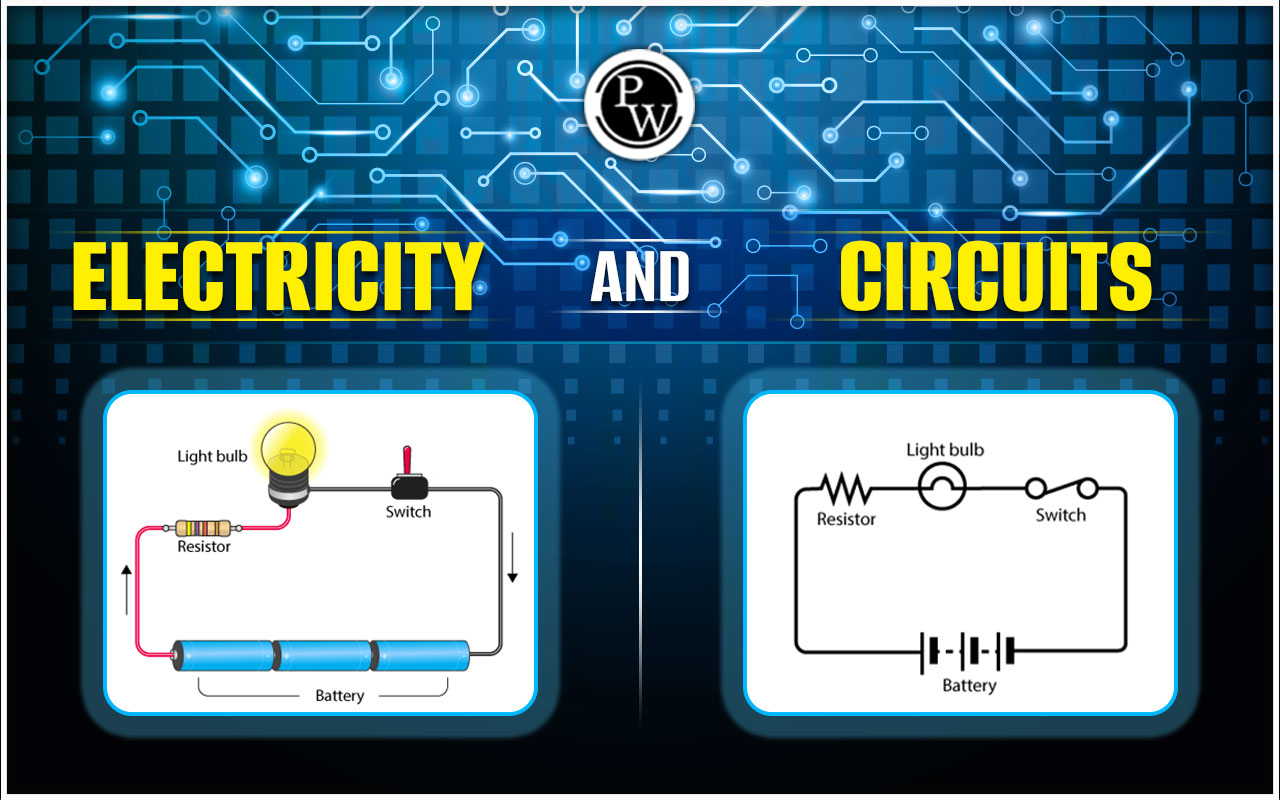
Electric Current
Electricity and Circuits: Electricity has transformed the modern world, with electric current as the core principle behind this technological breakthrough. Electric current refers to the movement of electric charge through conductors, such as wires. It powers a wide array of devices and systems essential in our everyday lives, ranging from household lighting to portable gadgets. Electric current is the movement of negatively charged particles called electrons. These electrons flow from regions of higher electric potential (voltage) to regions of lower potential, generating a steady flow of charge. The ampere (A), named after the renowned French physicist André-Marie Ampère, is the unit used to measure electric currents. Ampère made substantial contributions to the study of electromagnetism, a field deeply connected to electric current.Light, Shadows, and Reflections
Types of Electric Current
- Direct Current (DC): Direct Current (DC) refers to the flow of electric charge in a single, constant direction. This means that electrons move steadily and consistently. DC is commonly used in batteries and various electronic devices, such as cell phones and laptops. Its consistent flow makes it ideal for devices that require a controlled and uninterrupted supply of energy.
- Alternating Current (AC): Alternating current periodically changes direction, causing the flow of electrons to reverse at regular intervals. This oscillating pattern is what we commonly find in the power grids that deliver electricity to our homes. AC is advantageous for long-distance power transmission because it can be easily converted to different voltages using transformers, reducing energy loss over vast distances.
Uses of Electric Current
- Power Generation and Distribution: The process of generating and distributing electricity involves power plants that convert different energy sources, such as coal, natural gas, nuclear reactions, or renewable sources like wind and sunlight, into electric energy. This electricity is then transmitted over long distances through high-voltage power lines using AC. Substations help lower the voltage for distribution to homes, schools, and industries.
- Electronics and Technology: From small-scale electronics like transistors to complex integrated circuits, electric currents power the devices that have become indispensable in our lives. The precision control of electric currents enables advanced computing, communication, and automation.
- Transportation: Electric vehicles (EVs) utilize electric currents to charge their batteries and operate their motors. Similarly, trains, subways, and trams often employ electric currents to drive their propulsion systems, providing transportation solutions that are both efficient and eco-friendly.
- Medicine: Electric currents have numerous applications in the field of medicine. They power essential devices such as pacemakers, defibrillators, and electroencephalograms (EEGs). In addition, electric currents are employed in medical treatments like electroconvulsive therapy (ECT) and transcutaneous electrical nerve stimulation (TENS), which provide relief.
Living Organisms and their Surroundings
Electric Cell
The electric cell, also commonly referred to as a voltaic cell or galvanic cell, is a fundamental device in electrochemistry that converts chemical energy into electrical energy. It's the basis for batteries and is crucial in powering numerous modern technologies.Structure of an Electric Cell
The structure of the electric cell includes two electrodes, which are conducting materials that are submerged in an electrolyte solution, which acts as the ionic conductor. These electrodes are usually made from different metals or metal compounds and are connected by an external circuit through which electrons can flow. In this system, one electrode is known as the anode, where oxidation takes place, while the other electrode is called the cathode, where reduction occurs.How it Works
The operation of an electric cell is based on a fundamental principle - the transfer of electrons between two electrodes through a chemical reaction known as redox (reduction-oxidation). In simpler terms, one electrode goes through oxidation, releasing electrons, while the other electrode undergoes reduction and accepts those released electrons. During the redox reaction, ions in the electrolyte move from the anode to the cathode through the electrolyte solution, balancing the charges the electron flow creates. This movement of ions maintains a neutral charge in the solution and completes the electrical circuit. As long as the redox reaction continues, a flow of electrons occurs through the external circuit, creating an electric current.Bulb
A bulb connected to an electric cell is a simple yet fundamental example of an electrical circuit, demonstrating the conversion of electrical energy into light energy. This setup involves an electric cell (battery), a wire, and an electric bulb.Components
- Electric Cell (Battery): An electric cell, commonly known as a battery, is a device that stores chemical energy and converts it into electrical energy. It has two terminals: a positive terminal called the cathode and a negative terminal known as the anode.
- Wire: A wire serves as a conductor, enabling the passage of electric current. In this configuration, the wire is a pathway for electrons to flow from the battery's negative terminal to the electric bulb.
- Electric Bulb: An electric bulb, also called an incandescent light bulb, works by heating a wire filament to a high temperature using an electric current. This heat causes the filament to emit visible light.
Working
When the components are connected as described below, the circuit is complete, allowing the flow of electric current and causing the bulb to light up.Connecting the Components
- One end of the wire is connected to the negative terminal (anode) of the electric cell.
- The other end of the wire is connected to the base or bottom of the electric bulb's metal socket.
- The side of the bulb's metal socket is connected to the positive terminal (cathode) of the electric cell.
Completion of Circuit
- When the wire is connected from the battery's negative terminal to the electric bulb's socket, it provides a pathway for electrons to flow from the battery's negative terminal to the positive terminal.
- This flow of electrons constitutes an electric current.
Electric Current and Bulb Illumination
- As the electric current flows through the wire and the bulb's filament, it encounters resistance in the filament.
- The resistance in the filament causes it to heat up to a very high temperature, becoming white-hot.
- When the filament reaches this high temperature, it emits visible light due to incandescence, producing the characteristic glow of the electric bulb.
Electric Circuit
In electrical engineering and physics, an electric circuit is a foundation concept. It involves a closed pathway or loop that allows for the flow of electric current, enabling the transmission and regulation of electrical energy. Electric circuits are essential in powering various devices, from small electronic gadgets to large-scale industrial machinery.Components of an Electric Circuit
- Voltage Source: A voltage source, often represented by a battery or power supply, provides the energy necessary to drive electric current through the circuit. It creates a potential difference (voltage) that pushes electrons along the circuit.
- Conductors: These are materials, usually made of metals like copper or aluminum, that allow the flow of electrons. Conductors have low resistance, which permits the easy movement of electric charges.
- Load/Resistor: In an electrical circuit, the load refers to the component that uses electrical energy and converts it into a different form. For example, a light bulb converts electrical energy into light, a motor converts it into motion, and a resistor controls the flow of current by introducing resistance into the circuit.
- Switches: Switches open or close a circuit, allowing control over current flow. When a switch is closed, it completes the circuit and enables the current to flow; when open, it interrupts the current.
- Wires: Wires serve as the pathways for current to travel between different components of the circuit. They are typically made of highly conductive materials and have low resistance to minimize energy loss.
- Connectors: Connectors are used to join different components and establish electrical continuity. They ensure a secure and stable connection between wires and components.
Types of Electric Circuits
- Series Circuit: In a series circuit, the components are connected end-to-end in a single pathway. The same current flows through all components, and the total voltage is divided among them. If one component fails or is disconnected, the entire circuit is broken.
- Parallel Circuit: In a parallel circuit, the components are connected across common points, creating multiple pathways for current to flow. Each component has the full voltage applied to it, and the current is divided among the branches. If one branch is disrupted, other branches remain unaffected.
- Combination Circuit: Real-world circuits often combine series and parallel connections. These circuits can be more complex and require careful analysis to determine voltage, current, and resistance distribution.
Functioning of an Electric Circuit
When a circuit is closed, either by a switch or through the continuous loop of conductors, and connected to a voltage source, electric current starts to flow. This movement of electrons occurs because of the potential difference created by the voltage source. As the current moves through the circuit, it encounters different components like resistors that hinder its flow. This obstruction leads to a decrease in voltage across those particular components. Ohm's Law is a fundamental principle that governs electric circuits. It establishes a relationship between three key variables: current (I), voltage (V), and resistance (R). This relationship is expressed by the equation V = I × R. It demonstrates how voltage and current are directly proportional, while resistance and current have an inverse relationship.Electric Switches
Electric switches are essential components in electrical circuits. They have a straightforward yet vital function of controlling the flow of electricity. By interrupting or completing the path of electrical current, they enable regulation of various electrical systems and devices. At its core, an electric switch consists of a mechanism that can either connect or disconnect two or more electrical conductors. This action, often triggered by the user or an automated system, determines whether electricity can flow through a circuit. A basic manual switch comprises a movable lever or knob that physically opens or closes a gap between two contact points, effectively breaking or establishing the electrical connection. Switches are categorized based on their functions and designs:- Single-Pole Single-Throw (SPST) Switch: This is the simplest type of switch, with only one pair of contacts. It either allows or blocks the flow of electricity. An example could be a typical light switch in your home.
- Single-Pole Double-Throw (SPDT) Switch: This switch has one input terminal and two output terminals. It can direct the current to one of two possible paths. An SPDT switch is often used in applications where a choice between two different circuits is needed.
- Double-Pole Single-Throw (DPST) Switch: This switch has two contacts operating together. It can control two separate circuits simultaneously.
- Double-Pole Double-Throw (DPDT) Switch: Similar to the SPDT switch, but with two input and two output terminals. It can direct the current between two different paths in a circuit.
- Push Button Switch: This switch operates by pressing a button that engages or disengages the contacts. It's commonly used in devices like doorbells and machinery controls.
- Toggle Switch: Recognizable by its lever that can be flipped up or down to open or close the circuit. Toggle switches come in various configurations, from SPST to DPDT, and find applications in lighting, electronics, and more.
- Rotary Switch: This switch has a rotating dial or knob that selects different positions, each corresponding to a specific circuit configuration. It's often used in settings where multiple options need to be chosen.
- Mercury Tilt Switch: Utilizing the conductive properties of mercury, this switch is sensitive to changes in orientation. It's employed in devices like thermostats and anti-tilt mechanisms.
- Pressure Switch: These switches respond to changes in pressure and are often used in industrial applications like monitoring fluid levels or gas pressure.
Conductors and Insulators
Conductors, often metals, permit the flow of electric charges due to their abundant free electrons that readily move in response to an applied electric field. This facilitates the efficient transmission of electricity. In contrast, insulators, such as rubber or plastic, possess tightly bound electrons that hinder the flow of charges, making them poor conductors. This distinction is crucial in designing circuits and systems, enabling controlled electrical conduction for various applications, from power transmission to electronics while preventing unintended short circuits or leakage.Final Thoughts
Electricity powers our world, and circuits are like the roads that help it travel. Remember, circuits make lights glow, and devices work! So, next time you flip a switch, you'll know the magic behind the bright and buzzing world of electricity. Are you looking for a fun and educational way to learn about science? The Fundo Experiment Kit is perfect for you! This kit comes with over 20 experiments that are sure to keep you entertained and engaged. Order your kit today and start learning science the fun way! Related LinksElectricity and Circuits FAQs
What is electricity, and how does it flow through circuits?
Electricity is the flow of electrons through a conductor. Circuits provide a path for this flow, enabling energy transfer to power devices.
What are the essential components of an electric circuit?
An electric circuit comprises a power source (like a battery), conductive pathways (wires), and components (resistors, capacitors, etc.) that manipulate the flow of electricity.
What's the difference between series and parallel circuits?
Series circuits have components connected sequentially, sharing the same current, while parallel circuits have components connected side by side, maintaining the same voltage but splitting the current.
How do circuit breakers and fuses protect against overloads?
Circuit breakers and fuses interrupt the circuit when excessive current flows, preventing overheating and potential fires by cutting off the power supply.
Why are insulators crucial in electrical circuits?
Insulators prevent the unwanted flow of electricity, ensuring that the current follows the intended path and reducing the risk of electric shocks or short circuits.






Talk to a counsellorHave doubts? Our support team will be happy to assist you!


Check out these Related Articles








Join 15 Million students on the app today!
 Live & recorded classes available at easeDashboard for progress trackingMillions of practice questions at your fingertips


Free Learning Resources
PW Books
Notes (Class 10-12)
PW Study Materials
Notes (Class 6-9)
Ncert Solutions
Govt Exams
Our Other Websites
Class 6th to 12th Online Courses
Govt Job Exams Courses
UPSC Coaching
Defence Exam Coaching
Gate Exam Coaching
Other Exams
Know about Physics Wallah
Physics Wallah is an Indian edtech platform that provides accessible & comprehensive learning experiences to students from Class 6th to postgraduate level. We also provide extensive NCERT solutions, sample paper, NEET, JEE Mains, BITSAT previous year papers & more such resources to students. Physics Wallah also caters to over 3.5 million registered students and over 78 lakh+ Youtube subscribers with 4.8 rating on its app.
We Stand Out because
We provide students with intensive courses with India’s qualified & experienced faculties & mentors. PW strives to make the learning experience comprehensive and accessible for students of all sections of society. We believe in empowering every single student who couldn't dream of a good career in engineering and medical field earlier.
Our Key Focus Areas
Physics Wallah's main focus is to make the learning experience as economical as possible for all students. With our affordable courses like Lakshya, Udaan and Arjuna and many others, we have been able to provide a platform for lakhs of aspirants. From providing Chemistry, Maths, Physics formula to giving e-books of eminent authors like RD Sharma, RS Aggarwal and Lakhmir Singh, PW focuses on every single student's need for preparation.
What Makes Us Different
Physics Wallah strives to develop a comprehensive pedagogical structure for students, where they get a state-of-the-art learning experience with study material and resources. Apart from catering students preparing for JEE Mains and NEET, PW also provides study material for each state board like Uttar Pradesh, Bihar, and others
Copyright © 2026 Physicswallah Limited All rights reserved.