







More in PC Courses
Explore More Information About PC
There is a specific moment most learners hit around the third month of an online course. The notes are complete, the playlist is finished, the certificate has been downloaded — and the laptop still has nothing on it worth showing an employer or a client. The learning happened. The proof did not.
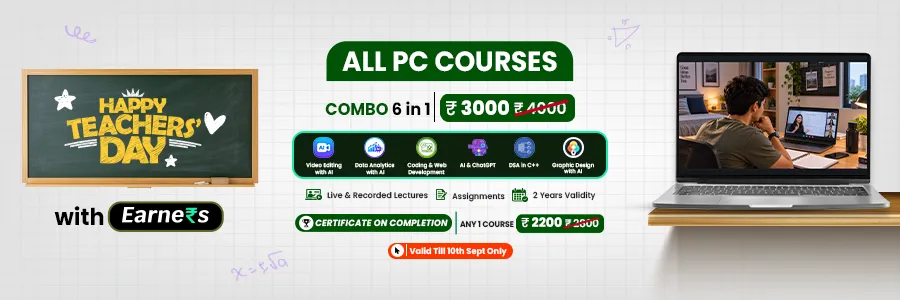
PW Earners PC Courses are structured to close that gap. Every one of the six tracks is built to be run on a laptop or desktop, taught in Hinglish, and measured by what sits in your project folder at the end. You are not collecting concepts. You are assembling a portfolio while you learn, one deliverable at a time.
The Delivery Model Behind All Six Courses
Before the individual tracks, it helps to understand what stays constant across the programme — because the format itself is a large part of the value.
- 12 live classes per course. These are the sessions where the reasoning gets exposed. A recorded video shows you the correct answer; a live class shows you the decision that produced it, and lets you interrupt it. Doubts get resolved while they are still small, not after they have compounded into a blocked project.
- 4 recorded lessons. These carry the dense material — the syntax-heavy segments, the tool walkthroughs, the topics that reward a second and third viewing at your own speed. You revise on your schedule, pause where you need to, and return before an interview without waiting for a repeat batch.
Six domain faculty. Coding, AI, design, data analytics and editing are each handled by a mentor who works in that field rather than a generalist rotating across all of them. Combined teaching and industry experience across the panel runs to roughly 35 years.
| Faculty | Experience |
| Nishtha Jain | 10 years |
| Devesh Sharma | 7 years |
| Raghav Garg | 6 years |
| Khushal Sharma | 5 years |
| Aditya Jain | 4 years |
| Nishant Saini | 3 years |
7 batches. Multiple batches exist so that a complete beginner and a learner with prior exposure are not forced into the same pace. You enter at a level that matches where you actually are, which reduces both boredom and drop-off.
Hinglish instruction. Technical education in India loses a large number of capable learners not to difficulty but to language friction. Hinglish removes the translation step between hearing a concept and understanding it, so your attention goes to recursion or colour grading rather than to vocabulary.
Project-based assessment. Each track ends in work you can show. That is the deliverable — not a completion percentage.
The Six Courses: What Each One Is Actually For
1. Data Analytics with AI
Built for: Learners targeting analyst roles in business, product, finance or operations.
The core stack: Microsoft Excel, SQL, Power BI and Tableau, advanced Python for analytics, data cleaning and visualisation, statistics fundamentals, AI tools for productivity, and capstone projects.
What makes this track distinct: Most analytics courses teach either the spreadsheet layer or the programming layer. This one runs the full chain — Excel for fast exploration, SQL for pulling from real databases, Python for anything the first two cannot handle, and Power BI or Tableau to present it to people who will never open your code. The statistics component is what separates a chart-maker from an analyst: knowing whether a difference in your data means anything is the skill that actually gets tested in interviews. AI tooling is layered on top for speed, not as a replacement for understanding the numbers.
What you leave with: Capstone projects built on realistic datasets, taken through cleaning, analysis and a finished dashboard.
2. Coding & Web Development
Built for: Aspiring frontend, backend and full-stack developers.
The core stack: HTML, CSS with Tailwind projects, advanced JavaScript including OOP and async, React 19 and Next.js, Node.js backend development, APIs, Git and GitHub, and full-stack projects.
What makes this track distinct: The curriculum is current, and that matters more in web development than in any other field on this list. React 19 and Next.js are what hiring teams are building on right now, not what they were building on three years ago. The advanced JavaScript block — async behaviour, object-oriented patterns — is the section that most beginner courses skip and most technical interviews go straight to. Git and GitHub are treated as core curriculum rather than an afterthought, because in a real team, code that cannot be collaborated on is code that does not ship.
What you leave with: Full-stack applications with working frontends, backends and API layers, versioned publicly on GitHub.
3. DSA in C++ with AI
Built for: Students preparing for placement drives, coding rounds and product-company interviews.
The core stack: Programming fundamentals and logic building, arrays, strings, recursion, sorting and searching, linked lists, stacks and queues, trees, graphs, dynamic programming, and OOP concepts.
What makes this track distinct: The sequencing is designed for interview readiness rather than syllabus coverage. It opens with logic building — the layer that determines whether recursion later feels intuitive or impossible — and ends at dynamic programming and graphs, which is precisely where the difficulty ceiling of most coding rounds sits. C++ is the deliberate choice: it remains the default language of competitive programming and the one most placement problems are calibrated against. AI-assisted practice supports pattern recognition across problem sets, so you learn to classify a question before you start solving it.
What you leave with: Structured coverage of the problem patterns that recur across placement tests, plus the OOP grounding that interviews test separately.
4. Graphic Design with AI
Built for: Learners moving toward creative roles, freelance design work or brand and social media positions.
The core stack: Design fundamentals and principles, Photoshop and advanced editing, AI design tools, branding and social media design, portfolio projects, and creative workflows.
What makes this track distinct: Fundamentals come before software, which is the right order and an unusual one. Hierarchy, spacing, colour relationships and composition are what make a design work; Photoshop is only the instrument that executes them. Learners who reverse this order end up as tool operators who can follow a tutorial but cannot originate a layout. The branding and social media modules are where the commercial value sits — that is the actual paid work in the Indian market. The workflow component addresses the part nobody teaches: file organisation, revision handling, and delivering to a client in the format they asked for.
What you leave with: A portfolio of branding and social media pieces — the exact artefact a design client or employer asks to see first.
5. Video Editing with AI
Built for: Aspiring editors, content creators and anyone building toward the creator economy.
The core stack: Adobe Premiere Pro fundamentals, transitions, cuts and effects, colour grading, audio editing, motion graphics basics, AI tools for faster editing, and social media content creation.
What makes this track distinct: Audio is treated as a first-class skill, which is where this course quietly separates itself. Viewers tolerate imperfect footage and abandon bad sound — every working editor knows it, and most beginner courses still bury it. Colour grading and motion graphics are what lift output above default-template editing, which is increasingly the difference between rates. AI tooling is deployed against the genuinely tedious parts — rough cuts, transcription-driven trims — so your hours go into the creative decisions. The social media module addresses format discipline: vertical framing, retention pacing, and the first three seconds.
What you leave with: Edited pieces in social-ready formats, graded and mixed, suitable for a reel or client pitch.
6. AI & Machine Learning
Built for: Learners aiming at AI, ML and data science roles.
The core stack: Python for AI and ML, machine learning models, data preprocessing and visualisation, and deep learning fundamentals.
What makes this track distinct: It gives preprocessing the weight it deserves. In practice, the majority of an ML practitioner's time goes into cleaning, encoding and shaping data — not into model architecture — and a course that rushes past this stage produces learners who can call a function but cannot get a real dataset into a usable state. The progression from classical ML models into deep learning fundamentals builds understanding in the correct order, so neural networks arrive as an extension of principles you already hold rather than as a black box.
What you leave with: Working models built end to end, from raw data through preprocessing to evaluation.
Choosing Your Track
| If you want to... | Take |
| Work with data and business decisions | Data Analytics with AI |
| Build and ship websites and applications | Coding & Web Development |
| Clear placement and product-company coding rounds | DSA in C++ with AI |
| Design brands, campaigns and visual content | Graphic Design with AI |
| Edit for creators, brands or your own channel | Video Editing with AI |
| Move into AI, ML and data science roles | AI & Machine Learning |
A useful test: ask what you want to be able to hand someone six months from now. A dashboard, a deployed website, a solved problem set, a brand identity, a finished edit, or a trained model. That answer points to your track.
What PW Earners PC Courses Are Designed to Deliver
Six tracks. A laptop as the only hardware requirement. Twelve live classes and four recorded lessons per course, seven batches across levels, six domain specialists, Hinglish delivery, and projects that exist to be shown rather than submitted.
The measure of the programme is not how much you covered. It is what you can open and demonstrate at the end of it.
PW Earners PC Courses 2026 FAQs
What are PW Earners PC Courses?
Can I join with no prior background?
How much of the course is practical?
Are classes live, recorded, or both?
What language are the classes taught in?
What courses are included in the PW Earners PC Courses Batch?
Do I need a laptop or computer?
Is this batch suitable for complete beginners?

Get Free Counselling Today
and Clear up all your Doubts
 Live & recorded classes available at easeDashboard for progress trackingLakhs of practice questions




