






Civil Services Reforms in India: Historical Evolution and Modern Initiatives
Civil Services Reforms in India focus on improving efficiency, transparency, accountability, and service delivery within the administrative system to better meet the needs of citizens.
 Deeksha Dixit25 Nov, 2025
Share
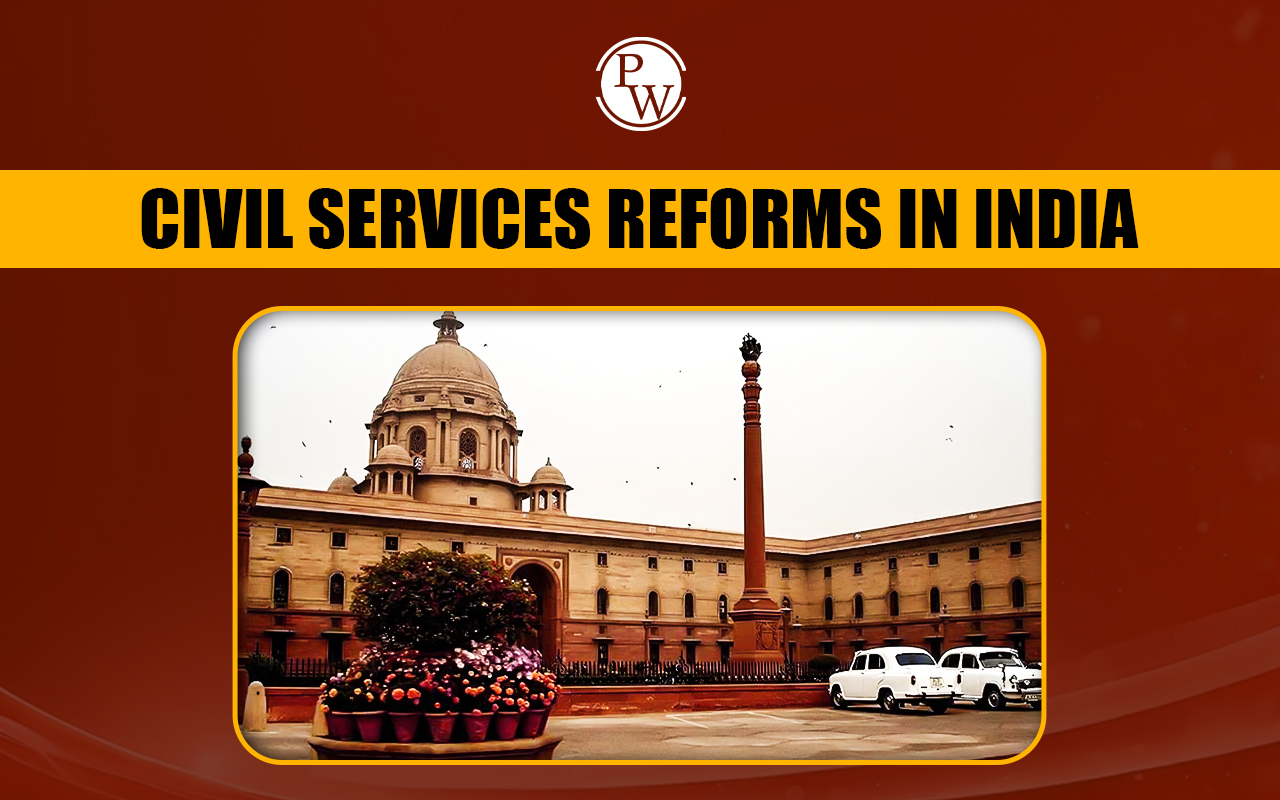
Civil Services Reforms in India are critical changes aimed at enhancing the efficiency, accountability, and responsiveness of the administrative machinery to better meet the dynamic needs of society and ensure effective governance.
As the permanent executive arm of the government, the Civil Services are pivotal in policy implementation, public service delivery, and maintaining national integrity, making continuous reform essential for a developing and evolving nation.
The necessity for these reforms arises from several challenges, including the traditional bureaucratic structure being slow, rigid, and often resistant to change, leading to issues like red tapism and complicated procedures. The goal is to transform the bureaucracy from a rule-book-focused entity to a proactive, results-oriented apparatus of public service.
Civil Services Reforms in India
Civil Services Reforms in India encompass a broad range of changes focusing on key areas such as recruitment, training, performance evaluation, promotion, and policy implementation. These reforms are vital for several reasons:
-
Efficiency and Effectiveness: To replace the traditional, slow and rigid structure with an agile, responsive, and result-oriented administrative framework.
-
Transparency and Accountability: To reduce corruption, enhance transparency, and ensure that civil servants are accountable for their decisions, thereby regaining public trust.
-
Capacity Building: To equip public servants with the necessary skills and domain knowledge to manage complex administrative tasks in a rapidly changing globalised world.
-
Public-Centric Administration: To align the focus of civil services with the needs of the citizens, promoting inclusive and effective governance.
Historical Perspective Committees and Their Recommendations
The journey of Civil Services Reforms in India is marked by various commissions and committees that have periodically reviewed the administrative system and proposed structural and functional changes.
Report on Public Administration by A.D. Gorwala, 1951
One of the earliest post-independence reviews, this report advocated for recruitment processes that were free from patronage and bias, and suggested better training mechanisms for recruits.
First Administrative Reforms Commission (ARC), 1966
The First ARC provided a comprehensive blueprint for administrative restructuring and recommended changes to enhance the overall governance machinery.
Kothari Committee, 1976
This committee introduced significant reforms to the recruitment process for the Civil Services Examination (CSE). It established the current three-stage examination process: Preliminary, Mains, and Personality Test (Interview). It also recommended a structure of nine written papers in the Mains examination.
Satish Chandra Committee, 1989
Building on the Kothari Committee's work, the Satish Chandra Committee recommended the inclusion of an Essay paper in the Mains examination. It also increased the weightage of the Personality Test to improve the evaluation of the candidates' overall suitability.
Hota Commission, 2004
The Hota Commission pushed for modernising the administration. Its key recommendations included:
-
Advocating for e-Governance and the use of Information and Communication Technology (ICT) to enhance administrative efficiency.
-
Recommending the introduction of an aptitude test in the preliminary exam (which was later implemented as the Civil Services Aptitude Test or CSAT).
-
Suggesting performance-based rewards and the removal of underperforming personnel.
Second ARC, 2005
The Second Administrative Reforms Commission placed a strong emphasis on establishing citizen-centric governance and promoting ethics in administration. It emphasized local empowerment and recommended the adoption of the Right to Information (RTI) Act. It also proposed the creation of a national ombudsman and advocated for a dedicated Civil Services Law.
Baswan Committee, 2016
This committee primarily addressed issues related to the UPSC examination and cadre management. Key recommendations included:
-
Addressing the shortfall of IAS officers by recommending an annual recruitment of 180 officers.
-
Proposing a reduction in the upper age limit for general category candidates.
-
Suggesting the removal of optional papers in the Mains examination.
Modern Initiatives in Civil Services Reforms
In recent times, the government has launched several flagship programs and initiatives to accelerate Civil Services Reforms in India, focusing on capacity building, specialisation, and leveraging technology.
Mission Karmayogi (National Programme for Civil Services Capacity Building - NPCSCB)
Launched in 2020, Mission Karmayogi is a massive reform aimed at transforming the mindset and enhancing the capacity of civil servants through a continuous online learning platform, iGOT Karmayogi.
-
Key Focus: Shifting the system from 'Rules-based' to 'Roles-based,' emphasising on-site learning, and creating a shared training ecosystem.
-
Goal: To build a citizen-centric, future-ready civil service by calibrating all positions to a Framework of Roles, Activities, and Competencies (FRACs).
Lateral Entry
To inject much-needed domain expertise and proficiency into the government's policy-making process, the government introduced the concept of lateral entry. This allows the induction of specialists from the private sector and academia at senior levels (like Joint Secretary, Director, and Deputy Secretary) to provide fresh perspectives and specialised knowledge.
NITI Aayog Recommendations
The NITI Aayog has outlined comprehensive proposals for Civil Services Reforms in India, covering four key areas:
-
Recruitment: Rationalising the over 60 existing civil services into a central talent pool for better allocation and matching of competencies to job descriptions.
-
Training: Emphasising mid-career training and outcome-oriented development, leveraging online platforms for skill development.
-
Evaluation: Developing benchmarks for performance assessment, reducing discretionary aspects in evaluation, and implementing the 360-degree appraisal system (which includes confidential feedback from peers, subordinates, and outsiders).
-
Governance: Strengthening ethical codes, promoting domain specialisation, and strengthening local governance through devolution of powers.
Challenges in Civil Services in India
Despite continuous efforts towards Civil Services Reforms in India, several challenges hinder the full potential of the administrative services:
-
Lack of Specialisation: Civil servants are often generalists who are transferred frequently across departments requiring specialised knowledge (e.g., from Steel and Mines to Culture), leading to a lack of domain expertise.
-
Political Interference and Neutrality: Political pressure and patronage can compromise the objectivity and professionalism of civil servants, affecting their decision-making and neutrality.
-
Status Quo-ist Mentality: There is an alleged resistance to change among some bureaucrats who fear that reforms may end their privileges, hindering the realization of objectives like greater local self-governance.
-
Corruption and Lack of Accountability: Corruption, red-tapism, and a lack of robust mechanisms to hold officials accountable continue to erode public trust. The security of tenure, though necessary for political neutrality, can sometimes breed insensitivity and disregard for transparency.
Civil Services Reforms FAQs
What is Mission Karmayogi related to Civil Services Reforms in India?
Which committee introduced the three-stage examination process for civil services?
Why is Lateral Entry considered an important Civil Services Reform?
What are the three All India Civil Services in India?









 Live & recorded classes available at easeDashboard for progress trackingMillions of practice questions at your fingertips

