Full Form of NAVY
 Ranvijay Singh2 Sept, 2023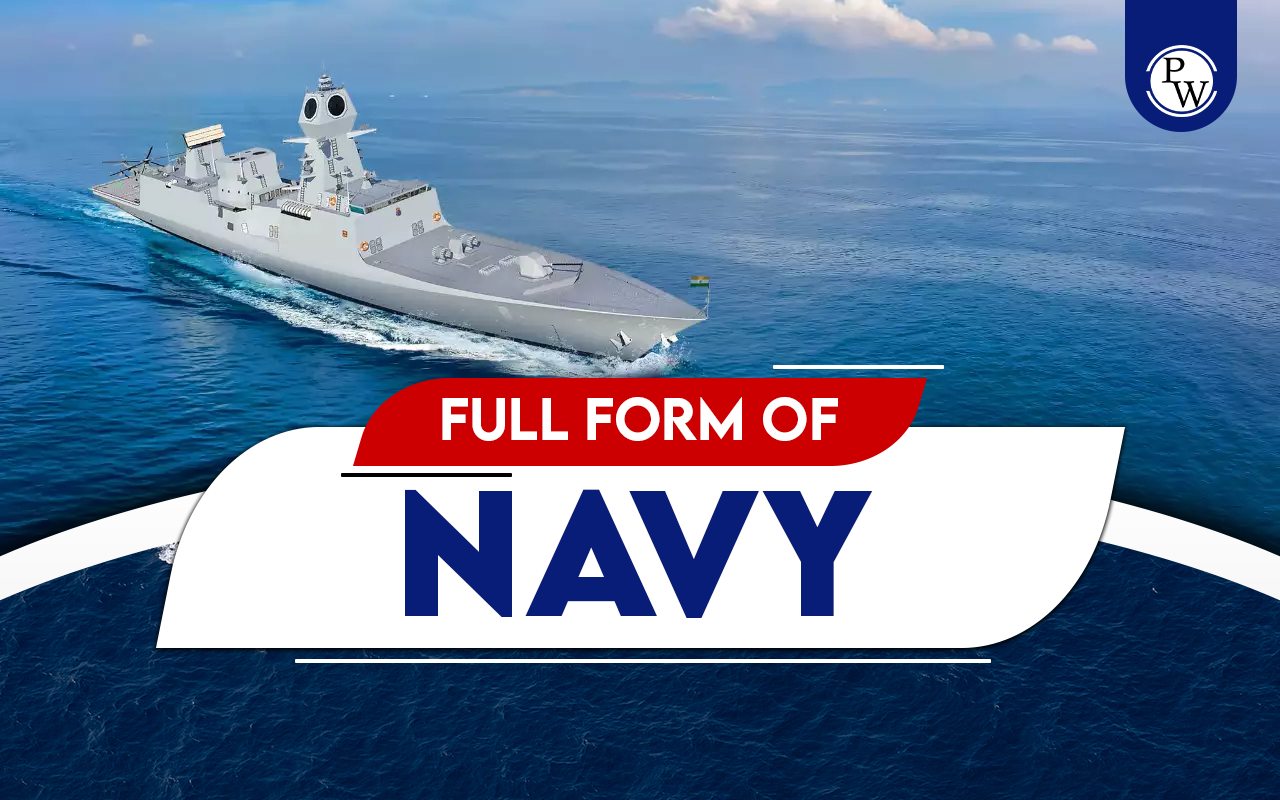
The full form of NAVY is: Nautical Army of Volunteer Yeomen
Category: Military and Defence
The navy, naval force or maritime force of a country is its branch of the armed forces made specifically for naval and coastal conflict, i.e., lake-borne, riverine, littoral, or ocean-borne fighting maneuvers. In addition to supplementary assistance, connectivity, training, and other sectors, it encompasses all operations performed by surface vessels, amphibious assault ships, submarines, and seaborne aircraft.
Functions of the NAVY
The navy's tactical attacking role is to deploy troops into areas beyond a nation's borders (for example, to protect sea lanes, deter or confront piracy, ferry troops, or attack other navies, ports, or shore installations). Preventing an adversary from radiating force from the sea is the navy's fundamental protective objective. Ballistic missile barrages from submarines could be used as a nuclear deterrent as part of the navy's major strategy. Although these divisions are more about strategic scope than logistical or operative division, naval activities can be broadly classified as riverine and littoral deployments (brown-water navy), open-ocean operations (blue-water navy), and everything in-between (green-water navy).Common Naval Traditions
With the possible exception of attackers and submarines, which are alluded to as boats, it is a basic custom to refer to all ships commissioned in a navy as ships rather than vessels. A ship's name prefix denotes whether it is a chartered ship. The ship's bell has long been a significant custom aboard naval warships of certain nations. In the past, this was used as a way to measure the flow of time, a way to warn people when there was a lot of fog, and for alarms and rituals. A Boatswain's call is used to "pipe" the ship's captain and much more senior staff aboard. Ships have historically been referred to as "she" in English. However, allowing women to sail on navy ships was traditionally regarded as unlucky. A cannon salute that is fired without a legitimate military objective shows respect and trust by temporarily disarming the ship. The number of guns discharged over time began to represent the official's rank as the custom developed.The Introduction of Naval Aviation
The use of military air power by navies, whether it be from cruisers that board aircraft or from shore bases, is known as naval aviation. Several navies employed flying boats and floatplanes during World War I, mostly for scouting purposes. By the end of World War II, aircraft carriers could carry fighter aircraft for defense and bomber aircraft that could attack naval and land objectives. Since World War II, helicopters have been loaded onto smaller ships for transport and anti-submarine warfare. In addition to using marine patrol and training aircraft, certain navies have also used land-based aircraft. Naval aviation forces largely carry out Navy missions at sea. They do serve a number of other purposes, though.Global Ranking of the Different Navies of the World
The WDMMW annual rating uses a system that considers values relating to the combined fighting power of the major global naval services. The algorithm generates the "True Value Rating" (TvR), which aids in clearly differentiating each power based on factors such as modernization, logistical support, assault and defense capabilities, and other factors in addition to overall strength. In this method, a power's quality and overall inventory mix are taken into consideration rather than just how many warships and submarines it has in total. Beyond this, emphasis is placed on force experience, inventory balance (overall mix of unit kinds), and local shipyard capabilities. The United States Navy presently holds a record-high TvR score of 323.9. (USN ). The USN, led by its renowned carrier fleet, has a wide variety of warship and submarine types, as well as a balance that is strengthened by overall numbers (quantity). Because of the vast industrial base in the United States, many of its products are obtained domestically. Top 10 nations with the most powerful navy establishments: 35 countries are currently tracked by the WDMMW, together with 35 distinct naval services and 2,948 individual units. The first 10 most powerful navy-possessing nations of the globe are as follows:- United States Navy with 243 units
- People’s Liberation Army Navy with 419 units
- Russian Navy with 265 units
- Indonesian Navy with 242 units
- The Republic of Korea Navy with 138 units
- Japan Maritime Self-Defense Force with 102 units
- Indian Navy with 102 units
- French Navy with 66 units
- British Royal Navy with 51 units
- Italian Navy with 54 units
Who is the Indian Navy's god?
The father of the Indian Navy, Chhatrapati Shivaji Maharaj Bhosale, was born on February 19, 1630, at Shivneri, a town close to Junnar (Pune district).
What is the number of warships that India possesses?
There are now 150 ships and submarines in the Indian Navy.
Why is there no fleet in Japan?
The establishment of a military is prohibited by Article 9 of the Japanese Constitution, which also forbids the use of war to resolve international conflicts.


Talk to a counsellorHave doubts? Our support team will be happy to assist you!


Join 15 Million students on the app today!
 Live & recorded classes available at easeDashboard for progress trackingMillions of practice questions at your fingertips


Free Learning Resources
PW Books
Notes (Class 10-12)
PW Study Materials
Notes (Class 6-9)
Ncert Solutions
Govt Exams
Our Other Websites
Class 6th to 12th Online Courses
Govt Job Exams Courses
UPSC Coaching
Defence Exam Coaching
Gate Exam Coaching
Other Exams
Know about Physics Wallah
Physics Wallah is an Indian edtech platform that provides accessible & comprehensive learning experiences to students from Class 6th to postgraduate level. We also provide extensive NCERT solutions, sample paper, NEET, JEE Mains, BITSAT previous year papers & more such resources to students. Physics Wallah also caters to over 3.5 million registered students and over 78 lakh+ Youtube subscribers with 4.8 rating on its app.
We Stand Out because
We provide students with intensive courses with India’s qualified & experienced faculties & mentors. PW strives to make the learning experience comprehensive and accessible for students of all sections of society. We believe in empowering every single student who couldn't dream of a good career in engineering and medical field earlier.
Our Key Focus Areas
Physics Wallah's main focus is to make the learning experience as economical as possible for all students. With our affordable courses like Lakshya, Udaan and Arjuna and many others, we have been able to provide a platform for lakhs of aspirants. From providing Chemistry, Maths, Physics formula to giving e-books of eminent authors like RD Sharma, RS Aggarwal and Lakhmir Singh, PW focuses on every single student's need for preparation.
What Makes Us Different
Physics Wallah strives to develop a comprehensive pedagogical structure for students, where they get a state-of-the-art learning experience with study material and resources. Apart from catering students preparing for JEE Mains and NEET, PW also provides study material for each state board like Uttar Pradesh, Bihar, and others
Copyright © 2026 Physicswallah Limited All rights reserved.