







Aldol Reaction And Condensation Of Ketones And Aldehydes, Important Topics For JEE 2024
 Shrivastav 1 Apr, 2024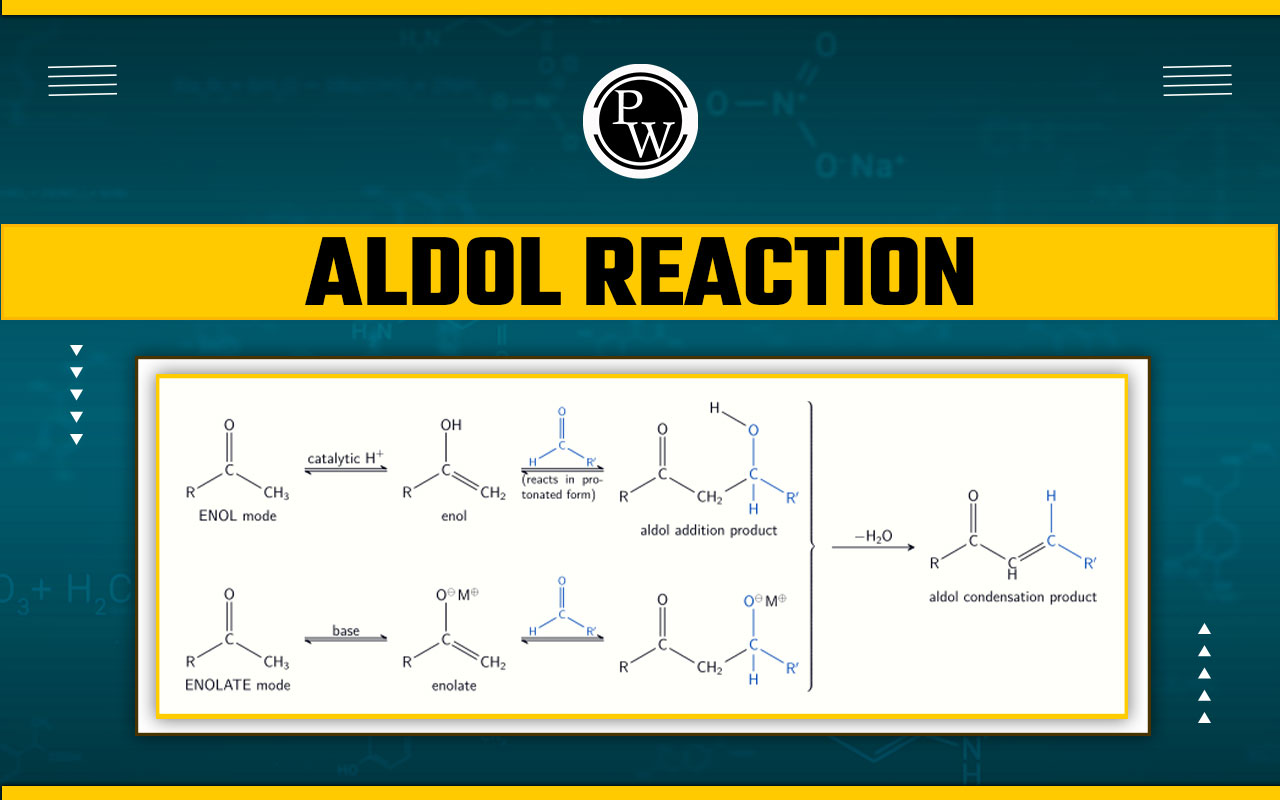
Aldol Reaction : A condensation reaction is a kind of chemical reaction in organic chemistry where two molecules combine to form one, typically at the expense of a smaller molecule like water. The process is also referred to as a dehydration synthesis if any water is lost. Nevertheless, other molecules like hydrogen sulphide, ethanol, ammonia, and acetic acid can also be lost.
The two molecules usually add to the addition product step-by-step, usually in equilibrium and with the loss of one water molecule—thus the name condensation. The reaction can also involve the molecule's functional groups. This class of reactions is adaptable and can happen in an acidic or basic environment or in the presence of a catalyst.

Aldol Condensation
Electrophilic substitution at the alpha carbon in enolate anions is also demonstrated by the Aldol Reaction, a useful carbon-carbon bond-forming reaction. Alpha C-H addition of one reactant molecule to the carbonyl group of another reactant molecule results in the dimerization of an aldehyde (or ketone) into a beta-hydroxy aldehyde (or ketone), which is the basic transformation in this reaction. Grignard reagents can be added to carbonyls in a similar way because enolates are carbanion-like substances. At least one of the reactants needs to contain alpha hydrogens in order for this reaction to happen.


Aldol condensation does not occur in aldehydes or ketones that do not have an α-hydrogen atom, such as formaldehyde (HCHO), benzaldehyde (C 6 H 5 CHO), and benzophenone (C 6 H 5 COC 6 H 5 ).
Cross aldol condensation
The crossed aldol reaction is the condensation reaction of two distinct aldehyde or ketone molecules in a protic solvent, like alcohol or water. Crossed aldol condensation is the condensation between two distinct carbonyl compounds. Both aldehydes can form carbanions and function as carbanion acceptors when they both contain alpha hydrogens. As a result, four different products come together.
One of the aldehydes can only function as a carbanion acceptor if it lacks alpha hydrogen. Only two products are formed in this scenario. An aromatic aldehyde, which lacks an alpha position, is a typical substrate for the crossed aldol reaction. In addition, the initial condensation product dehydrates quickly, resulting in the formation of α, β-unsaturated ketone and blocking the retro-aldol reaction.

A- A Condensation: When one molecule of A works as a nucleophile and another molecule of A works as a carbanion acceptor, the following product is formed.

B- B Condensation: When one molecule of B works as a nucleophile and another molecule of B works as a carbanion acceptor, the following product is formed.

A-B Condensation: When one molecule of B works as a nucleophile and another molecule of A works as a carbanion acceptor, the following product is formed.

B-A Condensation: When one molecule of A works as a nucleophile and another molecule of B works as a carbanion acceptor, the following product is formed.

Claisen – Schmidt condensation The reaction between an aromatic carbonyl compound that does not have an α-hydrogen and an aldehyde or ketone that has one is known as the Claisen-Schmidt condensation in organic chemistry. It could be considered a specific type of aldol-condensation. The reaction bears the names of Rainer Ludwig Claisen and J. Gustav Schmidt, two of its pioneering investigators who published independently on the subject in 1880 and 1881.

Cannizzaro reaction: A reaction involving organic compounds with an aldehydic group (–CHO) is known as the Cannizzaro reaction. It has Stanislao Cannizzaro's name because he proposed it in 1853. Aldol condensation, another organic compound reaction with an aldehydic group containing α-hydrogen in the presence of diluted alkali, has already been covered. The condensation product is β-hydroxy aldehyde. The product is referred to as aldol condensation because it includes both hydroxy (–OH) and aldehyde (–CHO) groups. Regarding the α-hydrogen, the Cannizzaro reaction is not the same as the aldol reaction.

Mechanism:
Step I : The OH- ion attacks the carbonyl carbon to form hydroxyl alkoxide

Step II: Anion (I) donates a hybrid ion to the second aldehyde molecule. The acid and the alkoxide ion transfer H + to obtain stability in the reaction's last stage.

Reaction with chloroform: Chloretone is created when acetone and chloroform react in the presence of sodium or potassium hydroxide. The formation of chloretone is actually caused by the anions in the reactants, CH 3 CO − and CCl 3 − , reacting and forming bonds with the cations, H + and CH 3 + , respectively. For additional purification, it could also go through recrystallization or sublimation. Chloretone is used as hypnotic. The following is a representation of the chemical equation that forms chloretone.

Reaction with primary amine: Schiff bases, or imine derivatives, are created when aldehydes and ketones react with ammonia or 1º-amines (compounds having a C=N function). The process, which is acid-catalysed and reversible in the same way as acetal formation, eliminates water.

Aldol Reaction FAQs
Q.1 : What is Aldol condensation?
Q.2: What is Aldol condensation?
Q.3: What is cannizzaro reaction?
Q.4: What is condensation reaction?















 Live & recorded classes available at easeDashboard for progress trackingMillions of practice questions at your fingertips

