






Electrical Instruments, Galvanometer, Rheostat, Wheatstone Bridge, Important Topics JEE 2024
 Shrivastav 21 Apr, 2024
Share
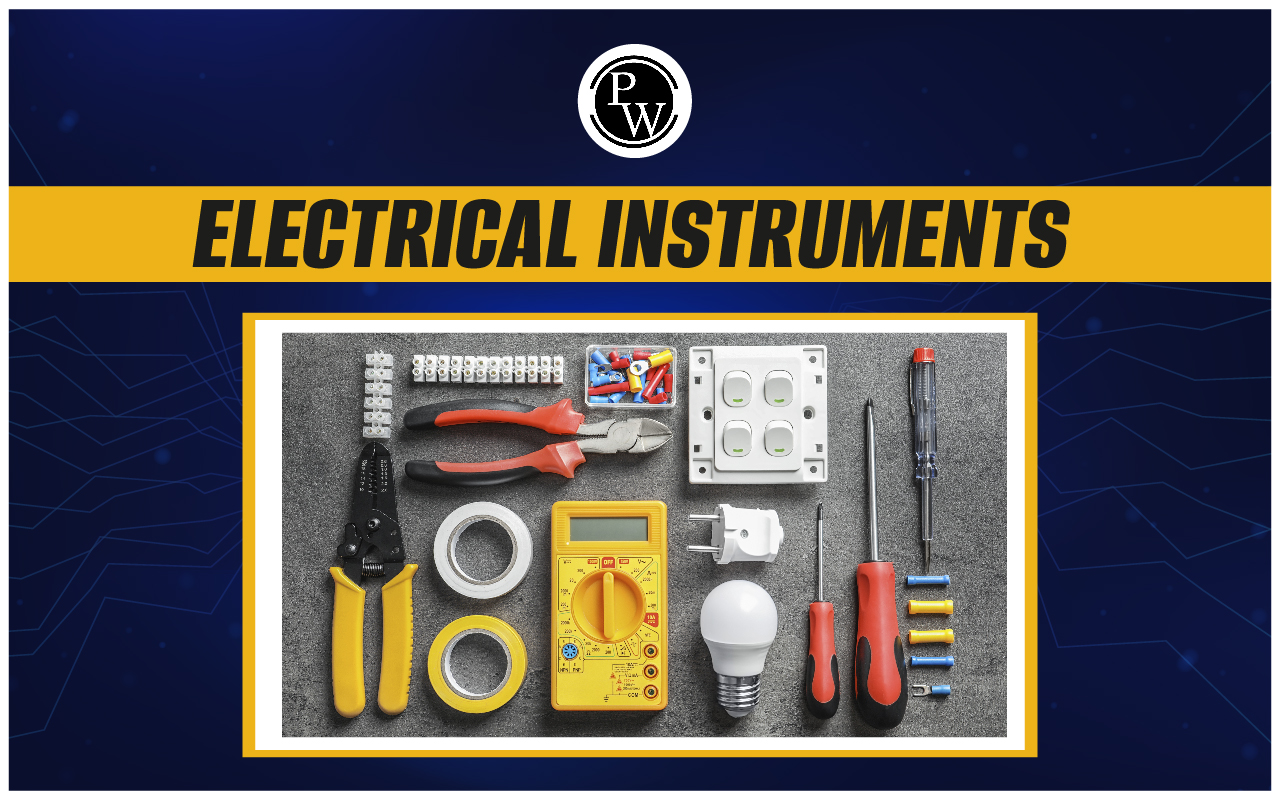
Electrical Instruments : A galvanometer is a device that detects electricity. An ammeter and voltmeter can made using a galvanometer. For that, we connect a resistance of appropriate value with the galvanometer. It is possible to find the value of an unknown resistance if we connect it with three resistors of known resistance in a Wheatstone bridge and obtain a balanced condition.
Galvanometer
Galvanometer : A device that defects the presence of electric current in the branch it is connected is called galvanometer. A galvanometer can be converted to ammeter and voltmeter by making some modifications.
Conversion Of Galvanometer Into Ammeter
Conversion Of Galvanometer Into Ammeter : Ammeter is a device that measures the electric current. A galvanometer can be converted into an ammeter by connecting low resistance in parallel to its coil. This small resistance connected in parallel to galvanometer coil is called shunt. It will control the current flowing through the galvanometer.
Shunt protects the galvanometer from burning. The range of an ammeter can be changed by using shunt resistance of different values.

If I is the desired range of the ammeter, then


Ammeter is connected in series for measuring the current. Resistance of ammeter,

As,

To convert an ammeter of range
I
ampere and resistance
R
G
Ω into an ammeter of range
nI
ampere, the value of resistance to be connected in parallel will be

Resistance of an ideal ammeter is zero.
Conversion Of Galvanometer Into Voltmeter
Conversion Of Galvanometer Into Voltmeter : Voltmeter is a device that measures the potential difference. A galvanometer can be converted into voltmeter by connecting a high resistance in series with its coil.

For maximum potential difference,


If R G is negligible, i.e., R G << R ,

For measuring the potential difference, a voltmeter is connected parallel to the element.
To convert a voltmeter of resistance R g Ω and range V volt into voltmeter of range nV volt, the value of resistance to be connected in series will be ( n – 1) R g .
Resistance of an ideal voltmeter is infinite.
Rheostat
Rheostat : A rheostat is a variable resistor used for controlling the flow of electric current in a circuit. The symbol used for rheostat is given by below

Current is inversely proportional to resistance. A rheostat is used to change the resistance of the circuit, so that current changes. The minimum resistance of a rheostat is zero and the maximum resistance is given by resistance rating of the rheostat. We know that resistance is directly proportional to the length of the conductor. In order to charge the resistance of the rheostat, effective length of the rheostat need to be changed.
Wheatstone Bridge
Wheatstone Bridge : The arrangement shown in the figure is called Wheatstone bridge.

The bridge has four resistors R 1 , R 2 , R 3 and R 4 . We obtain the balanced condition when the current through the galvanometer, I g = 0. Using KCL , we get


Using KVL , we get

Also,

From equation (1) and (2), we get

Wheatstone bridge can be used to find the unknown resistance value.
Electrical Instruments Example
Example 1: When a current of 5 mA is passed through a galvanometer having a coil of resistance 15 Ω, it shows full scale deflection. The value of the resistance to be put in series with the galvanometer to convert it into a voltmeter of range 0-10 V is
A.


C.


Sol. For a voltmeter,


Example 2:
A galvanometer having a coil resistance of 100 Ω gives a full scale deflection when a current of 1 mA is passed through it. The value of the resistance which can convert this galvanometer into ammeter giving a full scale deflection for a current of 10 A, is
A. 0.01 Ω B. 2 Ω
C. 0.1 Ω D. 3 Ω
Sol.

In parallel, current distributes in inverse ratio of resistance.
Hence,

As I g is very small, hence


Electrical Instruments FAQs
Q.1 : What is Galvanometer?
Q.2 : What is an Ammeter?
Q.3 : What is Voltmeter?










 Live & recorded classes available at easeDashboard for progress trackingMillions of practice questions at your fingertips

