







Physics Gravitation JEE Syllabus

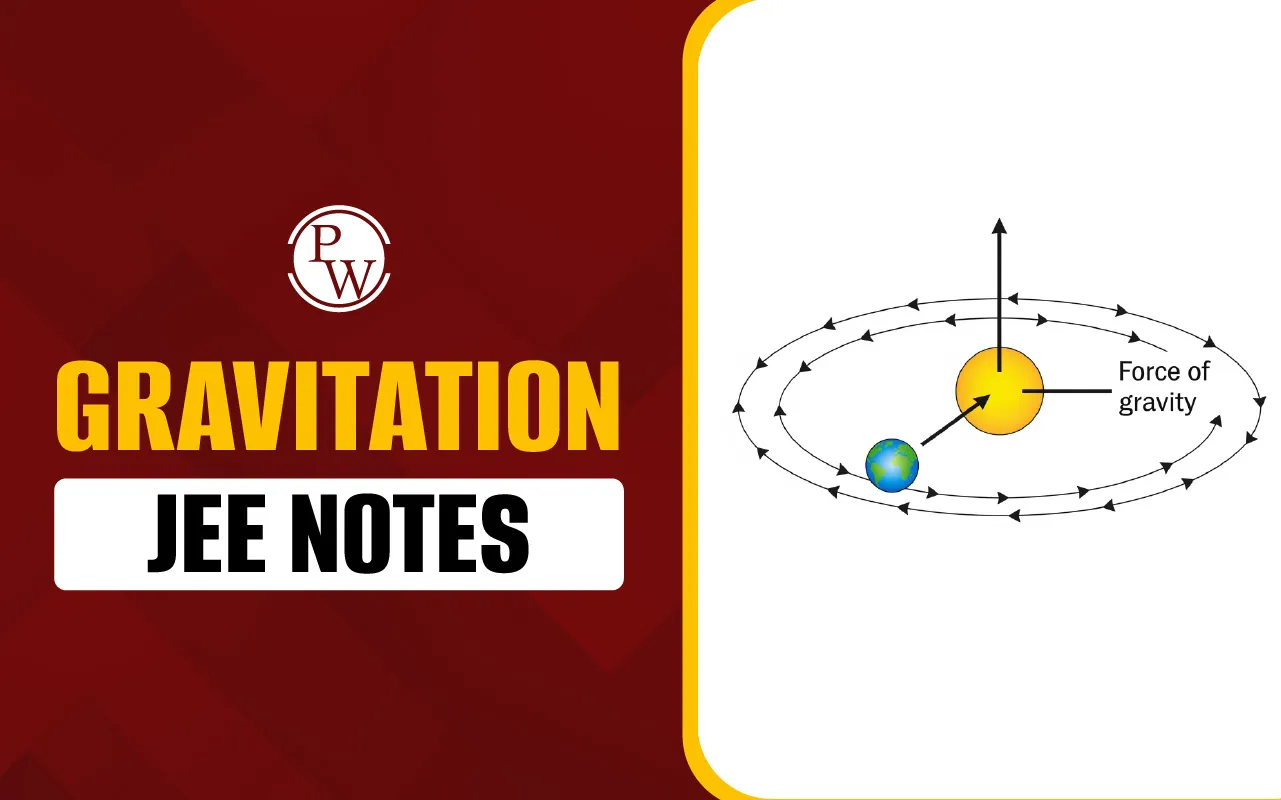
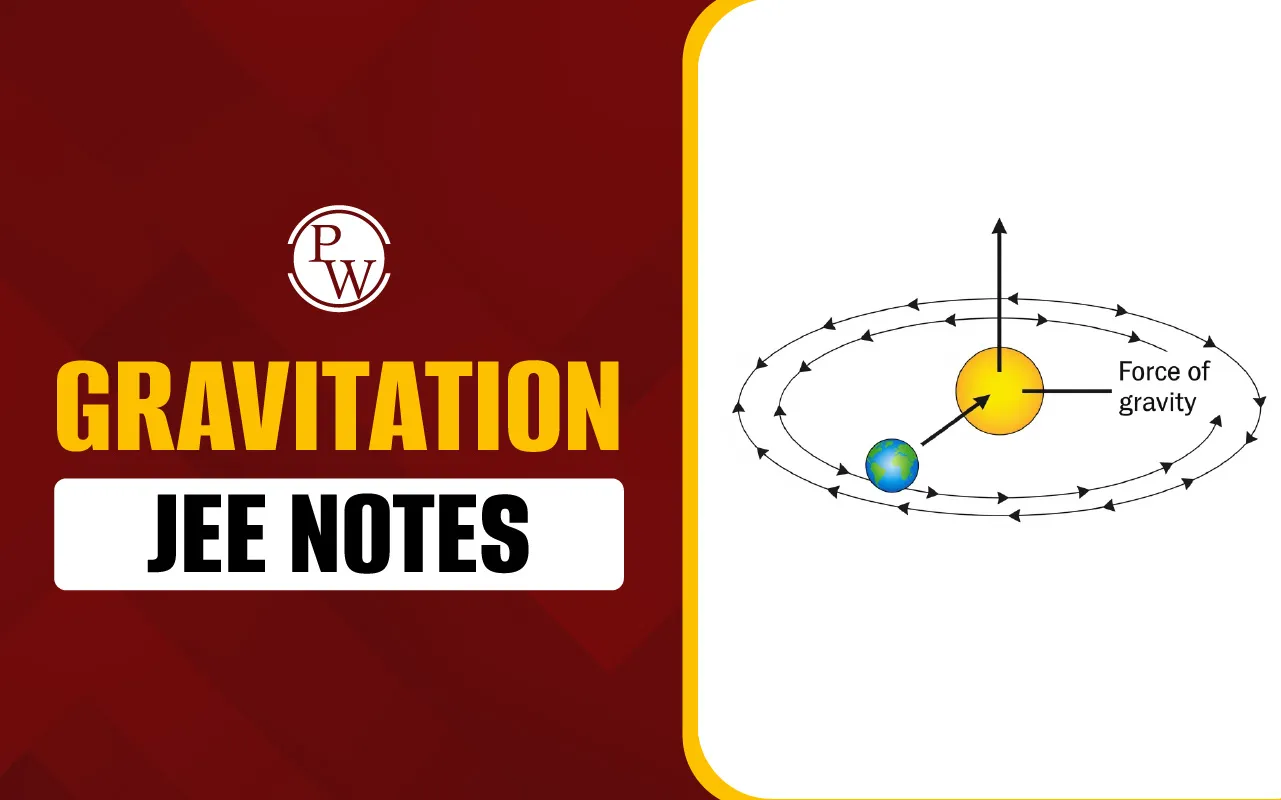
Gravitation is one of the fundamental topics in the Mechanics section of the JEE Physics syllabus. It explains the force responsible for holding planets in orbit, keeping the Moon around the Earth, and giving objects their weight near the Earth's surface.
Unlike many Mechanics chapters that focus on motion caused by contact forces, Gravitation introduces a force that acts over large distances without physical contact. The concepts covered here help you understand everything from falling objects to the motion of satellites and planets.
Newton’s Law of Gravitation
The study of Gravitation begins with Newton’s Universal Law of Gravitation. This law states that every particle in the universe attracts every other particle with a force proportional to the product of their masses and inversely proportional to the square of the distance between them.
The mathematical expression is: F = Gm₁m₂/r²
Here, G is the universal gravitational constant.
You will learn how this law explains the attraction between celestial bodies and how it forms the basis for many other concepts covered in the chapter.
Gravitational Field and Gravitational Potential
Once the Gravitational Force is understood, you will move towards gravitational fields and potentials.
A Gravitational Field helps describe the influence a massive body exerts on the space around it. Instead of calculating forces repeatedly, the field concept provides a more convenient way to analyse gravitational interactions.
The idea of Gravitational Potential is equally important. It helps explain the work done in moving objects within a gravitational field and is frequently used in energy-based problems.
These topics introduce a different way of looking at gravitational interactions and are commonly tested in conceptual JEE questions.
Acceleration Due to Gravity
One of the most familiar applications of Gravitation is acceleration due to gravity.
You will study how the Earth attracts objects towards its centre and why all freely falling objects experience acceleration. The chapter also explains how the value of gravitational acceleration changes under different conditions.
Serious situations include:
|
Condition |
Effect on g |
|
Increase in altitude |
g decreases |
|
Increase in depth |
g decreases |
|
Rotation of Earth |
Slight variation in g |
|
Different locations on Earth |
Small variations occur |
Understanding these variations is important because they frequently appear in JEE numerical questions.
Gravitational Potential Energy
Gravitational Potential Energy plays an important role in analysing systems influenced by gravity.
In this topic, you will learn how energy changes when objects move within a gravitational field. Unlike near-Earth calculations used in earlier classes, Gravitation introduces a more general approach applicable to large distances.
The concept is useful when studying satellites, orbital motion, and escape velocity. Many questions combine potential energy with conservation of energy principles to simplify calculations.
Motion of Planets and Satellites
One of the most interesting parts of the Gravitation JEE Syllabus is the study of planetary and satellite motion. You will learn how gravitational attraction provides the necessary centripetal force required for orbital motion. This explains why planets revolve around the Sun and why satellites remain in orbit around the Earth.
The chapter also introduces the significance of orbital paths and the factors that influence orbital motion. These concepts connect Physics with real-world space applications and are frequently used in examination problems.
Orbital Velocity and Escape Velocity
Orbital Velocity refers to the minimum speed required for a satellite to remain in a stable orbit around a planet.
Escape Velocity refers to the minimum speed required for an object to overcome the gravitational pull of a celestial body without further propulsion.
These concepts are closely related to gravitational energy and satellite motion and are among the most commonly tested areas in JEE examinations. Understanding the difference between these velocities is essential for solving many gravitational problems.
Satellites and Their Applications
The Gravitation JEE syllabus also covers artificial satellites and their motion around the Earth.
You will study the factors that determine satellite speed, orbital period, and stability. The chapter also introduces geostationary satellites and explains why they are important for communication and broadcasting systems.
Satellite-based questions often combine multiple concepts from Gravitation, making them valuable from an examination perspective.
Gravitation is an important chapter in the JEE Physics syllabus that explains how objects interact through gravitational forces. As you study Gravitation, you will learn about Newton’s Law of Gravitation, gravitational fields and potentials, acceleration due to gravity, potential energy, satellite motion, orbital velocity, and escape velocity. Together, these concepts provide a deeper understanding of planetary motion and many real-world applications involving gravity.
Gravitation FAQs
Is Gravitation an important topic for JEE?
What is included in the Gravitation JEE Syllabus?
Why is orbital velocity important in Gravitation?
What is the difference between orbital velocity and escape velocity?





 Live & recorded classes available at easeDashboard for progress trackingMillions of practice questions at your fingertips

