







Physics Rotational Motion JEE Syllabus

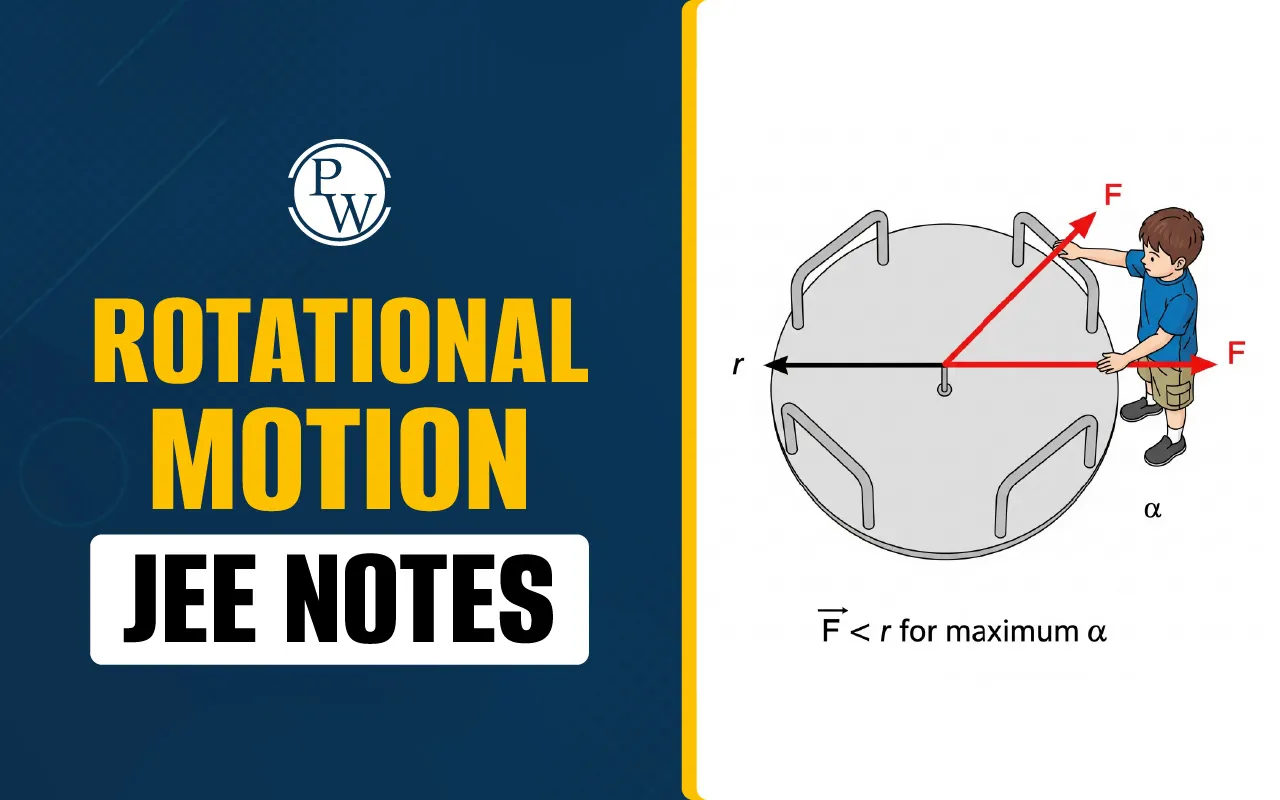
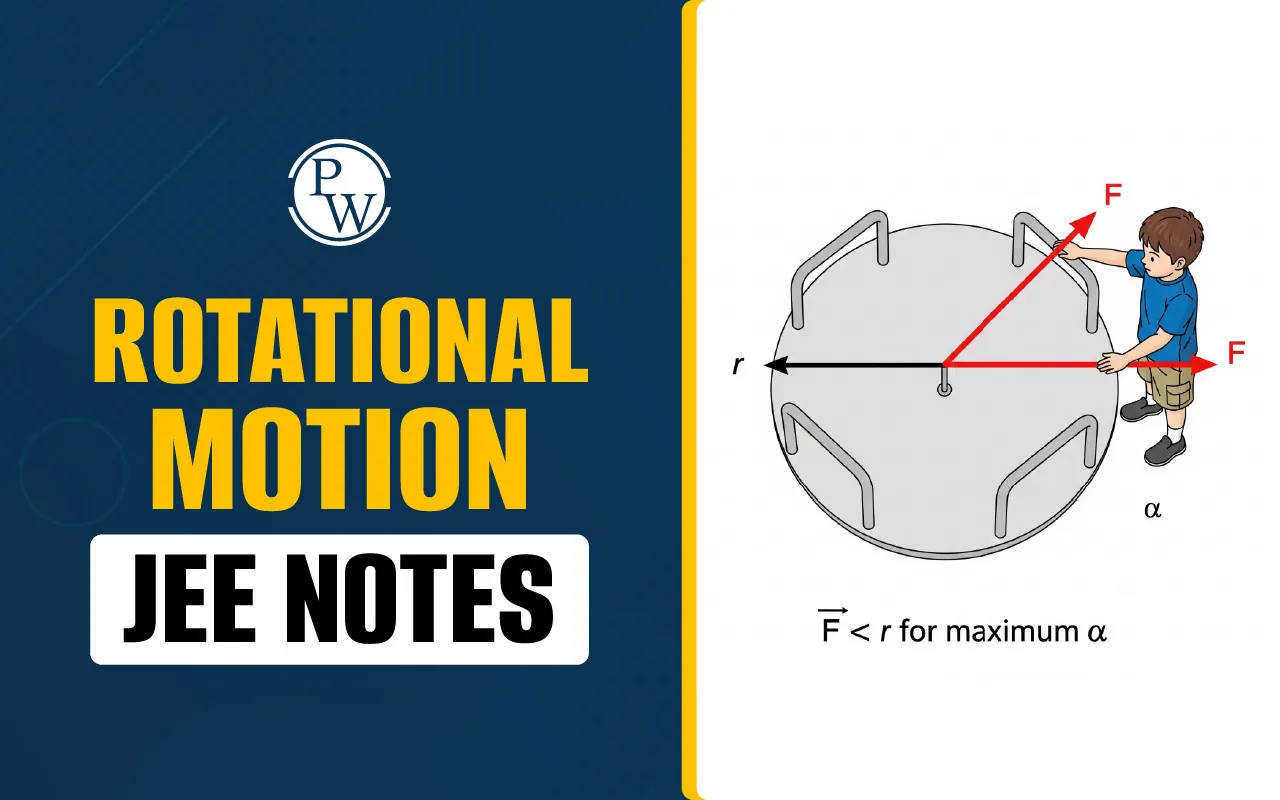
Rotational Motion is an important topic in the Mechanics portion of the JEE Physics syllabus. While earlier chapters mainly deal with the motion of particles and objects moving in straight lines or along curved paths, this chapter focuses on bodies that rotate about an axis.
Many real-world systems involve rotation. The movement of wheels, fans, gears, turbines, and even the Earth itself can be understood using the principles covered in Rotational Motion. As you study this topic, you will learn how familiar concepts such as force, momentum, and energy are applied to rotating bodies.
Angular Motion
Rotational Motion begins with the study of angular quantities that describe the rotation of a body. Instead of displacement, velocity, and acceleration, rotating objects are analysed using angular displacement, angular velocity, and angular acceleration.
It also includes how rotational and linear quantities are connected. Important relationships such as:
v = rω
a = rα
Torque
Torque describes the turning effect produced by a force. Just as force causes linear acceleration, torque causes angular acceleration.
In this topic, you will learn how the rotational effect of a force depends not only on the magnitude of the force but also on its distance from the axis of rotation. This explains why pushing a door near its handle is easier than pushing it near the hinges.
Moment of Inertia
Moment of Inertia is one of the most important concepts in Rotational Motion. It measures the resistance offered by a body to changes in its rotational state. Unlike mass, which depends only on the amount of matter present, moment of inertia also depends on how the mass is distributed around the axis of rotation.
|
Body |
Common Use in Problems |
|
Thin Rod |
Rotation about the centre or the end |
|
Ring |
Angular momentum and dynamics |
|
Disc |
Rotational energy and rolling motion |
|
Cylinder |
Combined motion applications |
|
Sphere |
Rolling and conservation principles |
Many questions directly use these standard expressions, making them an important part of preparation.
Rotational Dynamics
Once Torque and Moment of Inertia are understood, you will study the relationship between them through rotational dynamics.
A key equation introduced in this topic is:
τ = Iα, where τ is torque, I is moment of inertia, and α is angular acceleration.
This relationship plays a role similar to Newton’s Second Law in translational motion. It helps explain how rotating bodies respond when external torques act on them. Many JEE problems involving discs, pulleys, and rigid bodies are based on this concept.
Angular Momentum
Angular Momentum is the rotational counterpart of linear momentum. It helps describe the rotational state of a moving body and is particularly useful when analysing systems undergoing rotational motion.
One of the most important ideas you will study is the conservation of angular momentum. This principle explains how rotational motion behaves when no external torque acts on a system.
Questions based on rotating platforms, spinning objects, and rigid body systems often rely on this concept. It is also frequently combined with energy and dynamics-based applications.
Rotational Kinetic Energy and Equilibrium
Rotating Bodies possess kinetic energy because of their motion. In this topic, you will learn how rotational kinetic energy depends on both moment of inertia and angular velocity.
The chapter also introduces the conditions required for rotational equilibrium. For a body to remain in equilibrium, the net force and the net torque acting on it must both be zero.
These concepts are often applied to situations involving beams, supports, suspended bodies, and balancing systems. Such questions test your understanding of force analysis as well as rotational effects.
Rolling Motion
Rolling Motion combines translational and rotational motion into a single physical situation. Common examples include wheels, cylinders, and spheres moving along surfaces.
In this topic, you will study the conditions required for pure rolling and learn how linear and angular quantities are related. Since rolling motion combines concepts from multiple areas of Mechanics, it is often considered one of the most important applications of Rotational Motion.
Important Topics Covered in Rotational Motion
The Rotational Motion JEE Syllabus focuses on several closely connected concepts:
|
Topic |
What You Will Study |
|
Angular Motion |
Angular displacement, velocity, and acceleration |
|
Torque |
Turning effect of forces |
|
Moment of Inertia |
Rotational resistance of bodies |
|
Rotational Dynamics |
Relationship between torque and motion |
|
Angular Momentum |
Rotational momentum and its conservation |
|
Rotational Kinetic Energy |
Energy associated with rotation |
|
Equilibrium |
Conditions for rotational balance |
|
Rolling Motion |
Combined rotational and translational motion |
Rotational Motion is an essential chapter in the JEE Physics syllabus and forms a major part of Mechanics. As you progress through this topic, you will study angular motion, torque, moment of inertia, rotational dynamics, angular momentum, equilibrium, rotational kinetic energy, and rolling motion. Together, these concepts help explain the behaviour of rotating bodies and provide the foundation for solving a wide range of JEE Physics problems.
Rotational Motion JEE Syllabus FAQs
What topics are included in the Rotational Motion JEE Syllabus?
Is Rotational Motion important for JEE Main and JEE Advanced?
Why is the moment of Inertia important in Rotational Motion?
What is the difference between torque and force?









Get Free Counselling Today
and Clear up all your Doubts
 Live & recorded classes available at easeDashboard for progress trackingLakhs of practice questions

