







Internal Energy Of An Ideal Gas, Important Topics For JEE Main 2024
 Shrivastav 5 Mar, 2024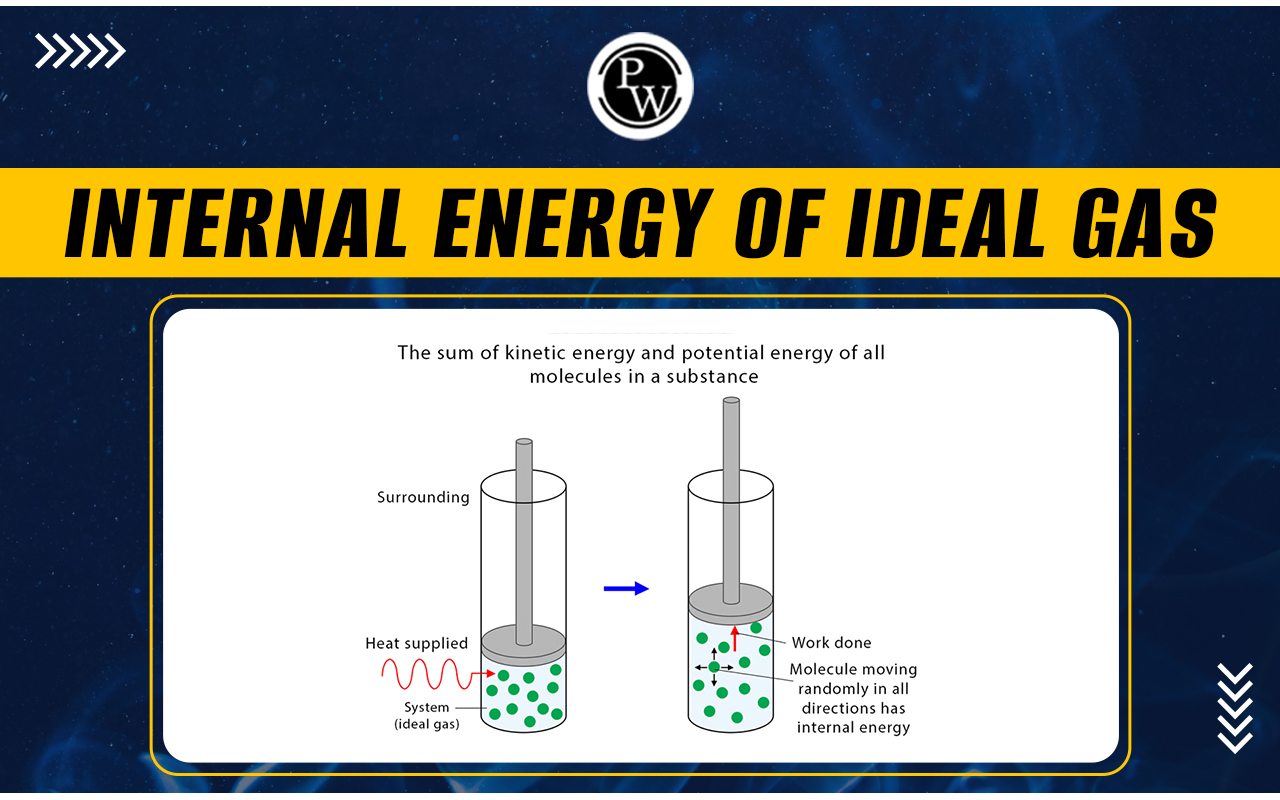
Internal Energy Of An Ideal Gas : We will study that Equipartition of energy states that the average energy of a molecule in a gas associated with each degree of freedom is kT where k is the Boltzmann constant and T is its absolute temperature. According to the equipartition theorem, the average energy of a molecule in a monatomic gas is 1/2 kT as the degree of freedom is 3.

This is also the result of the kinetic theory of gases. Also , internal energy is possessed by the system due to molecular configuration and molecular motion. In other words, the internal energy possessed by a system may also be said as the mean energy of ‘disordered’ motion of molecules. The energy due to molecular configuration is called internal potential energy.
Internal Energy Of An Ideal Gas
Internal Energy Of An Ideal Gas : In thermodynamics, the internal energy of a system is the energy contained within the system, excluding the kinetic energy of motion of the system as a whole and the potential energy of the system as a whole due to external force fields. It keeps account of the gains and losses of energy of the system that are due to changes in its internal state. The internal energy of a system can be changed by transfers of matter or heat or by doing work.
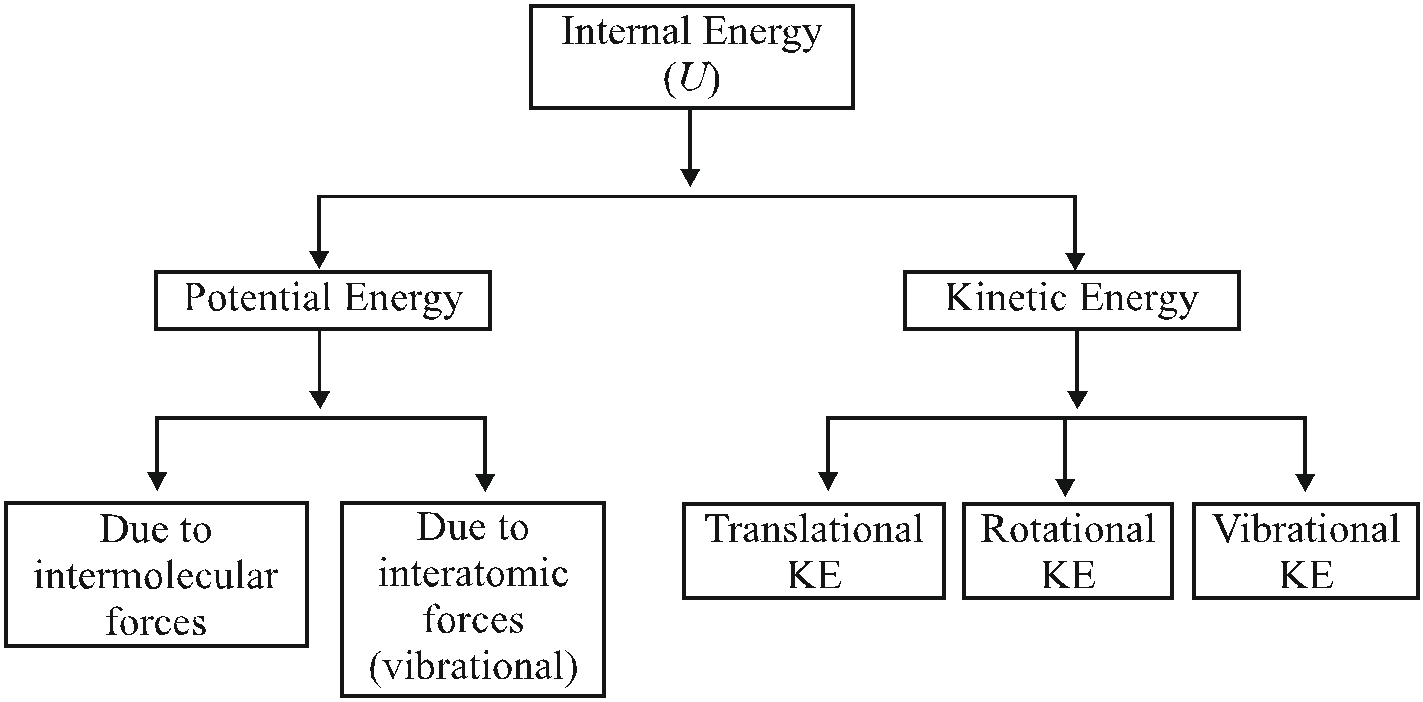
So, internal energy is possessed by the system due to molecular configuration and molecular motion. In other words, the internal energy possessed by a system may also be said as the mean energy of ‘disordered’ motion of molecules. The energy due to molecular configuration is called internal potential energy (U p ) and the energy due molecular motion is called internal kinetic energy (U k ). The total internal energy possessed by the system is then given by
U = U p + U k
Internal energy is defined as the energy associated with the random, disordered motion of molecules. It is separated in scale from the macroscopic ordered energy associated with moving objects. It refers to the invisible microscopic energy on the atomic and molecular scale.
Internal Energy Examples
At room temperature, a glass of water sitting on a table has no apparent energy, either potential or kinetic . However, on the microscopic scale the liquid is a mass of high speed molecules traveling at hundreds of meters per second. When we superimpose an ordered large scale motion on the water as a whole (may be by tossing/splashing the water across the room) then this microscopic energy would not necessarily be changed.
Internal Energy of an Ideal Gas
- Suppose a gas is contained in a closed vessel as shown in figure. If the container as a whole is moving with some speed, then this motion is called the ordered motion of the gas. Source of this motion is some external force. The zig-zag motion of gas molecules within the vessel is known as the disordered motion . This motion is directly related to the temperature of the gas. As the temperature is increased, the disordered motion of the gas molecules gets fast.
- The internal energy (U) of the gas is concerned only with its disordered motion. It is in no way concerned with its ordered motion. When the temperature of the gas is increased, its disordered motion and hence its internal energy is increased. Intermolecular forces in an ideal gas is zero. Thus, PE due to intermolecular forces of an ideal gas is zero. A monoatomic gas is having a single atom.
- Hence, its vibrational energy is zero. For dia and polyatomic gases vibrational energy is significant only at high temperatures. So, they also have only translational and rotational KE. We may thus conclude that at room temperature the internal energy of an ideal gas (whether it is mono, dia or poly) consists of only translational and rotational KE. U (of an ideal gas) = K T + K R at room temperatures.

K T (translational KE) and K R (rotational KE) depends on T only. They are directly proportional to the absolute temperature of the gas. Thus, internal energy of an ideal gas depends only on its absolute temperature (T) and is directly proportional to T.
U ∝ T
Law Of Equipartition of Energy
An ideal gas is just like an ideal father. An ideal father distributes whole of its properties and assets equally among his children. Same is the case with an ideal gas. It distributes its internal energy equally in all degrees of freedom. In each degree of freedom energy of one mole of an ideal gas is
RT, where T is the absolute temperature of the gas. Thus, if/be the number of f degrees of freedom, RT 2 the internal energy of 1 mole of the gas will be RT or internal energy of n moles of the gas will be fRT . Thus,


……(i)

For a monoatomic gas, f = 3.
Therefore, (for 1 mole of a monoatomic gas)

For a dia and linear polyatomic gas at low temperatures, f = 5, so,
(for 1 mole)

and for non-linear polyatomic gas at low temperatures, f = 6, so
(for 1 mole)

Important Points Of Law Of Equipartition of Energy
(i) For one molecule, R (the gas constant) is replaced by k (the Boltzmann constant). For example, internal energy of one molecule in one degree of freedom will be kT .

(ii) Ignoring the vibrational effects we can summarise the above results in tabular form as below.


(iii) From the above table, we can see that translational kinetic energy of all types of gases is same. The difference is in rotational kinetic energy.
Internal Energy (U) For an Ideal Gas:
Since internal energy is possessed by the system due to molecular configuration and molecular motion. As discussed in the earlier text, the energy due to molecular configuration is called internal potential energy (U p ) and the energy due molecular motion is called internal kinetic energy (U k ). So, the total internal energy possessed by the system is given by U = U p + U k In case of an ideal gas, the intermolecular forces are zero, so the potential energy for an ideal gas is zero and hence the total kinetic energy of the ideal gas is its internal energy U. Please note that a gas may possess kinetic energy due to
(a) Translational Motion (due to translatory motion of molecules) (b) Rotational Motion and
(c) Vibrational Motion For an ideal gas, the internal energy U depends upon temperature T only and is directly proportional to it. So, we have U ∝ T. Further the change in the internal is given by.
∆U = ∆U p + ∆U K
Since for an ideal gas, no interaction exists between the molecules (meaning Up = constant) and hence ∆U p = 0
∆U = ∆U K = nC V ∆ T = nC V ( T f – T i )
For infinitesimal temperature increments, we have
dU = nC V dT
Internal Energy Of An Ideal Gas FAQs
Q.1: How is internal energy is related to the change in temperature?
Q.2: Internal energy is _________.














 Live & recorded classes available at easeDashboard for progress trackingMillions of practice questions at your fingertips

