






Cheque & Its Types In the Indian Banking System
Banking Aspirants can get the details of Cheque & Its Types in the Indian Banking System in our Blog.
 Priyanka Dahima28 May, 2024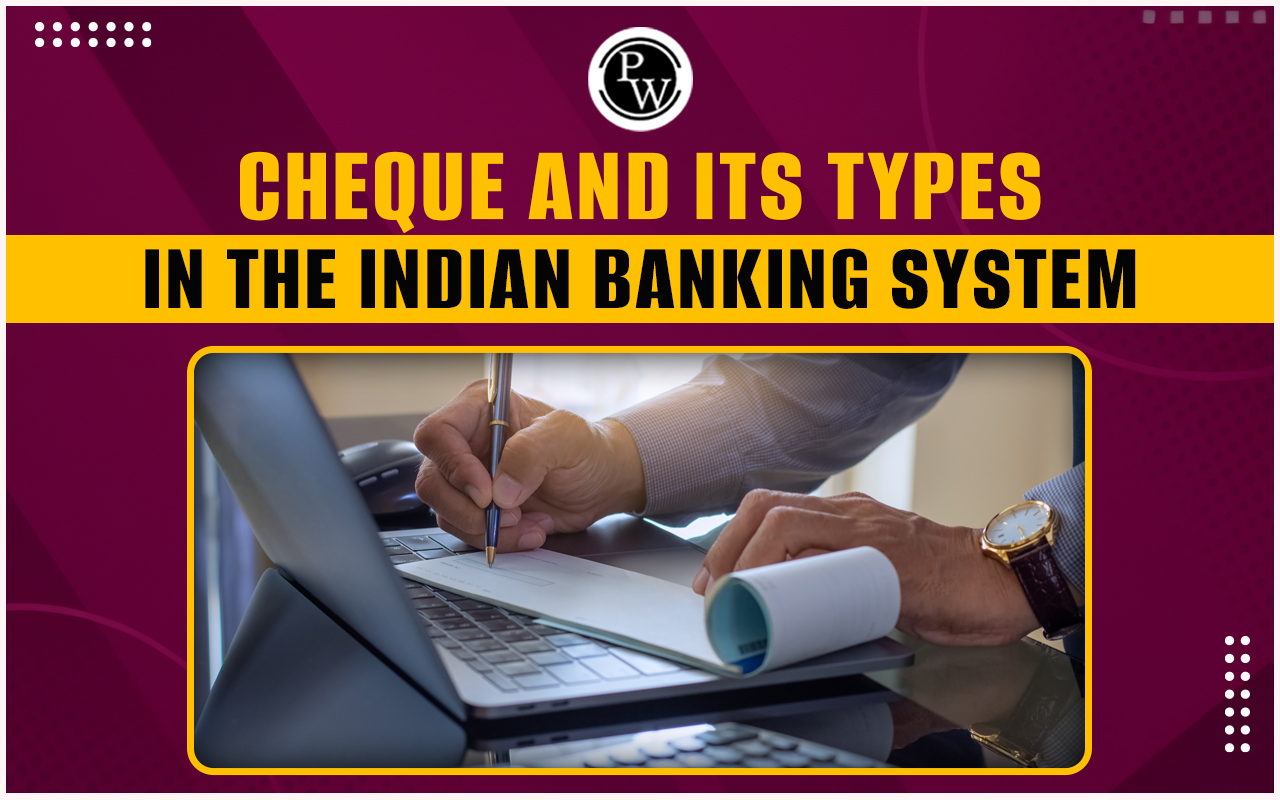
Cheque & Its Types In the Indian Banking System: A Cheque is a document you can give to your bank that instructs the bank to pay a specific amount in both numbers and words to the person whose name is on the Cheque.
Cheques are also called negotiable instruments. In the banking sector, a negotiable instrument is a document that promises to pay its owner a certain amount either when the document is delivered to the bank or before a certain date. Indian Banking System offers a variety of Current/ Cheque Accounts, time deposits, and savings accounts designed to meet your personal banking needs.Cheque in the Indian Banking System
A bank check is basically a written order from the account holder instructing the bank to pay a certain amount of money to a named person or entity. It acts as a legal document that guarantees payment and provides a tangible record of the transaction. Checks have been used for centuries and have evolved to meet the changing needs of economic life..Anatomy of Cheque
1. Drawer : The person who writes the Cheque and instructs the bank to make the payment. 2. Drawee Bank : The bank where the recipient has an account and from which the money is withdrawn. 3. Payee : The person or entity to whom the Cheque is addressed and which indicates who will receive the payment. 4. Amount : numerical and written presentation of the amount to be paid. 5. Date : The date the Cheque was issued. 6. Signature : The signature of the drawer confirming the authenticity of the Cheque.Cheque & Its Types in the Indian Banking System
- Bearer or Open Cheque
- Order Cheque
- Crossed Cheque
- Account Payee Cheque
- Post Dated Cheque
- Stale Cheque
- Ante Dated Cheque
- Truncated Cheque
- Traveler’s Cheque
- Mutilated Cheque
- Banker’s Cheque
Bearer or Open Cheque
- A Cheque is called open or bearer if it is not crossed and can be drawn at a bank counter.
- The holder of a bearer Cheque can do the following:
- receive this payment over the counter at the bank
- deposit the Cheque into his account
- Forward it to someone else by signing the back of the Cheque.
Crossed Cheque
- Cheques that are crossed are called crossed cheques.
- Unlike open or bearer cheques, Crossed Cheques cannot be cashed at a bank counter.
- Thus, the risk of theft or misuse of open Cheques can be avoided by using crossed checks
- Crossed Cheque are automatically credited to the payee's bank account
- A Cheque can be crossed by drawing two horizontal parallel lines on the Cheque, or without the words "Paid" or "Non-negotiable".
Order Cheque
- Order Cheque is a check payable only to the named person
- Such a Cheque may cross or cross out the word "chest" and write the word "order"
- The payee may transfer the order Cheque to someone else by writing his name on the back from such a Cheque down.
Ante-Dated Cheque
- A Cheque with a date in the box that is earlier than the date it was presented for payment is called an Ante-Dated Cheque
- For example, an Ante-Dated Cheque issued on May 20, 2015, may contain the date 05th May 2025.
Postdated Cheque
- A Cheque issued today must be presented to the bank within the prescribed time limit
- After this time limit, no payment will be made. Such a Cheque is called a Postdated Cheque.
- All cheques valid in India are valid for 3 months. A Cheque presented is called a Postdated Cheque.
- For example, a Cheque presented on 5/8/2015 is dated 24/05/2015, it is a postdated Cheque. The bank will not pay until 25/05/2015 or later.
Mutilated Cheque
- If a Cheque is torn into two or more parts and presented for payment, it is called a Mutilated Cheque.
- The bank is not allowed to cash such a Cheque without the drawer's approval.
- But if the Cheque is torn at the corners and nothing important seems to be removed or cancelled then the bank can pay against such a Cheque.
Truncated Cheque
- A Truncated Cheque is a Cheque that is cut during the clearing period by either the clearing house or the bank, regardless of whether they pay or receive payments, immediately after creating a sendable electronic image that replaces the additional physical written transmission of the Cheque
- The expression "clearing house" means a clearing house operated by the Reserve Bank of India or a clearing house recognized as such by the RBI
Banker's Cheque
- It is an instrument issued by a bank. in the name of a bank customer, containing an order to pay a certain amount to a certain person in the city
- A bank Cheque is valid for 3 months from the date of issue, but can be reconfirmed under certain conditions, legal requirements
- A bank Cheque cannot be dishonored because it is always paid in advance
- It is always pre-printed with the words "non-tradeable", meaning it is not tradeable.
Traveler's Cheque
- This is a pre-printed fixed-sum Cheque designed to enable the signer to make an unconditional payment to someone else for having paid the issuer for the privilege.
- Traveler's Cheques are accepted worldwide in more than 4,00,000 locations in 200 countries
- They can be redeemed or used at currency exchange offices, banks, shops, restaurants, hotels, etc.
- The non-expiration allows the cheque holder to cash the remaining Cheques or keep them for the next trip
- The use of such Cheques has declined since the 1990s as digital banking options such as credit cards, debit cards, and ATMs increased affordable much easier, and more convenient for travelers.
Features of Cheque
1. Issued by Individuals - A bank cheque can be issued by individuals who hold a savings or current account. It provides them with a convenient payment method. 2. Fixed Amount - The amount written on the cheque cannot be changed later on. It provides a secure means of transferring a specific sum of money to the payee. 3. Formal Order of Payment - A cheque is an unconditional order and not a request to the bank. It represents a legally binding instruction to the bank to make the specified payment. 4. Validity and Authorization - The cheque is valid only when signed and dated. Unsigned cheques are considered invalid and cannot be honored by the bank. 5. MICR Code - Magnetic Ink Character Recognition (MICR) code is present at the bottom of the cheque. It facilitates automated processing by banks.Cheque & Its Types in the Indian Banking System FAQs
Q1. What is a Cheque?
Ans. A Cheque is a document you can give to your bank that instructs the bank to pay a specific amount in both numbers and words to the person whose name is on the Cheque.
Q2. What are the different types of Cheques?
Ans. There are various types of Cheques and we have detailed them in our blog.
Q3. What is the Anatomy of Cheque?
Ans. Drawer: The person who writes the Cheque and instructs the bank to make the payment.
2. Drawee Bank: The bank where the recipient has an account and from which the money is withdrawn.
3. Payee: The person or entity to whom the Cheque is addressed and which indicates who will receive the payment.
4. Amount: numerical and written presentation of the amount to be paid.
5. Date: The date the Cheque was issued.
6. Signature: The signature of the drawer confirming the authenticity of the Cheque.
Q4. What are the Features of Cheque?
Ans. The Features of Cheque are -
1. Issued by Individuals - A bank cheque can be issued by individuals who hold a savings or current account. It provides them with a convenient payment method.
2. Fixed Amount - The amount written on the cheque cannot be changed later on. It provides a secure means of transferring a specific sum of money to the payee.
3. Formal Order of Payment - A cheque is an unconditional order and not a request to the bank. It represents a legally binding instruction to the bank to make the specified payment.
4. Validity and Authorization - The cheque is valid only when signed and dated. Unsigned cheques are considered invalid and cannot be honored by the bank.
5. MICR Code - Magnetic Ink Character Recognition (MICR) code is present at the bottom of the cheque. It facilitates automated processing by banks.
🔥 Trending Blogs



Check out these Related Articles




Join 15 Million students on the app today!
 Live & recorded classes available at easeDashboard for progress trackingMillions of practice questions at your fingertips


Free Learning Resources
PW Books
Notes (Class 10-12)
PW Study Materials
Notes (Class 6-9)
Ncert Solutions
Govt Exams
Our Other Websites
Class 6th to 12th Online Courses
Govt Job Exams Courses
UPSC Coaching
Defence Exam Coaching
Gate Exam Coaching
Other Exams
Know about Physics Wallah
Physics Wallah is an Indian edtech platform that provides accessible & comprehensive learning experiences to students from Class 6th to postgraduate level. We also provide extensive NCERT solutions, sample paper, NEET, JEE Mains, BITSAT previous year papers & more such resources to students. Physics Wallah also caters to over 3.5 million registered students and over 78 lakh+ Youtube subscribers with 4.8 rating on its app.
We Stand Out because
We provide students with intensive courses with India’s qualified & experienced faculties & mentors. PW strives to make the learning experience comprehensive and accessible for students of all sections of society. We believe in empowering every single student who couldn't dream of a good career in engineering and medical field earlier.
Our Key Focus Areas
Physics Wallah's main focus is to make the learning experience as economical as possible for all students. With our affordable courses like Lakshya, Udaan and Arjuna and many others, we have been able to provide a platform for lakhs of aspirants. From providing Chemistry, Maths, Physics formula to giving e-books of eminent authors like RD Sharma, RS Aggarwal and Lakhmir Singh, PW focuses on every single student's need for preparation.
What Makes Us Different
Physics Wallah strives to develop a comprehensive pedagogical structure for students, where they get a state-of-the-art learning experience with study material and resources. Apart from catering students preparing for JEE Mains and NEET, PW also provides study material for each state board like Uttar Pradesh, Bihar, and others
Copyright © 2026 Physicswallah Limited All rights reserved.