






Difference Between CLAT UG and CLAT PG 2026, CLAT UG vs PG Syllabus, Exam Pattern
CLAT UG and CLAT PG differ in terms of eligibility, exam content, and the level of legal knowledge required. Read on to know in detail the difference between CLAT UG and CLAT PG 2026.
 Swati Kumar16 Jan, 2025
Share
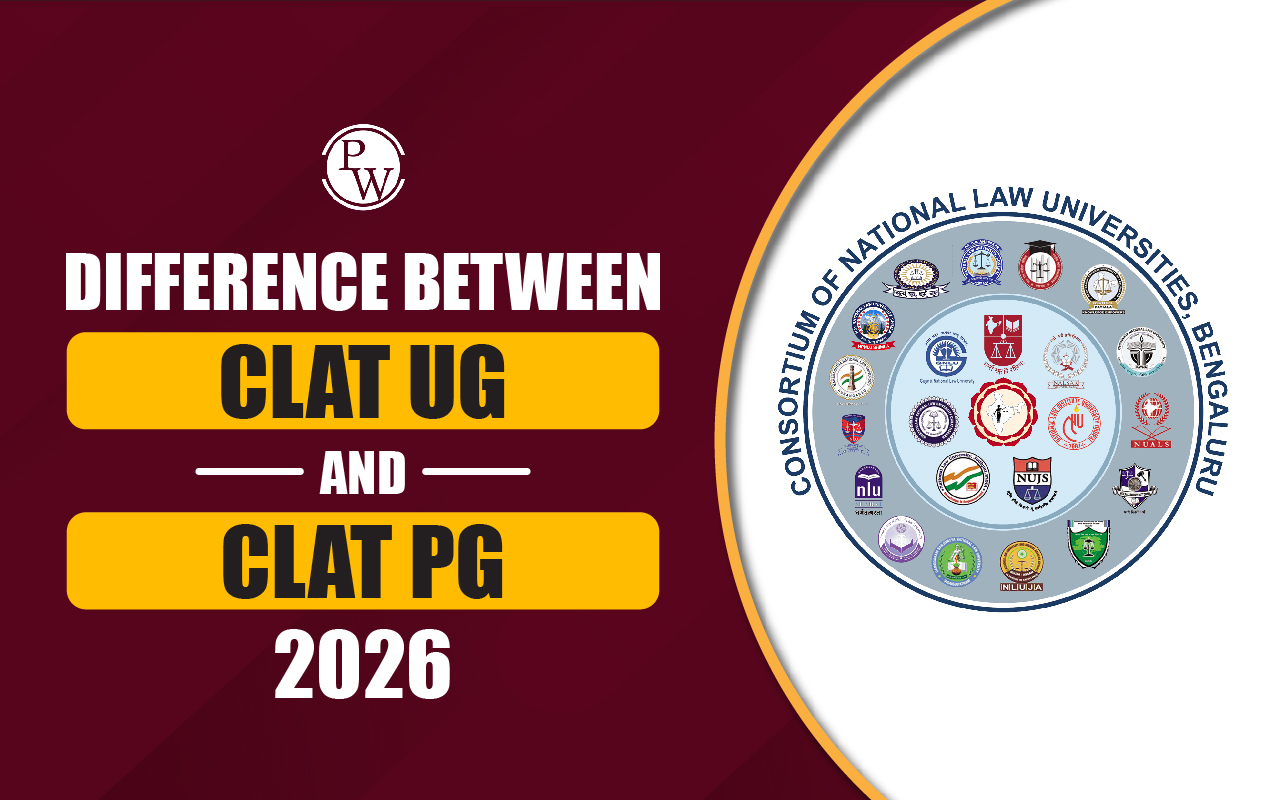
Difference Between CLAT UG and CLAT PG 2026: The main difference between CLAT UG and CLAT PG 2026 is the course in which candidates get admission after qualifying the entrance exams. While it's only scratching the bare surface, there are many differences between CLAT UG and CLAT PG including the exam pattern, syllabus, and eligibility criteria. Candidates must have an in-depth understanding of these two exams to figure out what needs to be done to be eligible for them.
Checkout Law Books from PW Store
Difference Between CLAT UG and CLAT PG 2026 Overview
CLAT UG and CLAT PG exams are conducted by the Consortium of National Law Universities and cater to different educational levels and legal aspirations. CLAT PG is designed for law graduates aiming to pursue their Master of Laws (LLM) degree, while CLAT UG provides admission to integrated law programs. The following table provides a snapshot of important information detailing the difference between CLAT UG and CLAT PG 2026.| Features | CLAT UG | CLAT PG |
| Conducting Body | The Consortium of National Law Universities | The Consortium of National Law Universities |
| Exam Level | National Level | National Level |
| Number of Participating Institutes | 24 | 21 |
| Number of Seats Offered | 3243 | 1373 |
| Courses Offered | 5-year LLB | LLM |
| Educational Qualification | Class 12 or equivalent exam | Bachelor’s degree in Law (LLB) |
| Age Limit | No upper age limit. | No upper age limit. |
| Total Questions | 120 | 120 |
| Negative Marking | Yes | Yes |
Difference Between CLAT UG and CLAT PG 2026 Eligibility Criteria
Difference Between CLAT UG and CLAT PG 2026 Exam Pattern
The CLAT UG and CLAT PG exam patterns differ in terms of the type of questions, number of sections, and the level of difficulty. The UG exam focuses on assessing general aptitude, while the PG exam tests more advanced legal knowledge. While both exams consist of 120 multiple-choice questions, 2-hour duration, and offline pen-and-paper mode, they differ significantly in subject complexity, question distribution, and target audience. The following table highlights the key difference between CLAT UG and CLAT PG 2026 exam patterns.| Subject | Features of CLAT UG 2026 | Features of CLAT PG 2026 |
|---|---|---|
| Exam mode | Paper-based test mode. | Paper-based test mode. |
| Test duration | 120 minutes | 120 minutes |
| Type of questions | Objective-type of question-based on Reading Comprehension passages of about 300-450 words. | The questions are comprehension-based from various legal subjects of graduation level |
| Total questions | 120 | 120 MCQs |
| Negative Marking | +1 for a correct answer -0.25 for an incorrect answer | +1 for a correct answer -1/4 mark for an incorrect answer |
Difference Between CLAT UG and CLAT PG 2026 Exam Syllabus
The CLAT UG and CLAT PG syllabi differ in their focus areas and depth of content. While the UG syllabus is designed to assess general aptitude across multiple subjects, the PG syllabus is more specialized, with an emphasis on advanced legal concepts and analysis.| Parameters | CLAT UG 2026 | CLAT PG 2026 |
| Subjects | English Language, Current Affairs, Legal Reasoning, Logical Reasoning, Quantitative Techniques | Constitutional Law, Jurisprudence, and other law subjects, including contemporary issues. |
Difference Between CLAT UG and CLAT PG 2026 Courses Offered
The CLAT UG exam primarily offers admission to integrated undergraduate law programs, while the CLAT PG exam provides entry into postgraduate law degrees. The courses differ in terms of their level of study, with UG programs focusing on foundational legal education and PG programs offering specialized legal knowledge.| Particulars | CLAT UG 2026 | CLAT PG |
| Courses Offered | BA LLB (Hons.), BBA LLB (Hons.), B.Com LLB (Hons.), BSc LLB (Hons.), BSW LLB (Hons.) | LLM |
Difference Between CLAT UG and CLAT PG 2026 Seat Intake
The seat intake for CLAT UG and CLAT PG varies, with the UG exam offering admission to a larger number of seats across various National Law Universities (NLUs) for undergraduate programs, while the PG exam generally has fewer seats, catering to postgraduate law courses. The seat allocation follows comprehensive reservation policies, including categories for Scheduled Castes, Scheduled Tribes, Other Backward Classes, Economically Weaker Sections, Persons with Disabilities, and specific state quotas. The seat intake in different law institutes for both CLAT UG and PG are as follows.| Name of the college | Courses | UG Seat Intake | PG Seat Intake |
|---|---|---|---|
| National Law School of India University (NLSIU), Bengaluru | BA LLB (Hons), LLM | 300 | 120 |
| The West Bengal National University of Juridical Sciences (WBNUJS), Kolkata | BA LLB (Hons), LLM | 132 | 66 |
| National Law University, Jodhpur | BA LLB (Hons), LLM | 120 | 50 |
| Gujarat National Law University (GNLU), Gandhinagar | BA LLB (Hons), LLM, B.Com LLB (Hons), B.Sc LLB (Hons), BA LLB (Hons), BSW LLB (Hons) | 172 | 57 |
| Rajiv Gandhi National University of Law (RGNLU), Patiala | BA LLB (Hons), LLM | 180 | 60 |
| National University of Advanced Legal Studies (NUALS), Kochi | BA LLB (Hons), LLM | 60 | 60 |
| National University of Study & Research in Law (NUSRL), Ranchi | BA LLB (Hons), LLM | 134 | 60 |
| Damodaram Sanjivayya National Law University (DSNLU), Visakhapatnam | BA LLB (Hons), LLM | 138 | 69 |
| Maharashtra National Law University (MNLU), Mumbai | BA LLB (Hons), LLM, BBA LLB (Hons) | 100 | 50 |
| Maharashtra National Law University, Aurangabad | BA LLB (Hons), LLM, BBA LLB (Hons) | 120 | 60 |
| Dharmashastra National Law University (DNLU), Jabalpur | BA LLB (Hons), LLM | 120 | 50 |
| National Academy of Legal Study & Research (NALSAR) University of Law, Hyderabad | BA LLB (Hons), LLM | 132 | 100 |
| National Law Institute University (NLIU), Bhopal | BA LLB (Hons), LLM, LLB, B.Sc | 202 ( 134 - BA LLB, 68 - BSc LLB) | 60 |
| Hidayatullah National Law University (HNLU), Raipur | BA LLB (Hons), LLM | 180 | 90 |
| GNLU Silvassa Campus | BA LLB (Hons), LLM | 66 | 33 |
| Dr Ram Manohar Lohiya National Law University (RMLNLU), Lucknow | BA LLB (Hons), LLM | 169 | 48 |
| Chanakya National Law University (CNLU), Patna | BA LLB (Hons), BBA LLB (Hons) | 138 (69 seats for BA LLB, 69 for BBA LLB) | -- |
| National Law University Odisha (NLUO), Cuttack | 180 | 46 | |
| National Law University & Judicial Academy (NLUJA), Assam | BA LLB (Hons), LLM | 60 | 40 |
| The Tamil Nadu National Law University (TNNLU), Tiruchirapalli | BA LLB (Hons), LLM, B.Com LLB (Hons) | 120 | 60 |
| Maharashtra National Law University, Nagpur | BA LLB (Hons), LLM, BBA LLB (Hons) | 120 | 60 |
| Himachal Pradesh National Law University (HPNLU), Shimla | BA LLB (Hons), LLM, BBA LLB (Hons) | 120 | 80 |
| Dr B R Ambedkar National Law University (DBRANLU), Sonipat, Haryana | BA LLB (Hons) | 120 | - |
| National Law University, Tripura | BA LLB (Hons), LLM | 120 | 50 |
Difference Between CLAT UG and CLAT PG 2026 FAQs
What is the main difference between CLAT UG and CLAT PG?
CLAT UG is for candidates seeking admission to undergraduate law programs, while CLAT PG is for those applying to postgraduate law courses.
Who can appear for CLAT UG and CLAT PG?
CLAT UG is for candidates who have completed their 10+2 or equivalent education, whereas CLAT PG is for those who have a law degree (5-year integrated LLB or 3-year LLB).
What is the syllabus for CLAT PG 2026?
The syllabus for CLAT PG includes key legal subjects such as Constitutional Law, Criminal Law, Jurisprudence, Family Law, Law of Contracts, International Law, and other major areas of law relevant to postgraduate legal studies.
What is the exam pattern for CLAT PG 2026?
CLAT PG consists of 120 multiple-choice questions (MCQs), and is conducted in offline pen-and-paper mode. The exam duration is 2 hours and there will be +1 for correct answers and -0.25 for incorrect responses.
Is there any age limit for CLAT PG 2026?
No, there is no age limit for candidates applying for CLAT PG 2026.
🔥 Trending Blogs


Talk to a counsellorHave doubts? Our support team will be happy to assist you!


Check out these Related Articles




Join 15 Million students on the app today!
 Live & recorded classes available at easeDashboard for progress trackingMillions of practice questions at your fingertips


Free Learning Resources
PW Books
Notes (Class 10-12)
PW Study Materials
Notes (Class 6-9)
Ncert Solutions
Govt Exams
Our Other Websites
Class 6th to 12th Online Courses
Govt Job Exams Courses
UPSC Coaching
Defence Exam Coaching
Gate Exam Coaching
Other Exams
Know about Physics Wallah
Physics Wallah is an Indian edtech platform that provides accessible & comprehensive learning experiences to students from Class 6th to postgraduate level. We also provide extensive NCERT solutions, sample paper, NEET, JEE Mains, BITSAT previous year papers & more such resources to students. Physics Wallah also caters to over 3.5 million registered students and over 78 lakh+ Youtube subscribers with 4.8 rating on its app.
We Stand Out because
We provide students with intensive courses with India’s qualified & experienced faculties & mentors. PW strives to make the learning experience comprehensive and accessible for students of all sections of society. We believe in empowering every single student who couldn't dream of a good career in engineering and medical field earlier.
Our Key Focus Areas
Physics Wallah's main focus is to make the learning experience as economical as possible for all students. With our affordable courses like Lakshya, Udaan and Arjuna and many others, we have been able to provide a platform for lakhs of aspirants. From providing Chemistry, Maths, Physics formula to giving e-books of eminent authors like RD Sharma, RS Aggarwal and Lakhmir Singh, PW focuses on every single student's need for preparation.
What Makes Us Different
Physics Wallah strives to develop a comprehensive pedagogical structure for students, where they get a state-of-the-art learning experience with study material and resources. Apart from catering students preparing for JEE Mains and NEET, PW also provides study material for each state board like Uttar Pradesh, Bihar, and others
Copyright © 2026 Physicswallah Limited All rights reserved.