AI Tools for Legal Research and Drafting: How Young Lawyers Can Use Them Effectively
 Avisha Das16 Nov, 2026

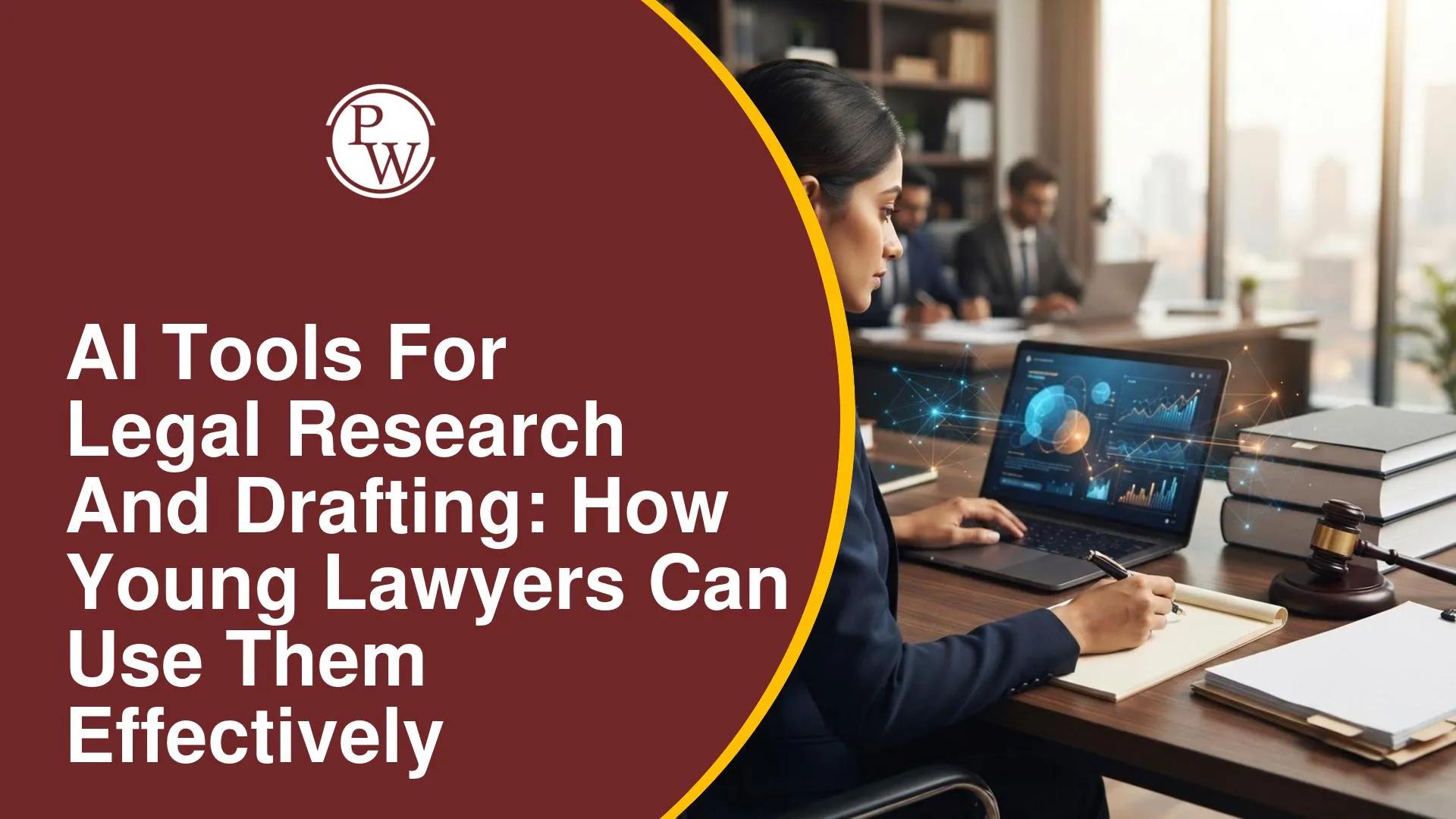
Legal research, drafting notices, reviewing agreements and preparing case summaries are regular parts of a young lawyer's work. These tasks often involve lengthy documents, multiple legal provisions and tight deadlines. AI tools can make some of this work faster, but their output is not always accurate or suitable for legal use.
For law students, interns, fresh advocates and junior associates, learning to use AI effectively means knowing which tasks it can assist with and where human judgment remains essential. PW Legal Skills also focuses on practical legal learning, including legal drafting and AI-assisted legal practice, which can help young lawyers build the fundamentals needed to use these tools responsibly.
What Are AI Tools in Legal Practice?
AI tools are software applications that can process information, generate text, summarise documents and respond to instructions. In legal practice, they can assist with research, drafting, contract review, document analysis and legal writing.
Young lawyers may use different categories of tools depending on the task:
-
Generative AI assistants: Help prepare preliminary research outlines, draft structures, summaries, and improve language.
-
Legal research platforms: Help locate judgments, statutes, citations and legal commentary.
-
Document analysis tools: Assist with reviewing lengthy agreements, comparing versions and extracting clauses.
-
OCR tools: Convert scanned documents and images into searchable text.
-
Transcription tools: Convert meetings, interviews or recordings into written notes, subject to confidentiality safeguards.
-
Translation tools: Prepare preliminary translations of legal documents for review by a competent person.
These tools can reduce repetitive work, but they do not independently establish whether a legal argument is correct or whether a document is suitable for a particular client or case.
How Can Young Lawyers Use AI for Legal Research?
Legal research requires identifying the applicable law, locating relevant authorities and understanding how they apply to the facts. AI can help young lawyers begin this process and organise their findings.
1. Identify Relevant Legal Issues
When assigned a research task, a junior lawyer may first need to break a broad legal problem into smaller questions. AI can help identify possible issues, relevant search terms and areas of law to investigate.
For example, if a matter concerns termination of an employment contract, AI may suggest researching contractual terms, applicable labour laws, notice requirements and relevant judgments.
The lawyer must still determine which issues are legally relevant to the facts.
2. Find Relevant Laws and Provisions
AI can suggest potentially relevant statutes, sections and legal principles. It can also explain a provision in simpler language or identify related provisions for further research.
However, always check the exact wording of the legislation, amendments, commencement dates, rules and applicable jurisdiction. An AI-generated explanation should not replace the original statutory text.
3. Research and Summarise Case Laws
AI can help identify judgments that may be relevant to a legal issue and prepare preliminary summaries of their facts, arguments and findings.
A young lawyer can use it to organise cases by legal issue or prepare a list of authorities for further review. However, every case name, citation, court, date and paragraph reference must be checked against the actual judgment.
Try this prompt for preliminary legal research:
I am researching a legal issue under Indian law concerning [briefly describe the issue]. Help me identify the legal questions, potentially relevant statutes and provisions, and search terms for finding judgments. Do not invent case citations. Clearly distinguish confirmed legal information from suggestions that require verification.
4. Prepare Legal Research Notes
Once the relevant primary sources have been located and checked, AI can help organise findings into a research note.
A useful format may include:
-
Legal issue
-
Relevant facts
-
Applicable legislation
-
Relevant judicial decisions
-
Legal analysis
-
Conclusion or points requiring further research
The lawyer should review the original authorities before relying on the final note.
How Can AI Help with Legal Drafting?
Legal drafting requires accuracy, clarity and an understanding of the client's requirements. AI can assist with preparing an initial draft or improving the presentation of a document, but the lawyer must decide what the final document should say.
1. Draft Legal Notices and Applications
AI can help prepare a preliminary structure for legal notices, replies, applications and other documents. It can organise facts chronologically, suggest headings and improve sentence clarity.
For example, a young lawyer may provide anonymised facts and ask AI to arrange them into a draft containing the parties, background, chronology, alleged breach and relief being sought.
Try this prompt for a preliminary legal notice:
Prepare a preliminary structure for a legal notice under Indian law based on these anonymised facts: [insert facts]. Include the parties, relevant background, chronology, alleged breach, legal issues and relief being requested. Do not invent statutory provisions or case law. Highlight missing facts or documents that a lawyer should verify before finalising the notice.
The lawyer must check the parties' details, dates, factual statements, legal grounds, limitation, relief and supporting documents before using the draft.
2. Review Contracts and Agreements
Contract review is another area where AI can assist young lawyers, particularly when working with lengthy commercial documents.
It can help with:
-
Identifying missing or unclear clauses.
-
Checking whether defined terms are used consistently.
-
Highlighting payment, termination, indemnity and liability provisions.
-
Comparing two versions of an agreement.
-
Preparing clause-wise summaries.
-
Flagging provisions that may require negotiation or further legal review.
Try this prompt for contract review:
Review the following anonymised contract clause from an Indian law perspective. Identify unclear wording, missing elements, possible commercial risks and questions that should be raised with the client. Do not assume that a clause is invalid merely because it is unusual. Explain which points require independent legal research.
AI can flag potential issues, but it may not understand the commercial intent behind a clause. The lawyer must assess whether the wording reflects the client's instructions and protects their interests.
3. Summarise Judgments and Lengthy Documents
Young lawyers often need to review lengthy judgments, contracts, pleadings and case files. AI can prepare preliminary summaries and help extract key information.
It may assist with:
-
Organising a judgment into facts, issues, arguments and findings.
-
Preparing a preliminary case brief.
-
Comparing the reasoning in two judgments.
-
Extracting important dates and events from documents.
-
Creating a timeline from a set of records.
A summary should never replace reading the relevant parts of the original judgment or document. Check the court's reasoning, operative order and context of the cited paragraphs before using the summary.
Want to understand the risks of AI-assisted contract work? Read AI in Contract Drafting: Opportunities and Challenges for Young Lawyers to learn where AI can help and why legal review remains important.
How Can Young Lawyers Verify AI-Generated Legal Work?
Verification is one of the most important steps when using AI in legal practice. An answer may sound convincing while containing an incorrect case citation, outdated provision or inaccurate interpretation.
A significant example came from the Supreme Court's decision in Pooja Ramesh Singh v. Jammu and Kashmir Bank Ltd., 2026 INSC 668, decided on 2 July 2026. The matter involved six AI-generated citations relied upon by the NCLT and NCLAT that were either non-existent or contained paragraphs that could not be traced to the cited judgments.
The Supreme Court set aside the orders and directed the Bar Council of India to constitute a committee to consider guidance and disciplinary consequences. The decision highlights the importance of checking AI-generated legal authorities before presenting them in legal proceedings. It does not prohibit legitimate use of AI in legal work.
Use this checklist before relying on AI-generated research or drafting:
-
Verify every case citation against the actual judgment.
-
Check the exact statutory provision and its latest amendment.
-
Confirm the court, date, case number and paragraph references.
-
Read the relevant passages in the original judgment.
-
Check whether a judgment has been stayed, reversed, distinguished or overruled.
-
Compare AI-generated summaries with the original document.
-
Verify facts, dates, names, figures and party details.
-
Check that the draft follows applicable court rules and procedural requirements.
-
Remove confidential or identifying client information from prompts unless the use is authorised and appropriately protected.
-
Review the final document personally before sharing or filing it.
Risks and Limitations of AI in Legal Research and Drafting
AI can make legal work more efficient, but relying on its output without review can create serious problems.
|
Risk |
What can go wrong |
Precaution |
|
Fake case law |
AI may generate non-existent judgments or incorrect quotations. |
Verify every authority using the original judgment. |
|
Outdated legal information |
It may rely on an older version of a law or miss a recent amendment. |
Check current legislation, notifications and commencement dates. |
|
Confidentiality concerns |
Client information may be exposed through a third-party platform. |
Use anonymised facts and approved, secure systems. |
|
Incorrect legal interpretation |
AI may overlook exceptions, procedural requirements or jurisdiction-specific rules. |
Analyse the law and facts independently. |
|
Bias or incomplete information |
The output may reflect gaps or bias in the information available to the system. |
Review the answer critically and consider alternative interpretations. |
|
Overdependence |
Young lawyers may stop developing independent research and drafting skills. |
Use AI to support learning and practice, not replace them. |
|
Poor drafting quality |
A polished draft may still contain incorrect facts or legal assumptions. |
Review every clause and factual statement before use. |
Protect Client Confidentiality and Personal Information
Legal professionals regularly handle pleadings, contracts, identity records, medical information, financial documents and private communications. Uploading such material to a public AI platform without assessing its data practices can expose confidential information.
Before using a tool, check its data storage, retention and privacy policies. Understand whether uploaded information may be used for model training and whether access controls are available. Use anonymised facts wherever possible and follow client instructions and professional obligations.
The Digital Personal Data Protection Act, 2023, and the DPDP Rules, 2025, have phased commencement dates. As of November 2026, the main processing obligations under Sections 3–17 are scheduled to commence on 13 May 2027. Lawyers should check the applicable commencement notifications and rules rather than assume that every provision is already operational.
Understand Professional Responsibility
The Advocates Act, 1961, and the Bar Council of India Rules set out professional standards and duties towards the court and clients. Section 35 of the Advocates Act provides for disciplinary proceedings in cases of professional or other misconduct.
Using AI does not transfer a lawyer's responsibility to the tool. The lawyer remains accountable for the accuracy of legal research, the quality of documents submitted and the handling of client information. Whether a particular error amounts to professional misconduct depends on the facts and applicable professional rules.
Looking to build practical legal skills beyond classroom learning? Check out PW Legal Skills Batches.
How to Choose and Use AI Tools Effectively?
Not every AI tool is suitable for every legal task. A young lawyer should consider the nature of the work and the reliability of the tool before using it.
Check these factors when selecting an AI tool:
-
Accuracy: Does it provide reliable legal information?
-
Source traceability: Can you access the judgments, statutes or documents behind its answers?
-
Privacy: What does it say about data storage, retention and model training?
-
Security: Does it provide access controls and secure document handling?
-
Suitability: Does it support the type of legal work you need to complete?
-
Cost and accessibility: Is it practical for your work requirements and budget?
A tool that produces fluent answers is not necessarily a reliable legal research tool. Source traceability, privacy and independent verification should guide your choice.
How Can Young Lawyers Build Practical AI and Legal Drafting Skills?
Learning AI tools is useful, but young lawyers also need strong legal fundamentals to identify errors and assess whether an AI-generated answer is suitable.
A practical approach includes:
-
Build legal research fundamentals: Learn how to locate primary legal sources and identify binding authorities.
-
Practise writing clear prompts: State the jurisdiction, legal issue, relevant facts and expected output.
-
Compare drafts: Prepare a draft independently and compare it with an AI-assisted version to identify gaps.
-
Practise contract review: Learn to identify unclear clauses, inconsistent terms and potential risks.
-
Read original judgments: Do not depend only on AI-generated case summaries.
-
Seek senior review: Ask an experienced lawyer to review AI-assisted work before using it in a live matter.
-
Understand professional ethics: Keep learning about confidentiality, client responsibilities and responsible technology use.
Looking to strengthen your practical legal drafting skills alongside AI knowledge? Read How PW Legal Drafting Certification Program Helps Build Practical Legal Skills.
PW Legal Skills Programmes for Young Lawyers
Young lawyers need more than familiarity with AI tools to produce reliable legal work. They must understand legal research, drafting formats, contract clauses, client confidentiality and professional responsibilities. PW Legal Skills offers programmes that focus on practical legal competencies and can complement these foundational skills.
PW Legal Drafting Certification Program Batch 3
The PW Legal Drafting Certification Program Batch 3 includes AI-powered legal drafting and modern legal practice as part of its eight practice-oriented modules. Its stated coverage includes AI-assisted legal research, prompt engineering, draft improvement, judgment summarisation, client consultation notes, confidentiality and responsible AI usage.
The programme also lists access to more than 10,000 editable legal drafts in English and Hindi. These resources can serve as references while practising different types of legal documents.
PW Contract Drafting Advanced Program
The PW Contract Drafting Advanced Program focuses on contract drafting and review. Its published programme information covers commercial, corporate and startup contracts, dispute documentation, workplace documents, real estate and infrastructure agreements, intellectual property contracts, and finance and security documents.
AI tools can help young lawyers save time on preliminary research, document review, summarisation and drafting. However, their usefulness depends on how carefully the output is checked and applied. Fake citations, outdated legal information and confidentiality risks make independent verification essential.
A strong legal professional understands the law first and uses technology to support that knowledge. Alongside responsible AI use, practical learning through PW Legal Skills programmes can help young lawyers strengthen their research, drafting and courtroom skills as they prepare for professional legal practice.